Cat Urine Smell in a Leather Sofa

Clara Townsend
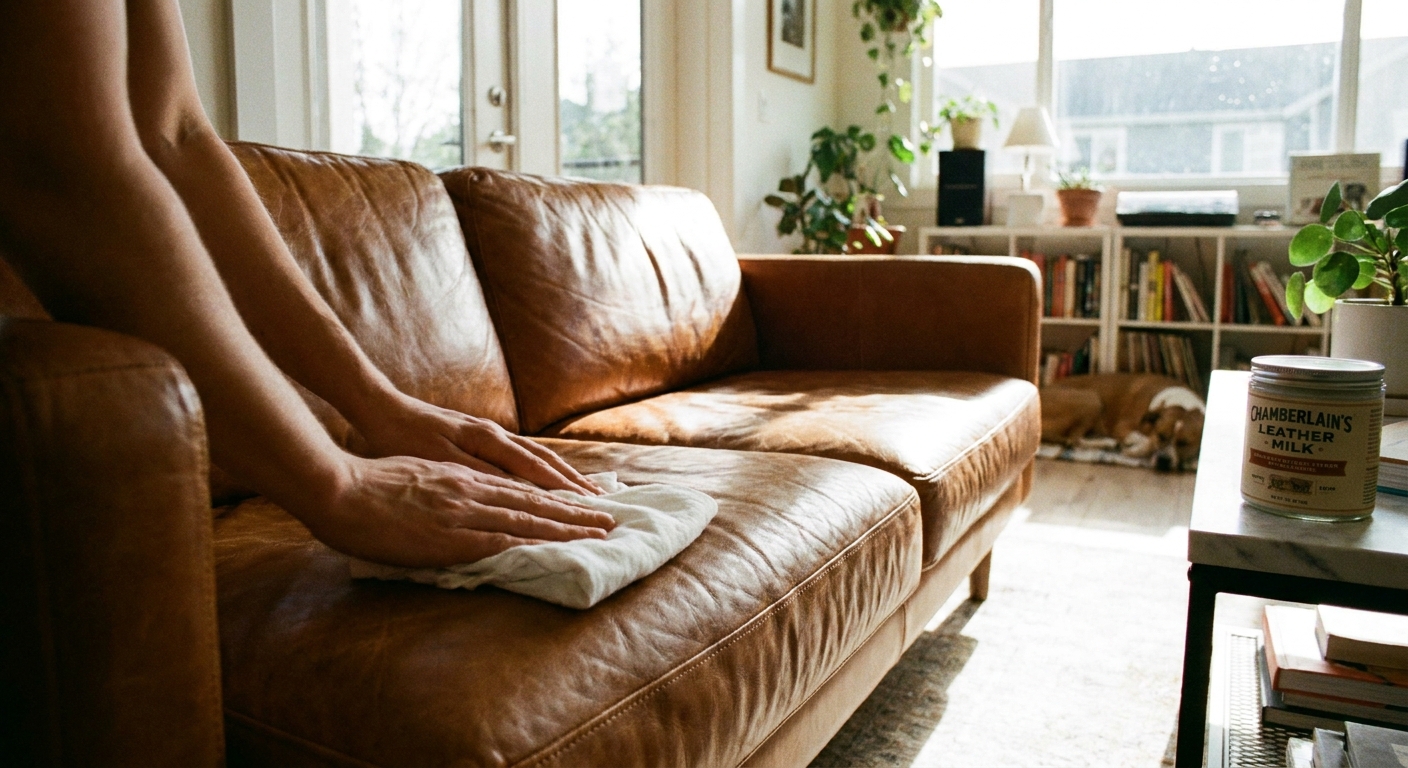
I love leather for the exact reason this problem feels so unfair. It is wipeable, it is durable, it is the kind of material that forgives real life. And then a cat urinates on it and suddenly you are dealing with an odor that seems to come and go with the weather, like your sofa is holding a grudge.
The trick with leather is that the mess is rarely only on the surface. Cat urine can slip through seams, piping, button tufts, and tiny finish cracks, then travel under the leather into the cushion wrap and foam. If we treat leather like fabric and soak it with cleaner, we risk swelling the hide, lifting dye, and cracking the finish as it dries.
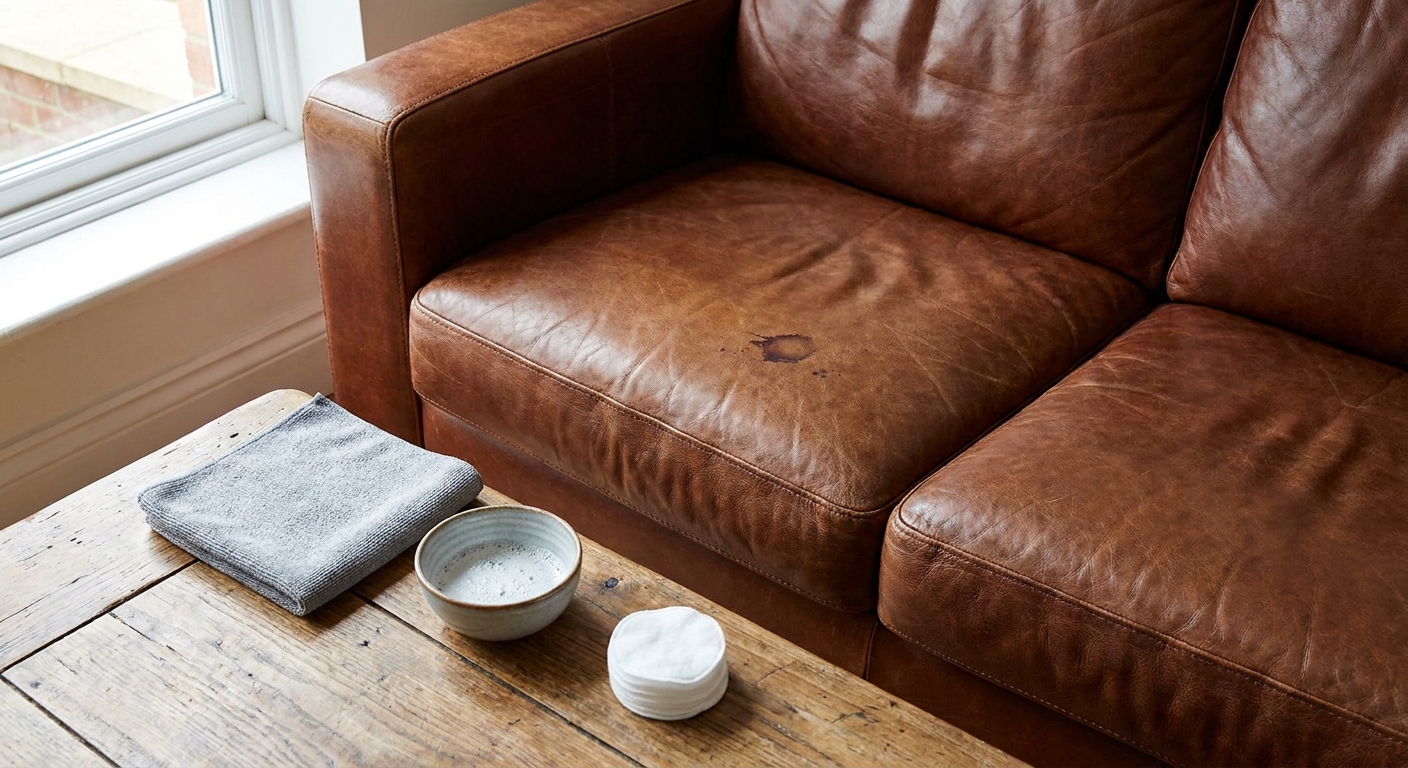
Below is my leather-safe approach: minimal liquid, lots of blotting, targeted odor neutralizing, and a clear plan for when replacement is the only sane option.
Before you start
Two quick minutes here can save you a week of regret.
- Check the care tag or manufacturer instructions if you have them. Some leathers are coated tougher than others, and some are surprisingly delicate.
- Test everything in a hidden spot (back panel, under a cushion, inside a skirt). Stop if you see dye transfer, a dull patch, tackiness, or a texture change.
- Do not mix chemicals. If you used something already, let the area fully dry before trying a different approach.
- Ventilate and protect your hands. Open a window, run a fan, and consider gloves. You are going to do some unglamorous detective work.
Leather types
Before you put anything wet on your sofa, take 60 seconds to identify what you are dealing with. The right method depends on whether the surface can absorb liquid or only lets liquid sneak in through openings.
- Finished leather (most sofas): Real hide with a protective topcoat. It resists spills, but seams and perforations are vulnerable. Too much moisture can still cause rippling or a dull patch.
- Aniline or semi-aniline leather: More absorbent, less protected, more likely to stain and darken. You need even less liquid and more patience.
- Bonded leather: Leather fibers mixed with polyurethane and pressed onto a backing. It often looks like leather until it starts to peel. Excess moisture and harsh cleaners can speed up delamination.
- Faux leather (PU or vinyl): A plastic surface over a fabric backing. Wipes easily, but urine can get into seams and the backing. Some odor can live underneath even if the top looks perfect.
If your sofa is already peeling or flaking, treat it like bonded leather and keep liquids to an absolute minimum. At that stage, aggressive scrubbing is basically helping it fall apart faster.
How urine travels
This is the part most people do not hear until they have “cleaned” the spot three times and the smell keeps returning.
Cat urine is watery at first, so it moves like water. On a leather seat, it tends to:
- Pool on the surface briefly, then find the fastest path down.
- Wick into stitching holes and along the thread line.
- Slip under welt and piping where the leather wraps and staples underneath.
- Collect in the cushion wrap (dacron or feather/down ticking) and then into foam.
Foam is the big issue. Once urine reaches foam, it can spread outward from the entry point and settle into a larger “odor halo” than the stain you see on top. And every humid day can wake that smell back up.
What not to do
If you do nothing else, skip these common “helpful” moves that backfire on leather.
- Do not steam clean leather. Heat plus moisture can warp finishes, drive wetness deeper into seams and padding, and make drying harder.
- Do not soak the leather surface with enzyme cleaner. Enzymes are wonderful for fabric and foam when you can fully treat and fully dry. Leather is not that situation.
- Do not use vinegar straight on leather. A tiny, well-diluted wipe can be fine for some finishes, but repeated acid exposure can dull or dry out leather and degrade some coatings.
- Do not use ammonia-based cleaners. Aside from finish damage risk, the odor may resemble urine to some pets and encourage repeat marking.
- Do not use baking soda paste. Abrasive grit plus moisture can scuff and leave a chalky haze in the grain.
What you need
You do not need a chemistry lab. You need absorbency, gentle cleansing, and controlled deodorizing.
- White paper towels or clean cotton rags
- Microfiber cloths
- Distilled water (helps prevent rings or mineral marks)
- A small bowl
- Mild soap: a drop of gentle dish soap or a leather cleaner labeled safe for finished leather
- 70% isopropyl alcohol (for light wipes on some finished leathers only)
- Cotton pads or cotton balls
- A fan
- Leather conditioner suitable for your sofa type
- Optional: a blacklight to find drips, edges, and repeat spots
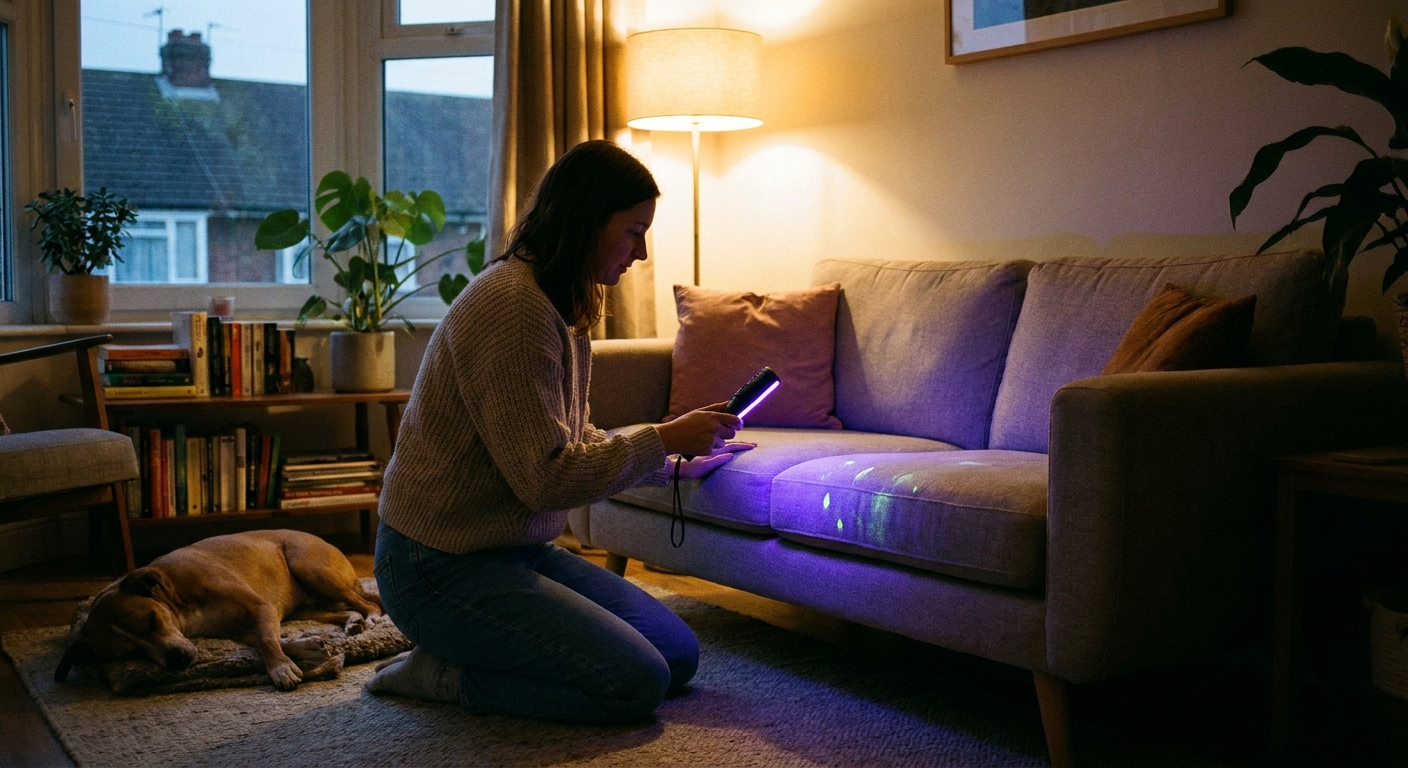
Blacklight note
A blacklight is a helper, not a judge. Some older stains fluoresce. Some cleaners, detergents, and brighteners fluoresce too. Use it to find areas to inspect, then confirm with a close sniff test and a careful look at seams and edges.
Leather-safe steps
Step 1: Blot hard
If the accident is fresh, blot immediately. Press straight down with paper towels or a cotton rag. Do not rub. Swap towels often. Your goal is to remove as much liquid as possible before it finds a seam.
If the urine has already dried, still start by blotting with a barely damp cloth to rehydrate just the very surface. Think “fog on a mirror,” not “wet sponge.”
Step 2: Clean the surface gently
Mix a small bowl of distilled water with one tiny drop of mild soap. Dampen a microfiber cloth, wring it out hard, then wipe the affected area and slightly beyond it. Follow immediately with a second cloth dampened with plain distilled water to remove any residue. Then blot dry.
Why the extra wipe? Soap film can attract grime and leave a dull patch on leather. Clean, then rinse, then dry.
Step 3: Controlled alcohol wipe (some finished leathers only)
On many finished leathers, a very light wipe with 70% isopropyl alcohol can help reduce odor while adding less water than most cleaners. It evaporates fast, which is the point.
- Test in a hidden spot first, especially on darker dyes and softer leathers.
- Avoid on aniline, waxed, pull-up, oiled, or otherwise “naked” leathers.
- Put alcohol on a cotton pad, not directly on the sofa.
- Tap and wipe lightly. Do not scrub.
- Stop if you see color transfer, a sudden shine change, dulling, or tackiness.
- Let it air dry with a fan.
Step 4: Follow the path
If the smell persists after the surface is clean, assume it traveled. This is where you stop treating the leather like the whole story.
- Remove the seat cushion if possible.
- Smell-test in layers: the leather cover, the cushion insert, the deck under the cushion, and the front edge where liquid may have dripped.
- Check seams and piping where urine could have entered. If the sofa has tufting, check each button area.
If the odor is strongest on the insert or the deck fabric under the cushion, you are not dealing with a “leather cleaning” problem anymore. You are dealing with an “inside the sofa” problem.
Step 5: If the insert took the hit, treat the insert (or replace it)
Many leather sofa seat cushions have a zipper. If yours does, unzip and inspect the foam. If it smells like urine up close, that is likely your culprit.
Best-case scenario: the foam is only lightly affected and the cushion has a separate wrap (dacron). You may be able to replace just the wrap, or the foam plus wrap, and keep the leather cover.
Options that actually make sense: treat foam and wrap outside the leather cover with an enzyme cleaner (follow the product label, allow full dry time), have an upholstery pro extract and dry it properly, or replace the foam and wrap.
What to avoid: trying to saturate foam while it is inside a leather cover. That is a recipe for trapped moisture and a sour, never-ending funk.
If you are determined to salvage foam, do it outside the leather cover and allow full drying time in a ventilated area. Realistically, though, foam holds onto urine salts stubbornly. Replacement is often the cleaner, faster win.
Step 6: Dry completely
Odor removal fails when moisture lingers. After any wipe-down, aim a fan at the area for several hours. If you lifted the cushion, stand it on edge so air can circulate around it.
Attached cushions and tufting
If your cushions are attached, tufted, or otherwise not designed to unzip and come apart, you are working with limited access. In that case:
- Do the surface steps (blot, gentle clean, careful spot-test methods) and then reassess after full drying.
- Inspect underneath as best you can. Sometimes urine runs down the front edge and lands on the deck, dust cover, or frame area.
- Consider a pro early if the odor is clearly coming from inside. Look for an upholstery cleaner who understands controlled moisture and drying, or a leather specialist if the finish is delicate. The goal is access plus drying, not just perfume.
Tufting is especially tricky because liquid can travel along internal folds. If you are smelling it at multiple tuft points, it is usually more than a surface situation.
Bonded and faux leather
Bonded leather and faux leather are usually less forgiving than full-grain finished leather when it comes to friction and solvents.
- Use even less liquid. Damp cloth, not wet cloth.
- Be cautious with alcohol. If the finish is fragile or already peeling, skip it. If you see color transfer or increased dullness, stop.
- Focus on seams and the underside. Odor often lives in the fabric backing or cushion materials below the surface layer.
If bonded leather is peeling, prioritize odor control from inside the cushion and frame area, then plan for repair or replacement. Once bonded leather starts flaking, it rarely “recovers” aesthetically.
When to replace the insert
I am all for saving furniture, especially the kind with good bones. But I also believe your home should feel like a comforting hug, not a suspense novel every time the heat turns on.
Consider replacing the cushion insert (foam and wrap) if:
- The odor is strongest when you smell the foam directly.
- The urine was left for hours or overnight.
- You have cleaned the leather surface and seams and the smell still blooms on humid days.
- The foam shows staining that goes deep, not just on the surface.
Good news: replacing a seat insert is often far cheaper than replacing the entire sofa, and it keeps your leather cover in play.
When to replace the sofa
This is the hard truth section, said gently.
Retiring the sofa is worth considering when:
- Urine reached the frame. If the deck padding, webbing, or wood smells strongly, odor can persist no matter what you do on top.
- Repeated marking happened in multiple spots. Multiple entry points mean multiple hidden reservoirs.
- The sofa is tufted or heavily channeled. Urine can travel along internal folds and become almost impossible to fully access.
- Bonded leather is failing. If the surface is peeling and the smell remains, you are fighting two losing battles at once.
- Your household can still detect it after cleaning and drying. If humans smell it, pets definitely smell it.
If the odor is in the structure and you cannot disassemble the piece enough to truly clean and dry it, replacement can be the most peaceful choice.
Odor triage
Here is a simple “sniff map” I use when diagnosing a smelly sofa. It is not glamorous, but it is effective.
- Top surface smells, seams do not: likely surface residue. Repeat gentle clean and thorough dry.
- Seams smell stronger than the panel: urine entered through stitching holes. Focus on seam-adjacent wiping and check the cushion insert.
- Cushion insert smells strongest: treat outside the cover or replace the insert.
- Under-cushion deck smells strongest: urine passed through. You may need professional upholstery cleaning or partial reupholstery.
- Wood or internal padding smells: consider professional help or replacement.
FAQ
Will enzyme cleaner work on leather?
Enzyme cleaners can help with odor, but leather is not something you want to saturate. If you use an enzyme product, use it sparingly and only if the label states it is safe for leather finishes. In many cases, enzymes are better reserved for the cushion insert or fabric deck where you can apply, dwell, and fully dry without trapping moisture against leather.
Can I use baking soda on leather?
I would not use a baking soda paste or scrub on leather. If you want a gentle deodorizing assist, keep baking soda off the leather surface and instead place an open container nearby, or use it on removable, washable covers and liners. Odor that lives inside foam will not be solved by sprinkling baking soda on top, anyway.
Why does the smell disappear and then come back?
Urine leaves behind salts and odor compounds that re-activate with humidity and warmth. That is why a sofa can smell fine for days, then suddenly announce itself when the room is warm or damp. It often points to urine in foam, wrap, or the deck below the cushion.
How do I keep my cat from returning to the same spot?
Once the odor is handled, block access while the area fully dries, and clean any surrounding drips you might have missed. If your sofa was a repeat target, add a practical barrier for a while, like a washable throw or a waterproof pet cover. Then look upstream: litter box cleanliness and location, household stress, medical issues like urinary tract problems, and whether another pet is triggering marking. A sofa that still smells even faintly can become a repeat target.
A final note
If you end up replacing a cushion insert or retiring a sofa, it does not mean you failed at homemaking. It means you refused to live with an invisible stink cloud. If you are keeping the sofa, once it is fully clean and dry, condition the leather. Urine cleanup, even when gentle, can leave the surface a little thirsty. A soft, conditioned finish also makes future wipe-ups less dramatic, which is the only kind of drama I want in a living room.