Terrazzo Cleaning, Polishing, and Chip Touch-Ups

Clara Townsend
Clara Townsend is an interior stylist, vintage furniture enthusiast, and the creative voice behind Velvet Abode. With over a decade of experience transforming both cramped city apartments and sprawling fixer-uppers, she believes that a beautiful home is built on personal stories rather than massive budgets. When she isn't hunting for the perfect brass sconce at a local flea market, she can usually be found rearranging her living room for the third time this month.
Terrazzo has that dreamy, confetti-in-stone charm that makes even a basic hallway feel like it belongs in a sunlit old hotel. But it is also the kind of surface that quietly punishes heavy-handed cleaning. If you have terrazzo floors in an apartment or a terrazzo countertop that is starting to look dull, you do not need a cart full of specialty products. You need a gentle routine, the right pH, and a little patience.
This is my renter-friendly, low-drama approach: how to tell if your terrazzo is sealed, what to mop with (and what to never, ever mop with), how to handle coffee and wine that settle into divider strips and tiny hairline channels, and what counts as a safe cosmetic chip touch-up versus a “call the landlord” moment.
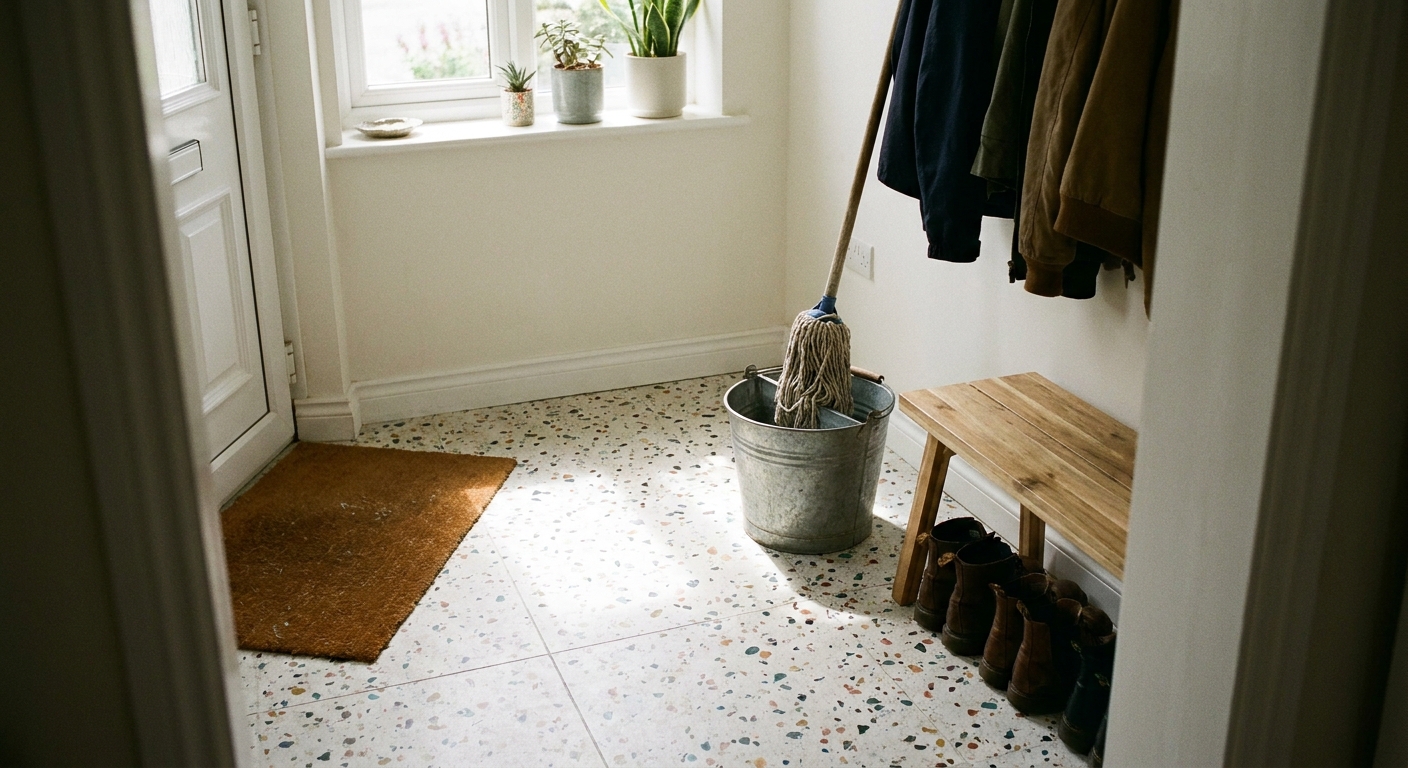
Sealed vs unsealed terrazzo
Terrazzo is a mix of stone chips (marble, quartz, glass, or granite) set into a binder, then ground and polished smooth. The binder matters:
- Cement-based terrazzo: More porous and more sensitive to acids and over-wetting.
- Epoxy terrazzo: Generally denser and more stain resistant, and often a bit more chemical resistant, but still not a free pass for acids, abrasives, or harsh degreasers.
In apartments you will typically see one of two surface scenarios:
- Sealed or finished terrazzo: There is a topical finish, a sealer, or a polish system that helps repel spills and slows staining. It usually looks a bit richer in color and cleans up more easily.
- Unsealed or worn sealer: The surface absorbs liquids faster, looks chalkier or patchy, and may darken quickly when water hits it.
How to tell what you have
- Water drop test: Put a few drops of water on an inconspicuous spot. If it beads for a few minutes, it is likely protected by a finish or sealer. If it darkens within 30 to 60 seconds, it is likely unsealed or the protection is worn.
- Touch and sheen: A topical finish can feel slightly slick and look more evenly shiny. A penetrating sealer may not change the feel much, so do not rely on “slick” alone.
- Stain history: If every little drip leaves a ghost, assume you have minimal protection and clean spills fast.
Important: Sealed does not mean indestructible. Terrazzo can still etch or dull if you use acidic cleaners, harsh degreasers, or anything abrasive. The goal is gentle, consistent care, not stripping it down every weekend.
The routine
Daily or every other day: dust-mop like you mean it
Grit is terrazzo’s sneaky enemy. Tiny bits of sand act like sandpaper under shoes and chair legs, slowly scratching away the shine.
- Use a dry microfiber dust mop or a vacuum with a hard-floor setting (no beater bar).
- Focus on entryways, under the dining table, and near the stove.
- If you are a “shoes on” household, consider a runner at high-traffic paths. Your future self will thank you.
Weekly: damp-mop, not a soak
Frequency depends on life. Pets, kids, and city grit might mean 2 to 3 times a week. Low traffic might mean every other week. Either way, terrazzo prefers a pH-neutral cleaner (around 7). Think “gentle soap,” not “strip everything.”
My simple damp-mop mix:
- 1 gallon warm water
- A small amount of pH-neutral stone floor cleaner (follow the label, and err on the side of less)
How to mop so you do not leave haze:
- Wring the mop well. You want damp, not wet. This matters extra for cement-based terrazzo and any floor with a worn finish.
- Mop in sections, then do a quick pass with a towel or dry microfiber if water tends to sit.
- If your floor looks cloudy after drying, you likely used too much product. Next time reduce the cleaner and consider a quick rinse pass with clean water.
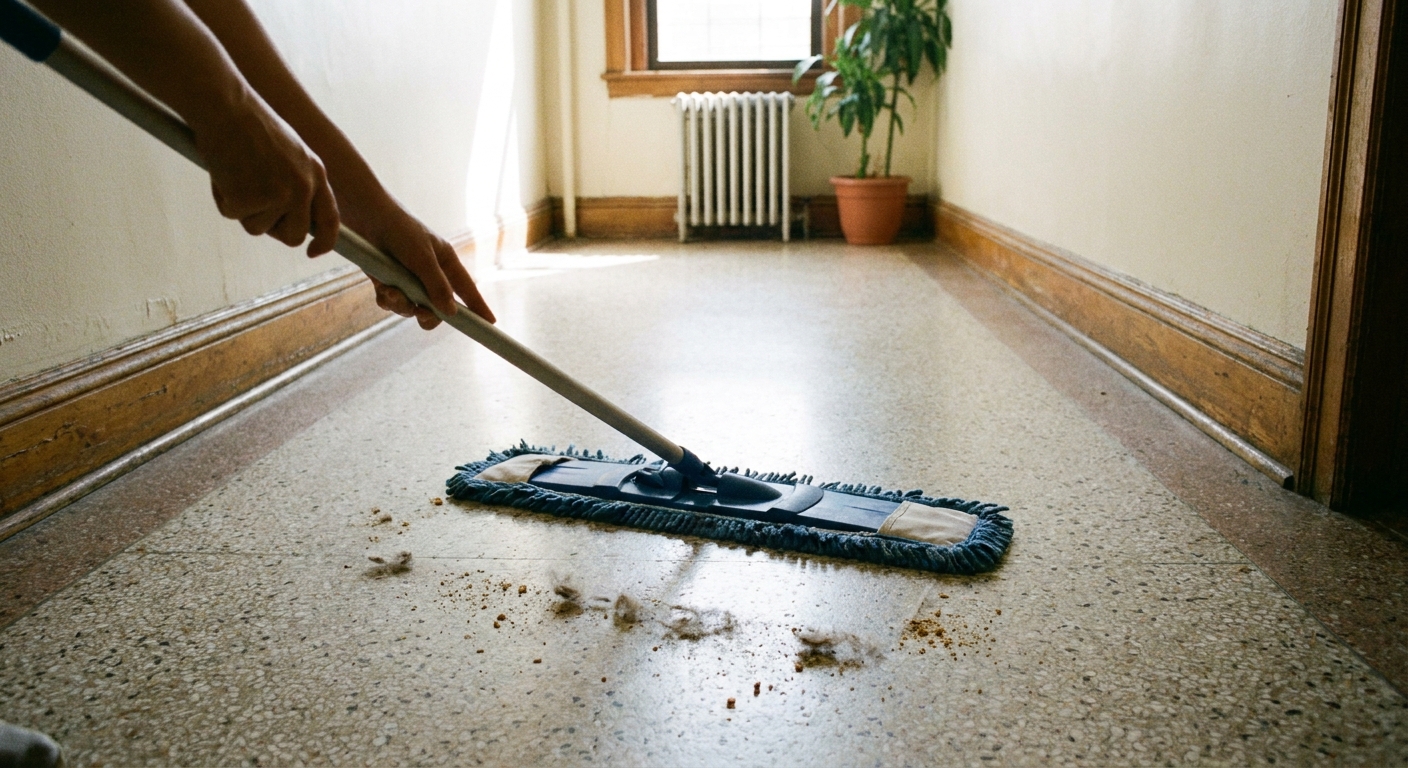
What to avoid
If you remember one thing, let it be this: terrazzo likes gentle, pH-neutral care. Also, “natural” does not always mean “safe for stone.”
- No vinegar or acidic cleaners: Acid can etch marble chips and can damage cement-based terrazzo over time. Epoxy terrazzo may be more resistant, but acids can still dull the finish and cause uneven sheen.
- No bleach for routine cleaning: It can discolor and break down finish systems and sealers, and it is too harsh for regular use.
- No abrasive powders or scrub pads: They scratch and dull the polish fast.
- Generally avoid steam mops: Especially on unsealed or worn areas, cement-based terrazzo, or floors with a topical finish. Heat and moisture can stress coatings and push moisture into porous spots. If your building explicitly says steam is okay for your specific finish system, follow their guidance.
- No random wax: Some terrazzo is maintained with specific polishing compounds or finish systems. The wrong wax can create uneven buildup that looks worse than the original dullness.
Spills and stains
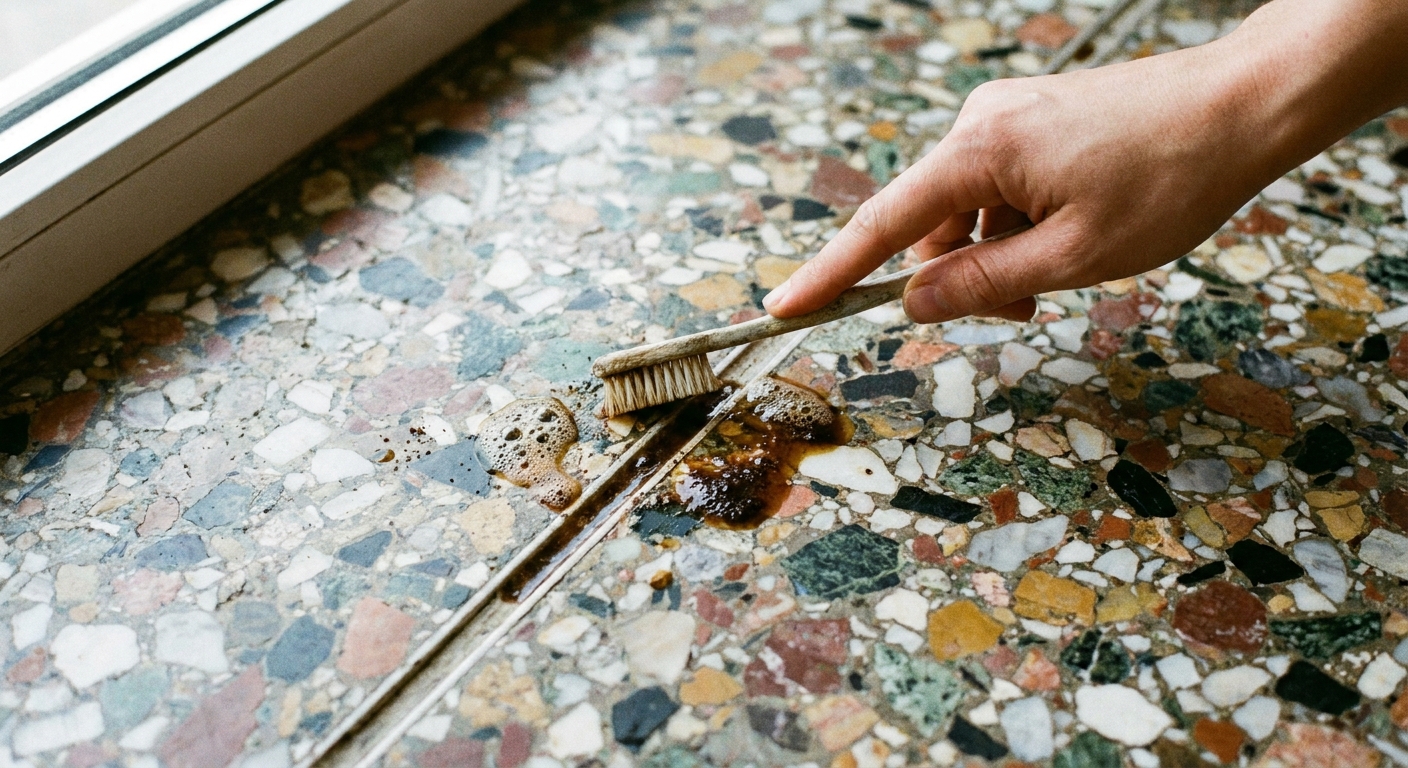
Many terrazzo floors have metal divider strips (classic terrazzo) or fine hairline channels. They are charming until coffee finds them. The key is to treat stains like a small emergency: fast blotting, then gentle chemistry.
Step 1: Blot, do not rub
- Use paper towels or a clean cloth to blot up as much as possible.
- Rubbing can push pigment deeper into pores and channels.
Step 2: Clean with neutral solution first
Mix a little neutral cleaner in warm water, dampen a cloth, and work the area gently. For divider strips and channels, a soft toothbrush is perfect.
Step 3: If the stain lingers, try a poultice (spot test first)
If the floor is unsealed or the sealer is worn, coffee and red wine can leave a shadow. A poultice helps draw staining up and out. The renter-friendly version is baking soda, but it is mildly alkaline and can leave residue or slightly dull some finishes if you get sloppy. Spot test in a hidden area and do not skip the rinse.
- Make: baking soda + water to a peanut-butter paste (thick enough to sit).
- Apply: spread over the stain, about 1/4 inch thick.
- Cover: plastic wrap taped at the edges to slow drying.
- Wait: 12 to 24 hours.
- Remove: lift off, wipe with clean water, and dry thoroughly.
If you want the safer “I do not want to mess this up” option: use a stone-specific poultice product that is labeled for terrazzo or natural stone, and follow the directions. In a rental, it is smart to ask building maintenance what they prefer.
What if the stain is in the strip or channel?
- Use a soft toothbrush with neutral cleaner.
- Rinse with a damp cloth so cleaner does not dry in the groove.
- Dry the channel with a folded paper towel pressed into the line.
Dullness and shine
When terrazzo looks tired, the cause is usually one of these: ground-in grit, cleaner residue, or a worn finish or sealer. Your approach depends on what kind of dull you are seeing.
If it looks hazy right after mopping
- Use less cleaner next time.
- Do a one-time rinse mop with plain warm water, then dry.
- Switch to fresh microfiber pads. Old pads can redeposit grime.
If high-traffic paths look flat and gray
This is often wear on the finish or sealer, not “dirt.” In a rental, your safest move is to ask building maintenance what system they use (topical finish, penetrating sealer, polishing compound, and how often they refresh it). Polishing or coating with the wrong product can create patchy shine that is hard to undo.
Renter-friendly refresh options:
- Thorough clean + rinse: remove residue first, because polishing over buildup just seals in the problem.
- Use a terrazzo-safe polish only if approved: Look for products labeled for terrazzo or natural stone and compatible with your finish type. If you cannot confirm, pause and ask.
When to call a pro: If the floor has widespread etching, deep scratches, or patchy shine, it likely needs professional honing and polishing. That is not a DIY job in a leased apartment, and it is usually the building’s responsibility if it is normal wear.
Countertops
If your terrazzo is on a countertop, the vibe is the same but the stakes are higher because food and acids are constant.
- Wipe spills quickly, especially wine, coffee, citrus, vinegar, tomato sauce, and oily splatters.
- Use cutting boards and trivets. Knives and hot pans can scratch or stress a finish system.
- Stick to a neutral cleaner and a soft sponge. Skip scouring powders.
- If water darkens the surface quickly, the sealer is likely worn. Ask management (or the fabricator, if you own) about resealing.
If you used vinegar or bleach
It happens. The goal is to stop the reaction and avoid piling on more products.
- Rinse thoroughly: Wipe or mop with clean water (change the water once or twice).
- Dry fully: Use towels to pick up leftover moisture, especially along edges and divider strips.
- Do not “fix” it with more chemicals: No baking soda scrubs, no magic erasers, no extra-strength degreaser.
- Watch for dull spots: If you see etching (a permanently dull or lighter patch), contact building maintenance. Etching is usually a refinishing issue, not a cleaning issue.
Chips and pockmarks
Terrazzo chips happen. A dropped mug. A chair dragged at the wrong angle. The trick is knowing which fixes are truly cosmetic and reversible, and which ones can make the damage look worse or get you in trouble with your lease.
Renter-safe: tiny surface chips
If it is a small, shallow chip and the edges are stable (no crumbling, no spreading crack), you can usually do a simple cosmetic fill that improves the look without pretending you are a restoration studio.
- Best option: clear epoxy gel or stone chip repair epoxy (a small amount).
- Color: keep it subtle. Trying to match the confetti perfectly often backfires. Clear fill can be less noticeable than a mismatched blob.
- Application: clean the chip with neutral cleaner and let it dry completely, then add epoxy with a toothpick.
- Finish: do not sand aggressively. If the product requires leveling, use the gentlest method recommended and stop the second you see you are affecting the surrounding polish.
My rule: If you cannot do it neatly in 10 minutes with minimal tools, it is probably not a renter DIY.
Call the landlord: anything deep or spreading
- Chips with crumbly edges or a soft, powdery base
- Cracks that travel beyond the initial impact point
- Any chip that is deep enough to hold water after mopping
- Damage near thresholds or corners where more cracking can occur
- Large missing pieces where a patch will need aggregate matching and polishing
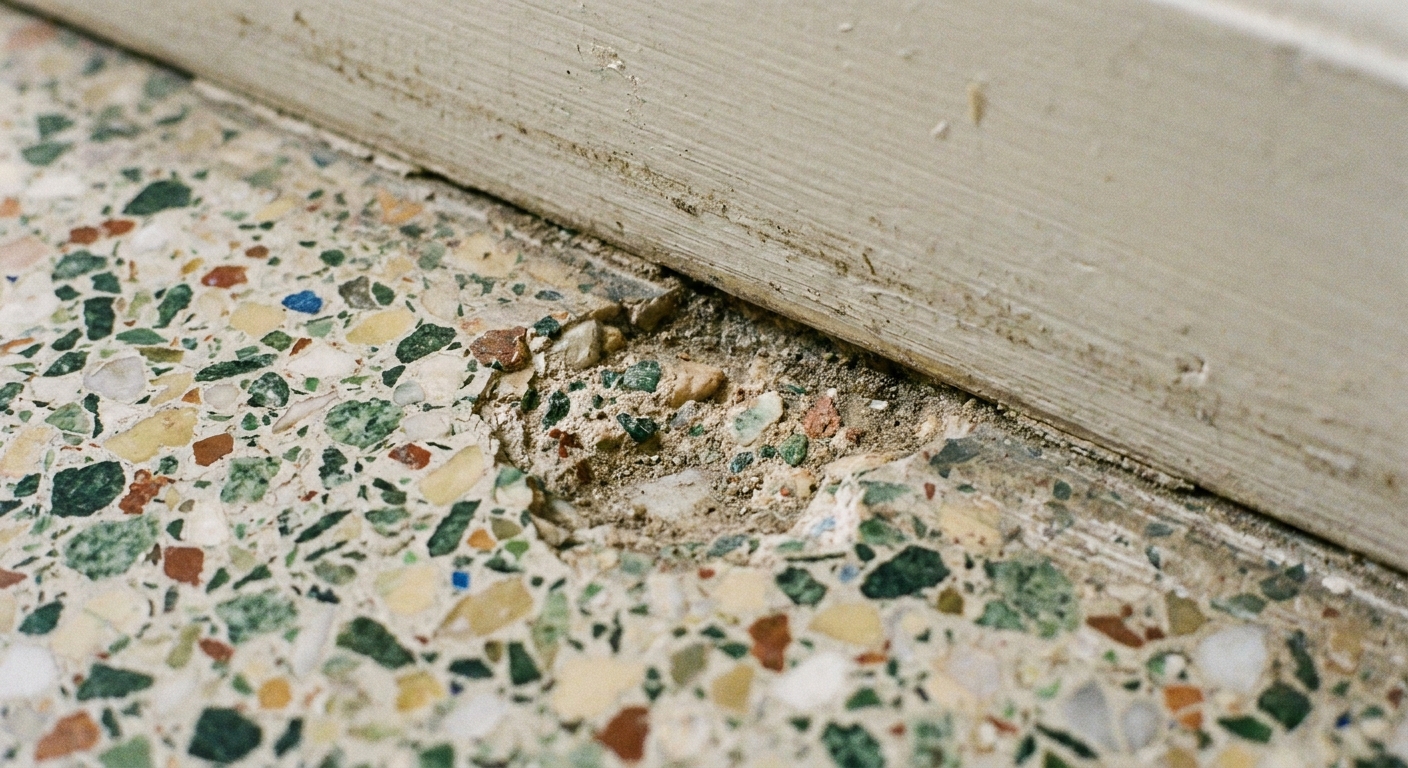
Troubleshooting
- Streaky after mopping: too much cleaner or dirty mop water. Use less product and change water more often.
- White haze: residue buildup. Rinse-mop with clean water and dry thoroughly.
- Dark spots that come and go: moisture absorption in unsealed or worn areas. Keep water minimal and talk to management about resealing.
- Chalky look: wear on finish. Do not strip it yourself. Ask what maintenance system the building uses.
- Persistent coffee or wine shadow: try a poultice (spot test), rinse well, and escalate if it worsens.
Keep it pretty
Terrazzo is surprisingly forgiving when you treat it like a stone surface and not like a kitchen tile floor.
- Use felt pads on chairs and stools. Refresh them when they pick up grit.
- Place a doormat that actually traps dirt, not just decorates the entryway.
- Blot spills quickly, especially anything acidic or deeply pigmented.
- Stick to neutral cleaners and soft tools.
If you are unsure whether your terrazzo is sealed or what your building uses for maintenance, take a quick photo and email your property manager. A two-minute question can save you from a weekend of experimenting and a floor that looks worse on Monday.