Stop Sofa Seat Cushions From Sliding Forward

Clara Townsend
Clara Townsend is an interior stylist, vintage furniture enthusiast, and the creative voice behind Velvet Abode. With over a decade of experience transforming both cramped city apartments and sprawling fixer-uppers, she believes that a beautiful home is built on personal stories rather than massive budgets. When she isn't hunting for the perfect brass sconce at a local flea market, she can usually be found rearranging her living room for the third time this month.
If your sofa seat cushions slowly inch forward until you are basically perched on the edge like a nervous houseguest, you are not imagining it. This is one of those everyday annoyances that makes a living room feel messy and uncomfortable, even when everything else is styled to perfection.
The good news: you do not need to buy a new couch, and you do not need to risk your deposit with staples, tacks, or anything permanent. Below are my favorite renter-friendly fixes, from quick under-the-cushion grips to stealthy solutions that live inside the cushion cover.

Why cushions slide
Cushions slide forward when the friction between the cushion bottom and the sofa deck is too low for the way you sit. It is usually a mix of a few very normal factors:
- Slick materials: Leather, faux leather, and some tightly woven synthetics (including some performance fabrics) can be surprisingly slippery.
- Softening fill: As foam compresses or feather/down loses loft, the cushion has less “grip” and stability, so it shifts more easily under pressure.
- Sofa deck tilt: Some sofas have a slight slope. Your body weight encourages the cushion to migrate toward the front edge.
- Loose covers: If the cushion cover has extra room, the insert shifts inside, and the whole cushion feels like it is scooting.
- Smooth or worn decking: A smooth platform offers nothing to grab onto. If the decking fabric underneath (often cambric) is sagging or polished from wear, cushions can drift even faster.
Translation: it is not you, it is physics. The fixes below work by adding friction, improving fit, or creating a gentle anchor without damaging the sofa.
Fastest fix: nonslip grip pads
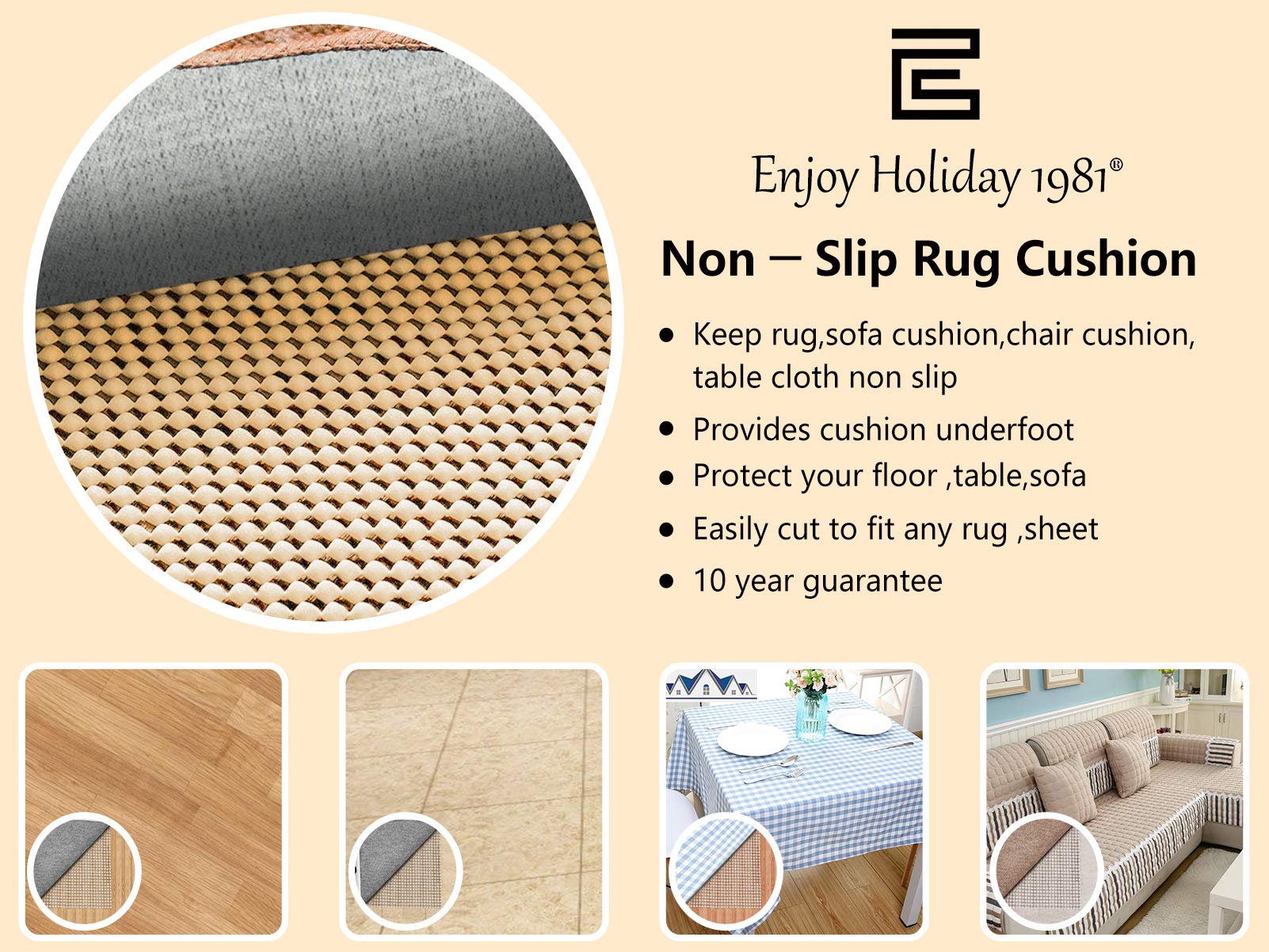
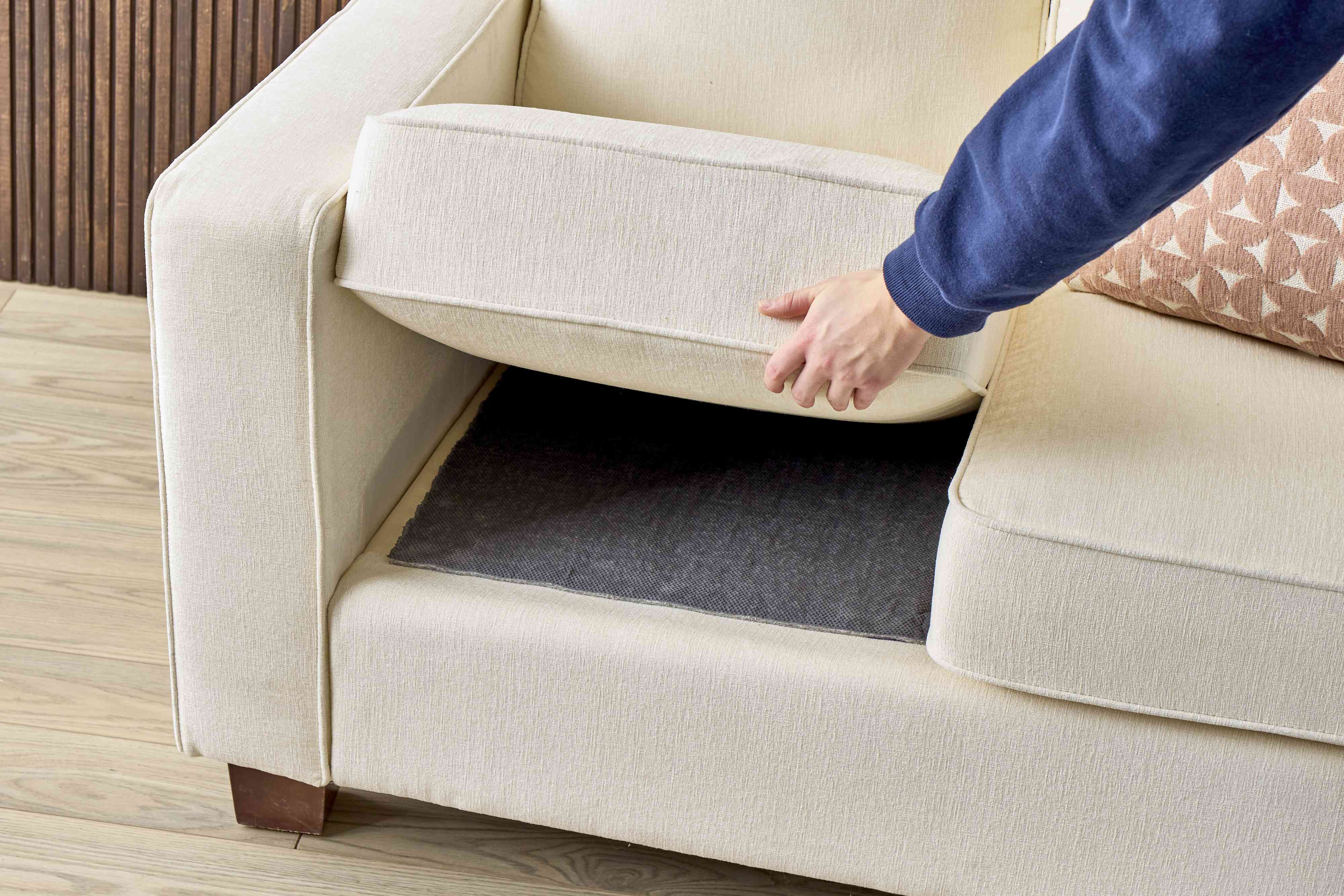
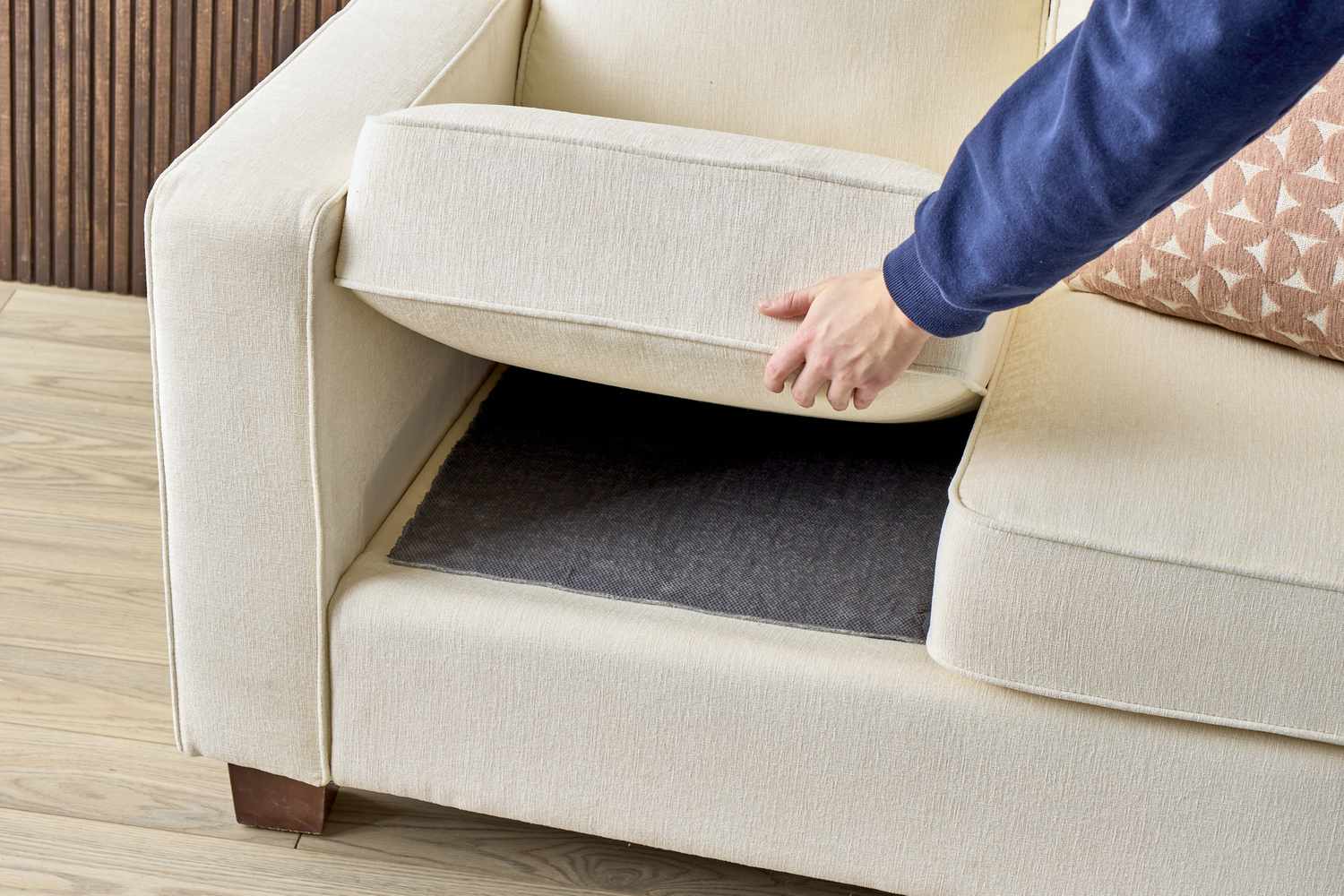
If you want a two-minute improvement with the biggest payoff, start here. Nonslip rug grip pads or shelf liner add friction between the cushion and the sofa deck.
What to buy
- Open-weave rug grip pad (the spongy kind you cut to size)
- Rubberized shelf liner (avoid anything overly sticky, gooey, or gel-like)
How to do it
- Pull the cushion off and wipe the sofa deck clean. Dust reduces grip.
- Cut the pad 1/2 to 1 inch smaller than the cushion footprint on all sides so it stays hidden.
- Lay it flat on the sofa deck, then put the cushion back on.
- Sit, scoot, and test. If it still creeps, add a second layer or swap to a higher-friction pad.
Note: If your sofa is leather, faux leather, or vinyl, choose a grip pad labeled surface-safe for delicate finishes. Some rubberized pads can transfer plasticizers or leave marks over time, especially in hot, sunny rooms. If you are unsure, check the sofa manufacturer guidance and lift-and-air-out the pad every few weeks.
Low-residue Velcro: most secure
When grip pads are not quite enough, removable hook-and-loop strips can give you a real anchor. The key is choosing an adhesive designed to remove cleanly and using small tabs so you are not wrestling your cushions every time you vacuum.
Before you commit
Adhesives are not a great idea on certain upholstery types, even if the packaging says “removable.” Be extra cautious (or skip this method) with aniline or semi-aniline leather, velvet, chenille, loose weaves, and older or flaky bonded leather. These materials can pull, bruise, or discolor.
Best setup
- Hook-and-loop strips with removable or low-residue adhesive
- Small sections placed strategically, not one long strip
Where to place it
You will usually get the best hold by placing tabs near the back third of the cushion. That area experiences backward pressure when you sit, which helps prevent forward creep.
Step-by-step
- Clean the contact areas with a lightly damp cloth and let dry fully.
- Do a hidden test first. Apply one small tab, wait 24 hours, then remove it to check for residue, color change, or pulled fibers.
- If all looks good, stick the loop (soft) side to the sofa deck and the hook side to the cushion bottom. This is gentler if you brush against it.
- Use two to four small tabs per cushion, each about 2 to 3 inches long.
- Press firmly and let the adhesive cure for the time listed on the package before heavy use.
Sneaky fix: liner inside cover
If you hate the idea of anything attached to your sofa, this is the stealth option. Often the cover is sliding around the foam insert, which makes the whole cushion feel like it is moving forward.
Adding a thin nonslip layer between the foam and the inside of the cover can dramatically reduce shifting, especially for loose slipcovers and softer inserts.
What works well
- A thin piece of shelf liner
- A piece of rug grip pad trimmed to fit
- Grippy fabric like suede cloth or a textured drawer liner
How to do it
- Unzip the cushion cover and pull the insert out halfway.
- Wrap the liner around the top and sides of the foam insert like a simple band, or lay it flat on the “seat” side depending on where the shifting happens.
- Slide the insert back in, smooth the cover, and zip closed.
Why I love this: nothing touches your sofa frame, nothing shows, and the cushion still lifts off easily for cleaning.
Small caution: Avoid super-sticky liners inside delicate covers (velvet, chenille, loose weaves). You want “grippy,” not “gluey.”
Make ties work harder
If your cushions have ties but they still creep forward, it is usually because the tie placement is not doing any real holding. Ties are most effective when they pull the cushion backward and down, not straight sideways.
Quick tie tweaks
- Re-tie with tension: Pull the cushion fully back, then tie firmly so the knot holds that position.
- Use a double knot: Especially on slick fabrics.
- Add a grippy underlayer: Pair ties with a grip pad. The ties keep placement, the pad prevents micro-sliding.
- Reroute ties to a sturdier anchor: If there is a frame bar or a sewn-in loop on the sofa base, tie to that instead of a looser slipcover panel.
If you are renting and the ties are poorly positioned, avoid sewing new tie points into the sofa itself. Instead, tie around an existing structural element or use removable hook-and-loop tabs as the anchor point.
What not to do
These fixes are tempting in the moment and regret-inducing later:
- Double-sided carpet tape (often leaves residue and can pull fibers)
- Hot glue (hard to remove cleanly, can melt synthetics)
- Spray adhesive (can soak into fabric and permanently stain)
- Staples or tacks (deposit risk, and you can damage the frame or decking)
- Very sticky gel pads on leather, faux leather, or vinyl (can mark finishes over time)
Comfort check
This is where I see people accidentally make the sofa less cozy while trying to make it more stable. A cushion that stays put should still be easy to live with.
What to aim for
- Easy removal: You should be able to lift cushions for vacuuming crumbs and pet hair.
- No hard edges: Avoid thick rubber pads that create ridges you can feel through the cushion.
- Breathability: If you use liners inside the cover, keep them thin so the cushion does not trap heat.
After you install any solution, sit like you normally do for a full evening. If you feel like you are fighting your own couch, adjust.
Cushion care helps too
Stopping the forward creep is mostly about friction and anchoring. Cushion care is about keeping the fill healthy. You need both, but they are not the same job.
Simple routine
- Fluff back cushions weekly if they are feather or polyfill.
- Rotate seat cushions every 2 to 4 weeks if they are identical in size.
- Flip only if your cushions are double-sided and designed for it.
- Air out grip pads occasionally, especially in humid homes or sunny rooms.
If one cushion always slides more than the others, that is a clue it is softer or more compressed. Rotating can help equalize wear.
Troubleshooting
Leather or faux leather sofa
- Start with a surface-safe grip pad.
- If you try hook-and-loop, keep it to small tabs, test first, and avoid it entirely on delicate leathers.
Slipcovered sofa
- Try the inside-the-cover nonslip liner first.
- Add an under-cushion grip pad if the entire cushion still migrates.
Very soft cushions
- Combine methods: grip pad + hook-and-loop tabs (or grip pad + tie tension).
- Consider adding a thin foam sheet under the insert inside the cover if the cushion is collapsing forward. This is removable and non-destructive.
Outdoor or sunroom seating
- Use materials that handle heat. Avoid anything that can melt or become gummy.
- Lift pads occasionally to prevent moisture trapping.
Worn or sagging decking
- A grip pad still helps, but if the decking fabric is sagging, cushions may keep drifting.
- In rentals, a reversible workaround is adding a thin, firm layer (like a cut-to-size upholstery foam sheet) under the cushions to create a flatter, more supportive base.
My go-to combo
If I am styling a rental where the sofa is adorable but the cushions have a mind of their own, I do this:
- A thin rug grip pad cut to size under each cushion
- Two removable hook-and-loop tabs near the back corners (only after a hidden test)
It is secure, invisible, and still lets you remove cushions without wrestling them like a fitted sheet.
A couch should feel like a comforting hug, not a slow-motion slip and slide. A little friction in the right place changes everything.
Shopping checklist
- Nonslip rug grip pad or shelf liner
- Removable, low-residue hook-and-loop strips (optional)
- Scissors and a measuring tape
- Lint roller or vacuum (clean surfaces grip better)
If you try one fix first, start with the grip pad. It is the cheapest, fastest, and easiest to undo if your sofa decides to be dramatic about it.