Small Dining Room Layout Ideas That Actually Fit

Clara Townsend
Clara Townsend is an interior stylist, vintage furniture enthusiast, and the creative voice behind Velvet Abode. With over a decade of experience transforming both cramped city apartments and sprawling fixer-uppers, she believes that a beautiful home is built on personal stories rather than massive budgets. When she isn't hunting for the perfect brass sconce at a local flea market, she can usually be found rearranging her living room for the third time this month.
If your dining area has ever made you mutter, “Why is this room shaped like a hallway?” you are my people. Small dining rooms are rarely small squares. They are skinny rectangles, pass-through corners, or that mysterious zone between the kitchen and living room where everyone drops mail.
The good news: you can absolutely fit a real table and chairs without turning dinner into an obstacle course. You just need a few reliable clearance rules (rules of thumb, not commandments), the right table shape, and a couple of sneaky storage swaps.
The three measurements that decide everything
Before you buy anything, grab a tape measure and jot down these three numbers. They will save you from the classic “the table fits but humans do not” situation.
Quick note: Unless I say otherwise, these clearances are measured from the table edge to the wall or furniture, and assume fairly standard dining chairs. (If your chairs are deep, chunky, or reclined, add a little buffer.)
- Clear walking path (minimum): Aim for 30 inches for a path where people regularly pass behind chairs. 36 inches is noticeably more comfortable. In a truly tight, low-traffic spot where you only need one person at a time to slip through, 24 inches can work as a compromise.
- Space to pull out a chair and sit: Comfortable clearance is about 36 inches from table edge to wall or furniture. Tight-but-doable is about 30 inches if you do not need to squeeze past when someone is seated.
- Table-to-wall (no seating on that side): If the table is intentionally parked against a wall and rarely moved, you can sometimes get away with about 8 to 12 inches. (This gives you breathing room for baseboards, cleaning, and preventing wall scuffs.)
Quick reality check: Chair sizes vary a lot. As a rough planning range, allow 18 to 24 inches for a chair tucked in and around 30 to 36 inches for pull-out and getting in and out comfortably. This is why small rooms love benches and wall-side seating.
One more number that helps: On a rectangular table, plan roughly 24 inches of edge space per person so elbows are not in a constant negotiation.
Pick the table shape that behaves in tight rooms
Table shape is not just aesthetics. It is traffic flow, knee space, and whether you will bruise your hip every Tuesday.
Round tables: best for awkward corners
A round table keeps circulation smooth because there are no sharp corners jutting into the walkway. It is also kinder in small spaces where people constantly “slide by.”
- Best sizes: 36 to 44 inches round for 2 to 4 people.
- Look for: A pedestal base. It buys you knee room and makes chair placement flexible.
Rectangular tables: best for long, narrow rooms
If your dining room is a skinny rectangle, a rectangular table will usually fit more naturally, especially if it runs parallel to the long wall.
- Best sizes: 48 x 30 inches seats 4 comfortably in most small rooms (and usually gives each person that nice 24 inches of space).
- Space saver tip: Choose a table with slimmer legs and rounded corners. Your thighs will thank you.
Square tables: best only in square rooms
Square tables can feel bulky in narrow rooms because all sides demand equal clearance. If your space is more hallway than square, skip it.
Drop-leaf and extendable: the best real-life option
If you eat at the table daily but host occasionally, an extendable table is the sweetest compromise. You get breathing room Monday through Thursday, and a proper spread when friends come over.
- Look for: Leaves that store inside the table, or a gateleg that folds down slim.
- Pair with: Stackable chairs or a bench you can tuck fully under.
Simple floor-plan sketches you can copy
These are not fancy. They are the kind of quick layouts I sketch on the back of an envelope while holding a coffee and thinking, “Okay, where do we actually walk?”
1) Narrow rectangle: table centered, console not sideboard
WALL                         WALL

[slim console 10–14"]

   (30–36") [  TABLE  ]  (30")
          C         C
          C         C

DOORWAY / PASSAGE WINDOW- Use a 10 to 14 inch deep console for storage without eating the walkway.
- Keep 30 inches minimum on the main traffic side, or 36 inches if this is a real pass-through.
2) Everyday wall-hugger setup
WALL

[ TABLE ]
[bench ]  C   C

(36" to pull out and sit)
(42–48" if you also need a main walking route here)

WALL / ENTRY- Bench on the wall side keeps the clearance demand lower.
- You get a real table, but you reclaim floor space when not hosting.
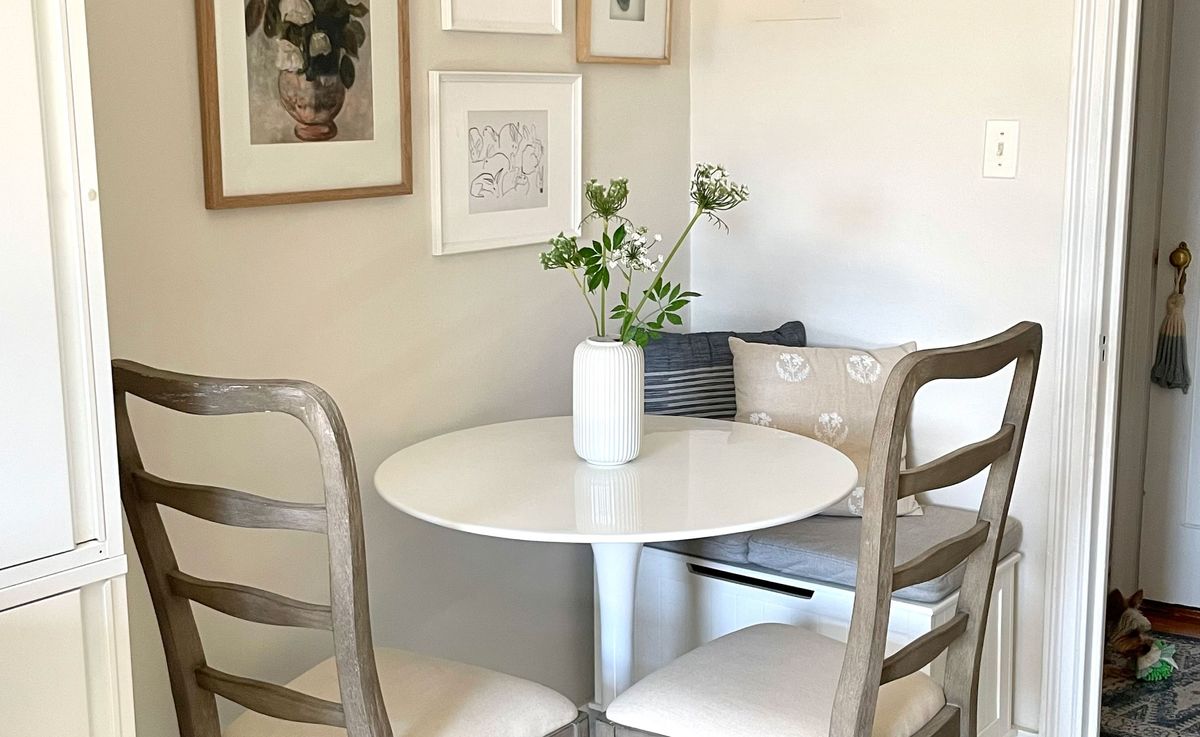
3) Awkward corner nook
WALL            WALL

   C   (round table)   C

   [banquette or bench]

OPEN TO KITCHEN- Round table prevents corner crowding.
- A bench or banquette creates a cozy destination instead of a forgotten corner.
Chair strategy: the easiest way to gain space
In small dining rooms, chairs are often the problem, not the table. The wrong chairs flare out, block pathways, and visually clutter the room.
Choose chairs that tuck in
- Armless chairs take up less width and slide in neatly.
- Low backs keep sightlines open, especially in open-plan spaces.
- Lightweight frames make it easy to scoot without scraping walls.
Mix chairs and a bench (my favorite cheat)
Put a bench on the wall side and chairs on the open side. This lowers the clearance you need and feels intentionally collected, especially if you mix vintage and modern.
Bench fit tip: Most dining tables are around 28 to 30 inches tall. Many benches that work well are around 18 to 19 inches high. If you are buying a bench or building a banquette, double-check that knees actually fit under the apron and that the seat height feels comfortable.
When to use folding chairs
If you host a few times a year, keep two pretty folding chairs in a closet. Think: wood, woven seat, or a simple black metal frame. Not the wobbly kind that make guests feel like they are camping.
Rug placement (without the chair snag)
Dining room rugs are wonderful, but only if chairs can slide in and out without catching. In tight spaces, the rug is also doing a visual job: anchoring the dining zone so it feels deliberate.
The rug rule that works
Choose a rug that extends at least 24 inches beyond the table edge on all seated sides. If you can manage 30 inches, even better.
If you cannot fit the perfect rug size
- Go rugless and lean into pretty floors, then add softness with linen curtains or upholstered chairs.
- Use a flatweave or low-pile rug so chair legs glide.
- Prioritize the pull-back sides: If one side is against a wall with a bench, the rug can be tighter there.
Best materials for dining
- Flatweave wool: durable, classic, forgiving.
- Indoor-outdoor: surprisingly chic now, and very renter-friendly.
- Patterned rugs: they hide crumbs and life better than a solid pale rug.
Sideboard vs console: the narrow-room tradeoff
I love a vintage sideboard as much as the next person who has dragged one home from a flea market, but in narrow dining rooms, depth matters more than romance.
Choose a sideboard when
- You have at least 36 inches between table edge and the sideboard for comfortable movement.
- You need real storage for servingware, linens, or small appliances.
- You host often and use the top as a buffet.
Choose a console when
- Your room is narrow and every inch counts.
- You want a landing zone for a lamp, a bowl for keys, or a bar tray.
- You can store bulkier items elsewhere.
Console that acts like a sideboard
- Add two lidded baskets underneath for napkins and candles.
- Hang one large mirror above to bounce light and visually widen the room.
- Use a plug-in picture light over art to create that restaurant glow without wiring.
Protect the walls (especially in tight layouts)
- Use washable paint or a more durable finish where chairs and elbows tend to graze.
- Consider a simple chair rail or slim wall molding if you are bump-prone.
- If the table sits close to a wall, add felt pads under table legs and chair feet so everything slides, not scrapes.
Lighting swaps that are renter-safe
Lighting is layout’s best friend. A small dining room with good light feels intentional, even if the table is compact.
Swap the fixture, keep it reversible
If your lease allows it, changing the light fixture is often a quick upgrade for someone who is comfortable with basic electrical work. Store the original fixture in a labeled box so you can reinstall it later. If you are not comfortable, hire a licensed electrician.
No hardwiring? Do this instead
- Plug-in pendant: Hang from a ceiling hook (use the right anchor for your ceiling type) and swag the cord neatly to an outlet.
- Plug-in wall sconces: Place them on either side of a mirror or art to widen the room visually.
- One warm table lamp on a console: It instantly makes dinner feel cozy and eliminates harsh overhead glare.
Pendant height
- Start at 30 to 34 inches from tabletop to bottom of the pendant.
- If you have tall ceilings or a large shade, go slightly higher so sightlines stay open.
Awkward features: doors, radiators, pass-throughs
Most small dining rooms are not blank boxes. Here is how to work with the quirks instead of fighting them.
If a door swings into the dining area
- Shift the table slightly off-center to protect the door swing.
- Use a round table to soften that collision zone.
- If possible, consider swapping to a door that swings the other way or a pocket door, but only if it is within your renovation scope.
If there is a radiator or baseboard heat
- Keep furniture a few inches off the heat source for airflow.
- Choose a slim console on legs rather than a heavy, flush-to-the-floor sideboard.
If the dining room is also a hallway
- Prioritize a 30-inch clear path minimum on the main traffic side, or 36 inches if you can swing it.
- Use a bench on the wall side so chairs do not jut out into the walkway.
- Consider an oval table to reduce sharp corners in the pass-through.
If you need accessibility clearance
If anyone in your home uses a mobility aid, plan on wider clearances than the minimums above. In that case, it is usually better to size the table down and keep circulation generous.
A quick will-it-fit checklist
- Measure room length and width, then subtract door swings and any must-keep pathways.
- Pick table shape based on footprint: round for awkward corners, rectangle for long rooms.
- Plan for about 30 to 36 inches behind seated diners on the main traffic side (closer to 36 if it is a frequent walkway).
- If space is tight, use a bench or wall-side seating to reduce chair clearance needs.
- Rug extends 24 inches beyond table edges on seated sides, or go flatweave and prioritize pull-back areas.
- Pick console depth 10 to 14 inches when a sideboard would crowd the room.
- Use warm, layered lighting: pendant (hardwired or plug-in) plus a lamp or sconces.
- Confirm table and seating heights play nicely together, especially with benches and banquettes.
If you are stuck between two table sizes, choose the smaller one and make it feel special. A beautiful linen runner, an amber-glow lamp on the console, and a vase of something leafy will do more for dining room energy than an oversized table you resent navigating.
My go-to small dining room formula
If you want one simple setup that works in most small homes, here it is:
- Table: 36 to 44 inch round pedestal or 48 x 30 inch rectangle with softened corners
- Seating: Two chairs plus a bench (or four slim chairs that tuck in)
- Storage: A 10 to 14 inch deep console with a lamp and a mirror above
- Lighting: Warm pendant centered over the table, hung 30 to 34 inches above the surface
- Rug: Flatweave, sized so chairs stay on it when pulled out
Your dining room does not need to be huge to feel generous. It just needs to let people sit down, pull out a chair without apologizing, and stay a while.