Sagging Couch but Cushions Look Fine?

Clara Townsend
Clara Townsend is an interior stylist, vintage furniture enthusiast, and the creative voice behind Velvet Abode. With over a decade of experience transforming both cramped city apartments and sprawling fixer-uppers, she believes that a beautiful home is built on personal stories rather than massive budgets. When she isn't hunting for the perfect brass sconce at a local flea market, she can usually be found rearranging her living room for the third time this month.
You know that feeling when your sofa looks totally normal, but the moment you sit down you sink like a polite little pebble into a pond? If your cushions still look full and perky, you are probably not dealing with a stuffing problem at all. You are dealing with what I call the hidden structure problem: springs that have slipped, webbing that has stretched, or a frame joint that has loosened over time.
This is especially common with secondhand sofas (my beloved category), flat-pack styles, and anything that has survived a few moves. The good news: you can usually diagnose the culprit in under 15 minutes, and some fixes are genuinely renter-safe.

Quick signs the cushions are not the problem
Before you start shopping for foam, look for these clues. They point to support failure underneath the cushions.
- The cushions look even, but you feel a dip in one spot every time you sit.
- The sag is directional (one side or one corner), not an overall softness.
- You can feel something “give” suddenly, like a hammock effect.
- There is noise, like creaking, popping, or a little metallic twang when you shift.
- The cushions pass the flip test: you rotate or swap them and the sag stays in the same place on the sofa.
Diagnose the cause in 10 minutes
Here is my no-drama process. You do not need special tools, just a flashlight and a little curiosity.
Step 1: The cushion swap test
Swap the seat cushions left to right. Sit again.
- If the sag moves with the cushion, the cushion is the issue.
- If the sag stays put, look underneath. The support system or frame is to blame.
Step 2: The “hand press” map
Remove the seat cushions and press down firmly on the deck (the upholstered base you normally sit on) across the full width.
- One area that drops much lower than the rest often means a broken spring, stretched webbing, or failed support bar.
- An even, overall softness can mean webbing has stretched across the whole seating area, common on budget and mid-range sofas.
Step 3: The underbelly peek
Carefully tip the sofa forward or on its side. If you are renting and nervous about scuffing floors, slide a thick blanket underneath first.
Look for:
- Loose or torn cambric (the thin black fabric stapled to the bottom). This will not cause sagging, but it can hide the real issue by blocking your view of the springs, webbing, or broken wood. If it is hanging down, it is worth moving it aside so you can inspect properly.
- Sinuous springs (S-shaped metal). Check for a spring that has popped out of its clip or a clip that has pulled free.
- Webbing (strips of fabric). If it looks stretched, wavy, or torn, it is no longer doing its job.
- Cracked wood, separated corners, or a gap at a joint. Any separation often translates to a dip up top.
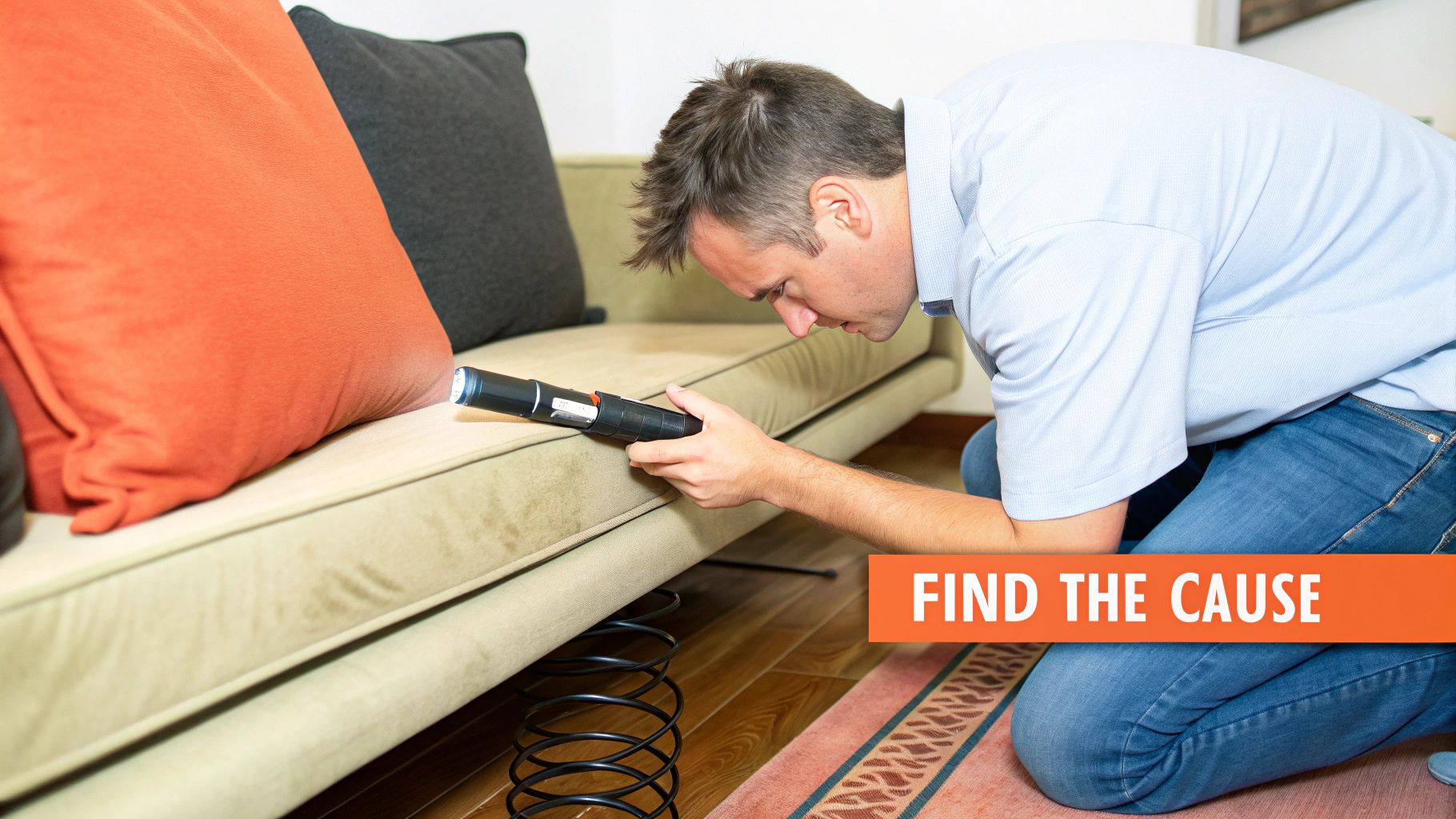
Step 4: The wiggle test for loose joints
With the couch upright, grab the arm and gently wiggle it. Then try the backrest. You are not trying to Hulk it, just checking stability.
- If you feel movement at the corners, the frame joints or fasteners are likely loose.
- If the couch creaks with every shift, a joint may be opening and closing under load.
Common culprits (and what they feel like)
Broken or slipped sinuous springs
What it feels like: a sudden dip, sometimes a “drop” sensation in one seat, often paired with a metallic ping or creak.
What you will see: one spring detached from its clip, a bent spring, or a clip pulled out of the wood frame.
Stretched webbing
What it feels like: a gentle hammock effect across a wider area, not just a single hole.
What you will see: webbing strips that look slack, wavy, or frayed. Sometimes the staples are still holding, but the webbing has simply tired out.
Loose frame joints or a cracked rail
What it feels like: a sag that gets worse over time, plus creaking or shifting when you sit down or stand up.
What you will see: gaps at corners, split wood, or hardware that looks crooked or partially pulled out.
Center support failure (common on sleepers and long sofas)
What it feels like: the middle seat sags, but the sides feel okay.
What you will see: a center leg missing, a bowed center beam, or support that no longer touches the floor.
Renter-safe checks and temporary fixes
If you cannot do permanent repairs, you can still make the sofa far more livable. Think of these as “stability shapewear” for furniture.
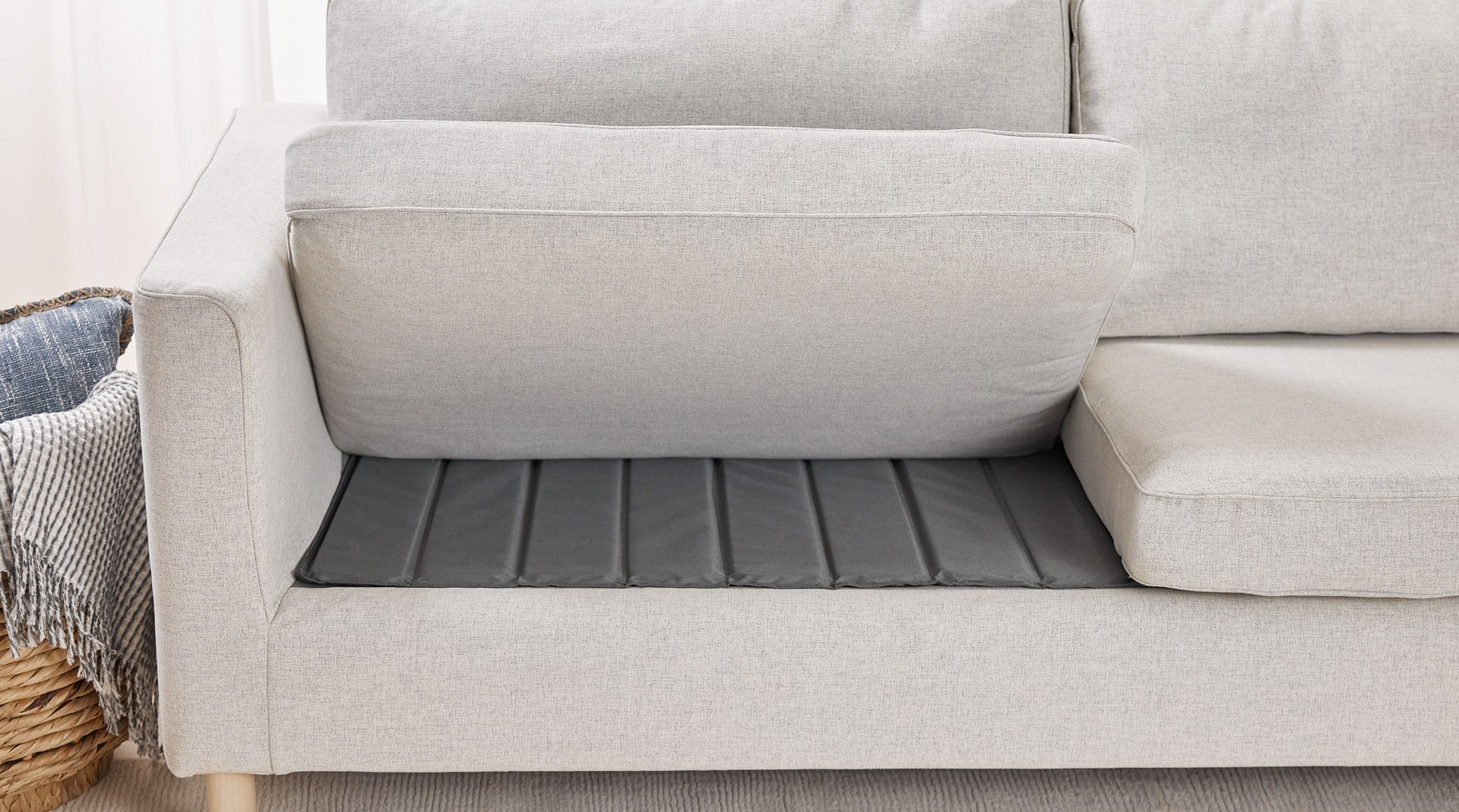
1) Add a firm support panel under the cushions
This is my favorite quick fix for stretched webbing or tired springs.
- Cut a piece of plywood or MDF to fit the seating area (or use two smaller panels side by side).
- Sand edges lightly or wrap the panel in an old blanket to prevent snagging.
- Place it on top of the deck under the seat cushions.
Pros: instant improvement, no tools, fully reversible. Cons: can feel firmer, reduces some “sink-in” comfort.
2) Use furniture shims for a missing or short center leg
If the center support is not meeting the floor, the whole sofa can bow.
- Check for an existing center leg that is adjustable.
- If it is missing, a temporary fix can be a stack of dense rubber shims or a solid wood block placed under the center beam.
- Add a felt pad under the shim to protect floors.
3) Tighten what is accessible (without taking the sofa apart)
Many sofas have accessible bolts under the arms or along the frame.
- Flip the sofa or crawl underneath with a flashlight.
- Tighten visible bolts or screws using the correct tool (usually an Allen key or socket wrench).
- If a screw keeps spinning, stop. That can mean stripped wood, and overtightening can worsen the damage.
4) Reattach a loose bottom dust cover (for visibility, not support)
A loose cambric dust cover will not change how supported the sofa feels, but it will get in your way when you are trying to see what is actually going on underneath.
- If it is simply hanging, use a staple gun to reattach it to the frame, or use heavy-duty upholstery pins if you cannot staple.
- If it is torn, you can patch it temporarily with fabric tape, then re-staple to keep it tidy.
DIY repairs if you are allowed to get hands-on
If the couch is yours, or your landlord is fine with repairs, these are the next-step options that actually address the structure.
Reclip or replace sinuous spring clips
- Replace broken clips with matching upholstery spring clips.
- If the wood where the clip mounts is damaged, you may need to move the clip slightly to fresh wood.
- Always check that springs sit evenly and do not rub against fabric.
Rewebbing
Replacing webbing is a high-impact repair, especially on vintage frames that are otherwise solid.
- You will need upholstery webbing and a webbing stretcher for proper tension.
- Replace in the same pattern (often a woven grid).
- Staple securely with heavy-duty staples.
Reinforce a loose joint
For a wobbling frame, a careful combination of wood glue, clamps, and new corner blocks can bring a sofa back from the brink. If the joint is cracked or the frame is particleboard, this can become a short-lived fix.
Stylist note: If the frame is hardwood and the upholstery is in good shape, repairs can be absolutely worth it. If the frame is flimsy and the sofa is already uncomfortable, do not guilt yourself into an endless DIY relationship.
When replacement beats repair
I love a rescue project, but I also love not throwing good money after a bad frame. Consider replacement if:
- The frame is cracked in multiple places or the wood is splitting around major load points.
- The sofa uses particleboard or stapled-only construction and the joints are failing again and again.
- The cost of repair is more than 50 to 70 percent of a better-quality replacement you actually like.
- You can feel the frame through the seat even after adding a support panel.
- It is a sleeper sofa and the mechanism or main supports are bent. Those repairs get expensive fast.
What to tell a landlord or seller
If you are renting, a clear description helps. Try:
- “The sag stays in the same spot even after swapping cushions.”
- “There is visible separation at the front rail joint.”
- “One sinuous spring is detached from its clip underneath the left seat.”
- “The center support does not reach the floor, and the middle seat dips.”
If you bought secondhand and can still message the seller, ask for a photo of the underside and frame corners before you attempt major fixes.
A simple decision tree
If you want the quickest path to “what do I do next,” here it is.
- Sag moves when you swap cushions: cushion issue (foam, fill, or inserts).
- Sag stays in one seat, you see a loose spring: reclip or replace spring clip, or add a support panel as a temporary fix.
- Overall hammock feel, webbing looks wavy: add a support panel now, plan rewebbing later.
- Creaking and frame wiggle: tighten accessible hardware, then assess joints. If the frame is cracked, replacement is often kinder to your time.
- Middle seat dip on long sofa: check center leg and center beam first.
Comfort upgrades after you fix the structure
Once the sofa is supported again, you can fine-tune comfort without chasing the sag.
- Add a thin layer of high-density foam or a sofa topper under the cushions if the new support feels too firm.
- Rotate cushions monthly to keep wear even.
- If you love that sink-in feel, use a topper rather than letting the frame do the sinking for you.

Safety notes
- If you see sharp metal, torn springs, or staples sticking out, stop using the sofa until it is covered or repaired.
- Wear gloves when checking the underside. Springs and clips can be surprisingly bitey.
- If the frame is actively cracking when weight is applied, treat it like a broken chair. It can fail suddenly.