Red Wine Running Down a Fabric Headboard

Clara Townsend
The first time I dealt with red wine on a headboard, I learned the hard way that gravity is not your friend. On a seat cushion, you can press straight down, unzip, rinse, repeat. On a fabric headboard, the wine travels. It threads itself along seams, behind buttons, and down into padding you cannot remove. The goal is not to scrub it out in one heroic moment. The goal is to stop the run, keep liquid out of the foam and wall, and lift pigment in controlled passes.
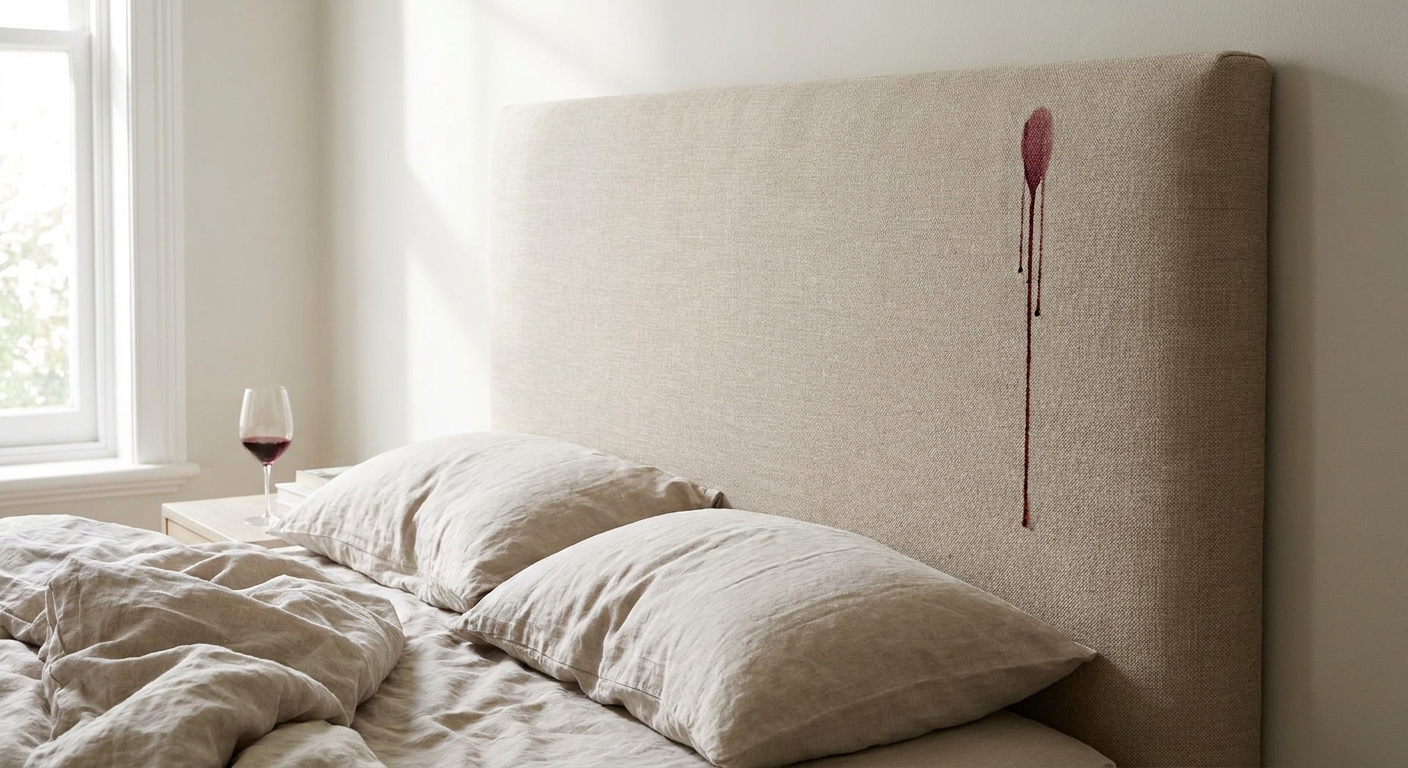
If you are standing there with a glass in one hand and panic in the other, start here.
First 2 minutes: stop the run
Do this before you reach for any cleaner. When wine is moving down a vertical surface, every second matters because the liquid keeps feeding the stain below it.
What you need
- White paper towels or clean white cotton cloths
- A dry bath towel you do not mind staining
- Cold water
- A small bowl
- A spoon
Step 1: Catch the drip at the lowest point
Find the very bottom edge of the visible wine trail and press a folded paper towel there like a little “dam.” You are trying to intercept what is still migrating downward.
Step 2: Blot from the top, but only with dry pressure
Start at the top of the spill and blot with a dry cloth, pressing gently and holding for a few seconds each time. Do not rub. Rubbing pushes pigment sideways and can fuzz up the fabric, which makes the stain look larger even when it is lighter.
Step 3: Protect the wall and the bed
If your headboard is mounted to the wall, tuck a dry towel between the headboard and the wall if you can reach. If you cannot reach, press a towel along the outer edges where liquid might sneak around. Pull pillows and bedding away from the area so you are not creating new problems while you fix this one.
Check the care tag first
If your headboard has an upholstery tag (often underneath, behind, or on the back), it may list a cleaning code:
- W: Water-based cleaning is generally considered safe.
- S: Solvent-based cleaning only. Water can cause marking or shrinkage.
- WS: Either water-based or solvent-based methods are typically acceptable.
- X: Vacuum only. No water, no solvent. This is where I would stop and call a professional.
Even with a “W” or “WS” code, the headboard is still fixed upholstery, so the big rule stands: use very little moisture and dry fast.
Why heavy extraction is risky
I know the temptation: spray, scrub, suck it out with a spot cleaner or upholstery extractor, and call it done. That approach works best on removable, horizontal cushions where you can control saturation and dry both sides. A headboard is a different construction.
Headboards are usually a fabric sandwich
Most upholstered headboards are built like this: outer fabric, then a layer of batting (a fluffy fiber layer that softens the look), then foam, then a backing board. All of it is stapled and sealed together. You cannot unzip it, rinse it, or set it in the sun to dry evenly.
What over-wetting does here
- It can drive liquid deeper. Spraying cleaner onto a vertical stain often pushes wine through the fabric into the batting and foam.
- It can soak the foam. Foam acts like a sponge. Once wine and cleaner get in, they spread beyond the visible spot.
- It can reach the wall. When foam becomes saturated, gravity pulls moisture down the inside of the headboard. That moisture can migrate to the bottom edge and onto paint, drywall, baseboards, or carpet.
- It slows drying. Slow drying increases the risk of lingering odor, brownish rings, and in worst cases, mildew.
This is not “never use a machine” advice. Pros can use controlled extraction and fast drying successfully. The risk is DIY-style saturation, especially on fixed upholstery.
Think of a headboard as something you clean with controlled moisture, not something you rinse.
Lift the wine safely: a low-moisture method
Once you have stopped the run and blotted up as much liquid as possible, you can start lifting the remaining pigment. The key is to work with a barely damp cloth and repeat gentle passes rather than flooding the fabric.
Mix a simple solution
In a bowl, mix:
- 2 cups cold water
- 1 teaspoon clear dish soap
Cold matters. Heat can make pigments and tannins harder to remove on many upholstery fabrics, so keep things cool until the stain is gone.
How to apply it
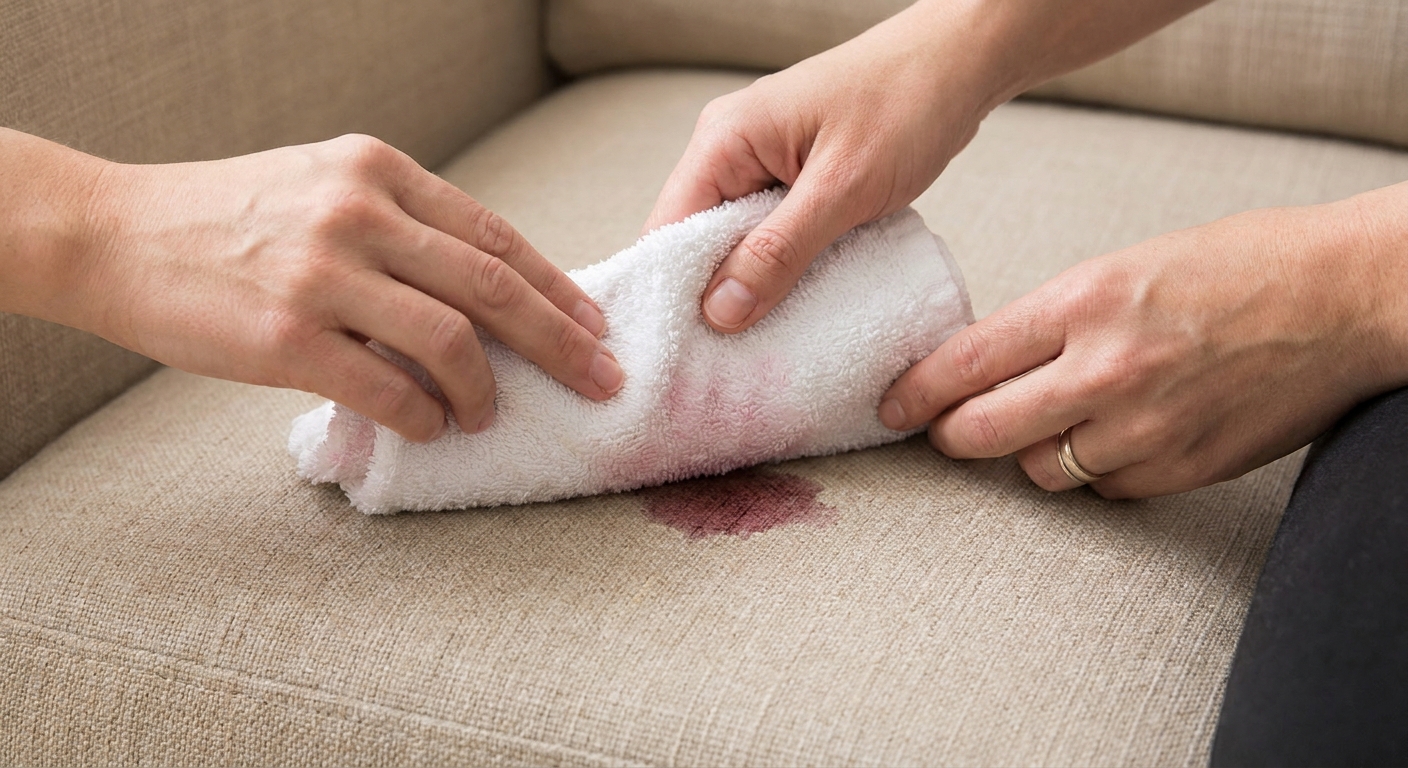
- Dampen, do not soak. Dip a clean white cloth into the solution, then wring it out hard. It should feel barely damp.
- Blot from the outside in. Start at the outer edges of the stain and work inward. This helps prevent a bigger halo.
- Hold pressure, then lift. Press for 5 to 10 seconds, then lift straight off.
- Switch to a dry cloth. After every few blots, use a dry cloth to pull moisture back out.
Repeat, slowly. This is one of those tasks where patience looks like progress.
If the stain is in the batting
This is the part people miss. With headboards, the visible stain on the fabric is only the first chapter. The batting underneath can hold a faint, pinkish shadow even after the surface looks better, especially along tufting, seams, and trim where liquid likes to wick.
Signs the batting has wine in it
- The surface looks lighter, but the stain “blooms” back as it dries
- You see a soft-edged pink or purple cast that will not lift with light blotting
- The fabric feels slightly damp or cool longer than the surrounding area
What to do next
Keep going with low moisture and accept that it may take multiple rounds spaced out over time. Here is a rhythm that works well:
- Round 1: blot with the soapy mix, then blot with plain cold water on a fresh cloth to remove soap residue
- Drying break: point a fan at the headboard for at least 1 to 2 hours
- Round 2: repeat only if you still see color
That fan step is what keeps this from turning into a watermark situation. Drying between rounds keeps the batting from staying wet and helps prevent a larger ring.
Material warnings
Some headboard fabrics are less forgiving, especially when it comes to water marks, pile changes, and dye bleed. Go extra slow and test in a hidden spot first if yours is any of the following:
- Velvet (especially cotton or rayon/viscose velvet): it can crush, show pressure marks, or shift pile direction.
- Linen and linen blends: can watermark easily.
- Wool or silk upholstery: can be damaged by the wrong cleaner, and dye stability can be unpredictable.
- Viscose/rayon: notoriously prone to water spotting and texture change.
If your headboard is a high-end textile, a saturated jewel tone, or something you cannot replace, professional upholstery cleaning is often the safer move.
Target tannins: when you need a stronger step
If you have blotted promptly and the stain is still clearly visible, you are likely dealing with tannins that have started bonding to the fibers. You can step up carefully without turning your headboard into a science experiment.
Option: diluted hydrogen peroxide (test first)
Hydrogen peroxide can lighten red wine, but it can also lighten fabric dye and weaken some natural fibers. I consider this mainly for light, colorfast fabrics and even then, only after a spot test in a hidden area like the back edge.
- Mix 1 part 3% hydrogen peroxide with 2 parts water.
- Dab on with a cotton swab or corner of a cloth, only on the stained area.
- Wait 5 minutes, then blot with a water-damp cloth, then blot dry.
If you see any dye from the headboard lifting onto your cloth, stop and skip this method.
Option: call a professional sooner if the headboard is special
If the headboard is silk, mohair, a true vintage textile, or a saturated color you cannot replace, I would rather you spend money on a pro than gamble with bleaching. Wine plus unknown dye is a risky pairing.
Dry it thoroughly
Even when you clean with minimal moisture, you still need to dry thoroughly because any dampness trapped in batting and foam can linger.
- Run a fan pointed at the headboard for several hours.
- Keep the room airy. Crack a window if weather allows.
- Avoid high heat. Hair dryers and steam can make remaining pigment harder to remove on many fabrics, and they can also damage finishes or texture.
- Do not push the bed back tight against the headboard until it is fully dry.
If you are dealing with a lot of moisture from an earlier cleaning attempt, a dehumidifier in the room can help a lot.
What not to do
This is the quick list I wish someone had taped inside my linen closet years ago.
- Do not rub. You will spread dye and rough up fibers.
- Do not pour water down the stain. Gravity will pull it deeper and lower.
- Do not steam it while color remains. Heat can make wine pigments and tannins harder to remove on many upholstery fabrics.
- Do not over-spray stain remover. A headboard cannot be rinsed properly, so residue can attract dirt later.
- Do not use colored towels. Dye transfer is real, especially on light upholstery.
When it follows a seam or tuft
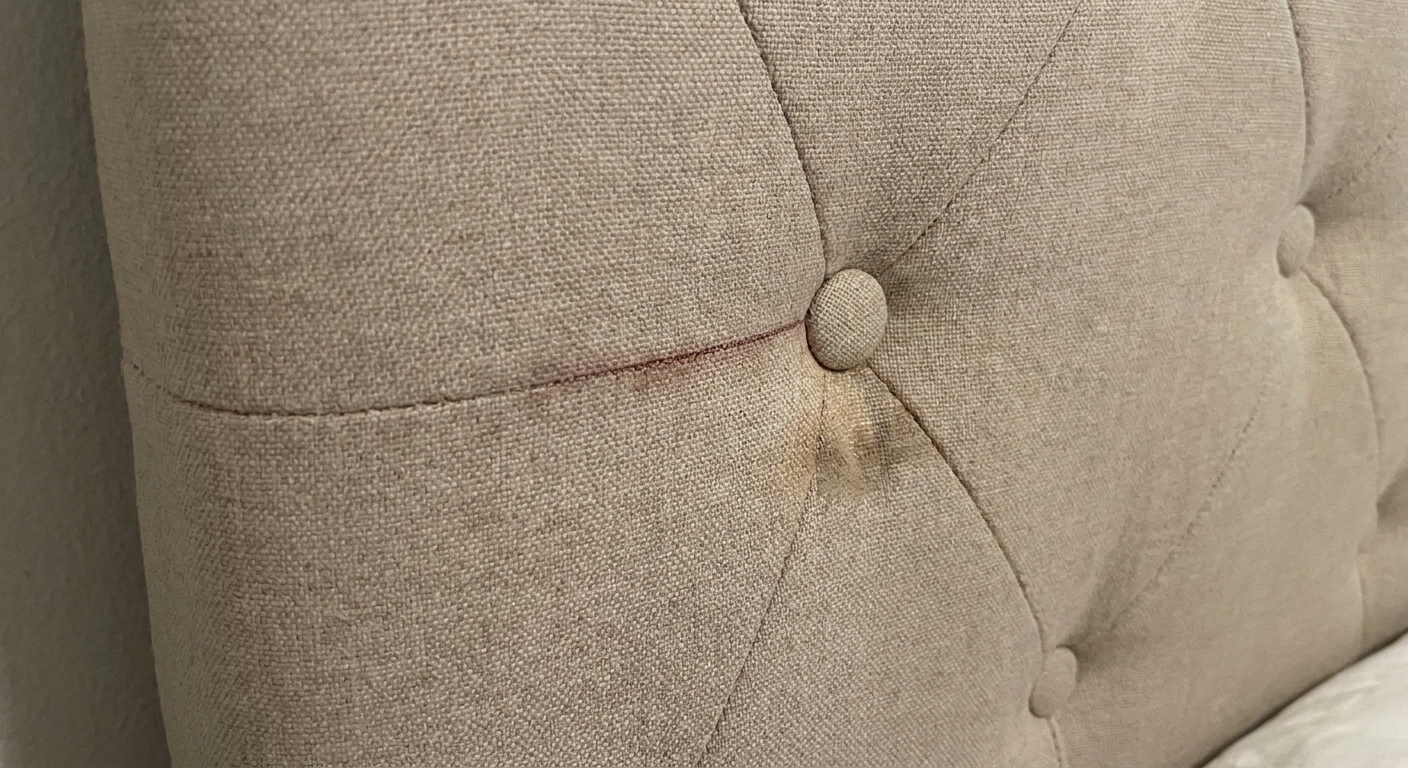
Wine loves structure. It will run along piping, seams, and tufted channels like it found a freeway.
- Use a folded paper towel edge to press into the seam and pull out moisture.
- Work in tiny sections rather than chasing the whole line at once.
- Keep the “dam” at the bottom the entire time, replacing it as it gets damp.
FAQ
Is club soda better than water for wine on a headboard?
Club soda is not magic, but it can work as a gentle, low-residue rinse if you are blotting carefully. The bigger issue is not what liquid you use. It is how much you use. For a headboard, keep moisture minimal and focus on blotting and drying.
What if it dried before I noticed?
You can still improve it. Start by lightly dampening a cloth with plain cold water and blotting to rehydrate the stain, then use the low-moisture soapy method. Expect more rounds with drying breaks. Dried wine is stubborn, but not hopeless.
What if my headboard has a removable cover?
If it truly unzips or slips off, you can treat it more like a cushion cover, meaning you have more rinsing and drying options. Still, check the care label first, and do not assume you can machine-wash unless the tag explicitly says you can.
What if my headboard is velvet?
Be extra gentle. Velvet shows pressure marks and can change pile direction. Blot with very light pressure, avoid over-wetting, and do not brush aggressively. If it is a pricey velvet or you cannot identify the fiber, professional upholstery cleaning is the safest path.
When is it time to call a professional?
Call if the stain is large, the headboard is valuable or vintage, the fabric dye seems unstable in a test, you see an “X” care code, or you have already accidentally soaked the foam. Professionals have tools to control moisture and speed drying, which is the make or break detail with fixed upholstery.