Recliner Won’t Recline or Stuck Halfway

Clara Townsend
Clara Townsend is an interior stylist, vintage furniture enthusiast, and the creative voice behind Velvet Abode. With over a decade of experience transforming both cramped city apartments and sprawling fixer-uppers, she believes that a beautiful home is built on personal stories rather than massive budgets. When she isn't hunting for the perfect brass sconce at a local flea market, she can usually be found rearranging her living room for the third time this month.
There is a very particular kind of frustration reserved for a recliner that only almost works. The footrest pops up an inch and freezes. The back leans slightly, then stops as if it hit an invisible wall. And suddenly you are tempted to yank the handle like you are starting a stubborn lawn mower.
Before you force anything, pause. A stuck recliner is often not “broken beyond hope.” It is commonly jammed, misaligned, or disconnected. The good news is that a careful five to fifteen minute check can save you from bent hardware, snapped cables, stripped gears, and pinched fingers.
What you need
- Flashlight (phone light works)
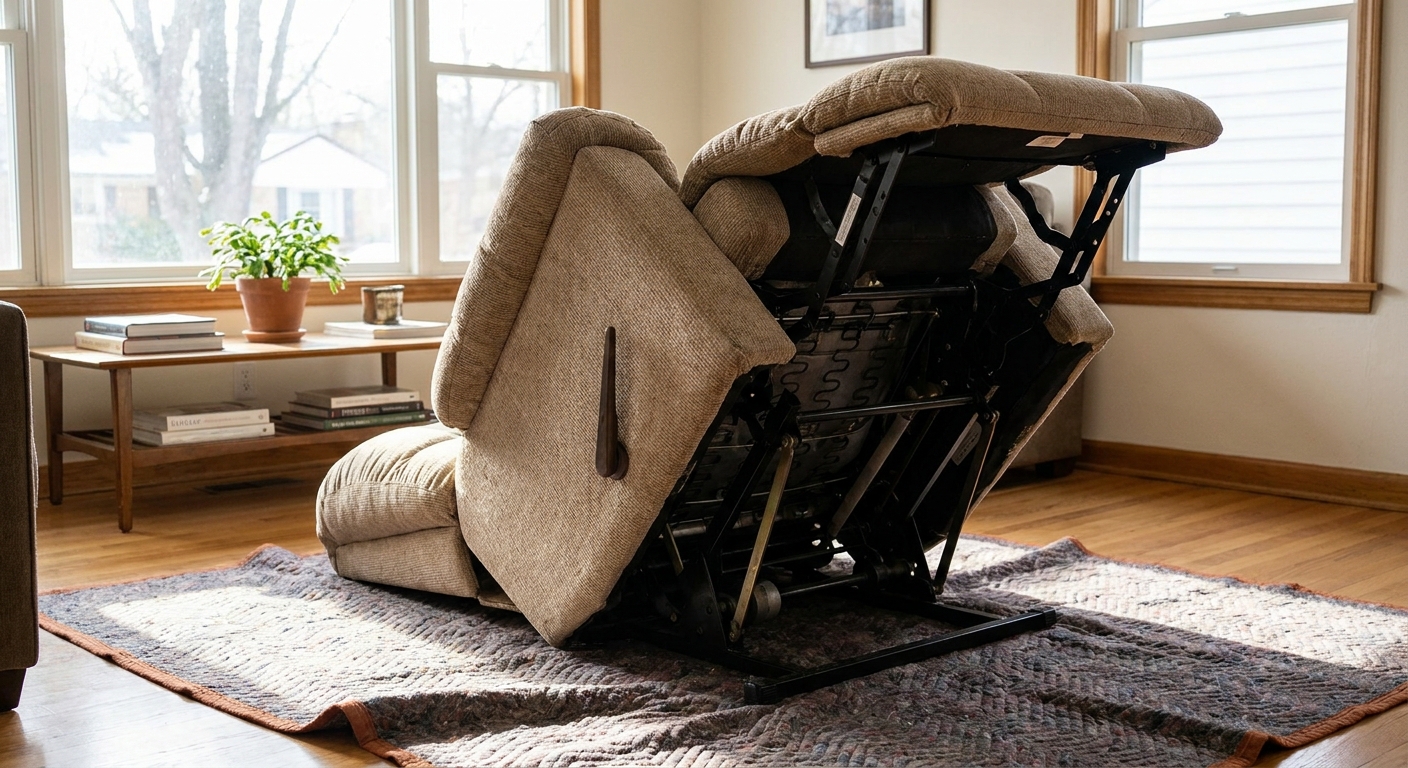
- Blanket or cardboard (for tipping the chair safely)
- Gloves (optional, but helpful around sharp brackets)
- Basic screwdriver or socket/Allen key (only if you find an obviously loose fastener)
- Wooden dowel or paint stir stick (optional, for nudging debris without using fingers)
Most checks below take 5 to 15 minutes. If you end up tightening hardware or tracing cables, budget closer to 20.
First, a quick safety reset
Recliners have surprising pinch points. Treat the mechanism like you would a folding ladder: useful, but not something to wrestle.
- Unplug power recliners before you inspect anything underneath. If it is battery-powered, switch it off or remove the battery pack if accessible.
- Clear the area: move rugs, side tables, and floor lamps so you have room to tip the chair safely.
- Protect your floors with a folded blanket or a piece of cardboard if you need to tilt the recliner forward.
- Keep hands out of the scissor mechanism (the crisscrossing metal under the seat). Use a flashlight, not your fingers, to “feel around.” If you must move something, use a wooden dowel or similar tool.
- Do not sit in it while testing. Test from the side until it moves smoothly again.
What not to force
If you take one thing from this page, let it be this: forcing a stuck recliner usually turns a small fix into a parts order.
- Do not jump or “body slam” the footrest shut. This can twist the linkage and pop rivets.
- Do not crank the handle repeatedly if it suddenly went loose or has no resistance. That often means the cable has slipped, stretched, or snapped.
- Do not lubricate first if the chair is jammed halfway. Lubricant can temporarily mask symptoms, attract dust, and encourage you to keep forcing a mechanism that is actually binding or misaligned.
- Do not use pliers on the release cable as a first move. Over-pulling can break the cable end or the handle mount.
If you hear grinding, a hard pop, or rapid clicking that was not there before, stop and skip to the noise section below.
Know your recliner type
- Manual handle recliner: has a side handle and usually a cable to a latch.
- Manual push-back: no handle. You recline by leaning back (and the footrest may pop out as you shift your weight). These still use linkages underneath, but there may be no handle cable to check.
- Power recliner: uses a wired hand control (wand), buttons on the arm, and a motor/actuator underneath.
Safe inspection order
This sequence works for most manual and power recliners. You are looking for something obvious before you get into take-it-apart territory.
1) Check for a simple jam
This is one of the most common causes, especially in homes with throw blankets, pet toys, or those charming little baskets that migrate.
- Look under the front edge and along both sides of the footrest.
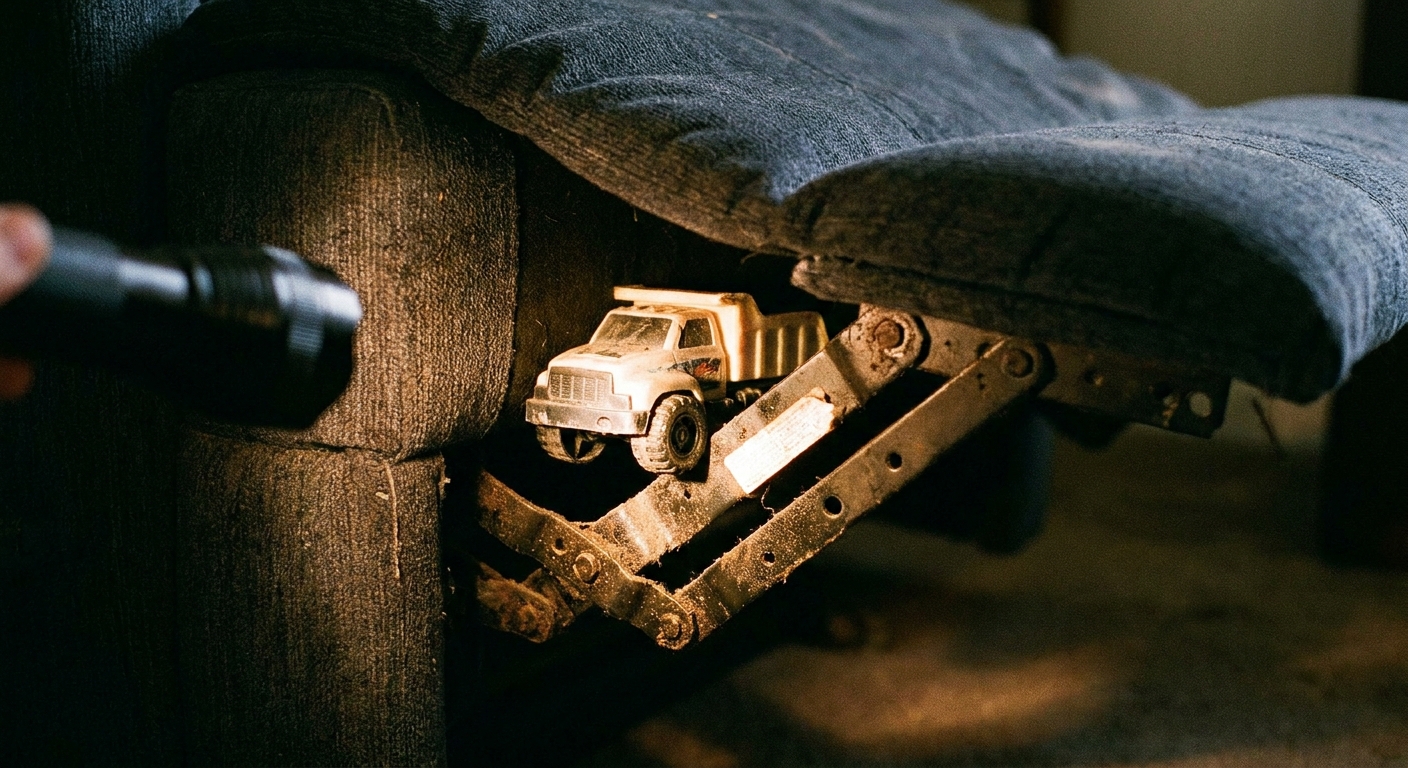
- Check the gap between the footrest and the frame for socks, remote controls, coins, hair clips, and toy parts.
- Feel the carpet or rug edge. A thick rug can catch the footrest and stall it halfway.
If you find an obstruction, remove it and try again gently. If it still catches at the same spot, keep going down the list.
2) Make sure it is sitting square
If one side of the base is lifted on a rug corner or uneven floor, the linkage can bind. This can look like the chair is stuck when it is really just twisted.
- Slide the recliner so all legs are on the same surface.
- If it is on a plush rug, test it on a hard floor temporarily.
- Check for a loose base rail or wobble that makes the chair rack side-to-side.
3) Manual handle: handle and cable
If your handle suddenly feels floppy, spins too freely, or pulls with no “grab,” the cable is often the culprit. (If you have a push-back recliner with no handle, skip to the linkage check.)
- Look at the handle mount: is the handle loose at the side of the chair? Tighten obvious screws if accessible.
- Peek between the seat and side with a flashlight. Many recliners use a cable that runs from the handle to a release latch.
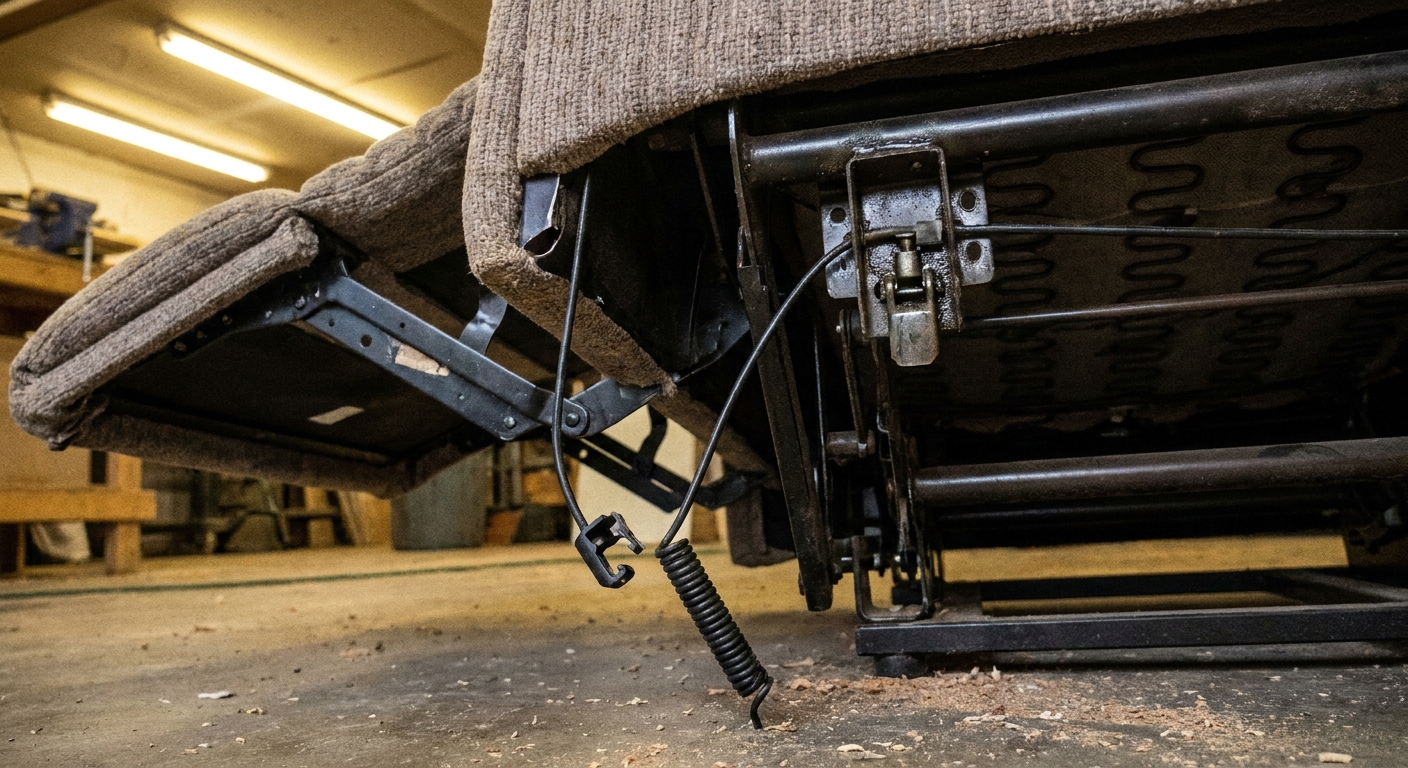
- Tip the chair forward carefully (onto a blanket) and look underneath for a cable that has slipped out of its bracket or looks kinked.
What you might see:
- Cable disconnected: the metal end is no longer seated in the release mechanism. This can sometimes be re-seated by hand if nothing is bent.
- Cable stretched: it is attached but has slack, so pulling the handle does not move the latch enough to release.
- Cable broken: the handle moves, but the cable end is frayed or separated. This is typically a replacement part situation.
4) Check brackets and linkage
If the footrest comes out crooked or one side moves more than the other, you may have a bracket that shifted, a bent linkage arm, or a loose bolt.
- With the chair tipped forward, look for left-right symmetry. The arms and scissor mechanisms should mirror each other.
- Check for a bolt that backed out or a nut missing on one side.
- Look for shiny “rub marks” where metal is scraping. That is often the binding point.
If you spot a loose fastener and can safely tighten it, do so. If anything looks visibly bent, do not force the recline. A bent linkage is one of those issues that gets worse fast.
5) Power recliner: reset basics
Power recliners can freeze mid-motion due to a tripped power supply, an overheated motor, a loose connector, or a control box that needs a reset. Do these in order:
- Unplug the chair from the wall for 60 seconds. Plug it back in directly to a wall outlet. During testing, avoid power strips or extension cords so you can rule out low voltage, loose switches, or flaky connections.
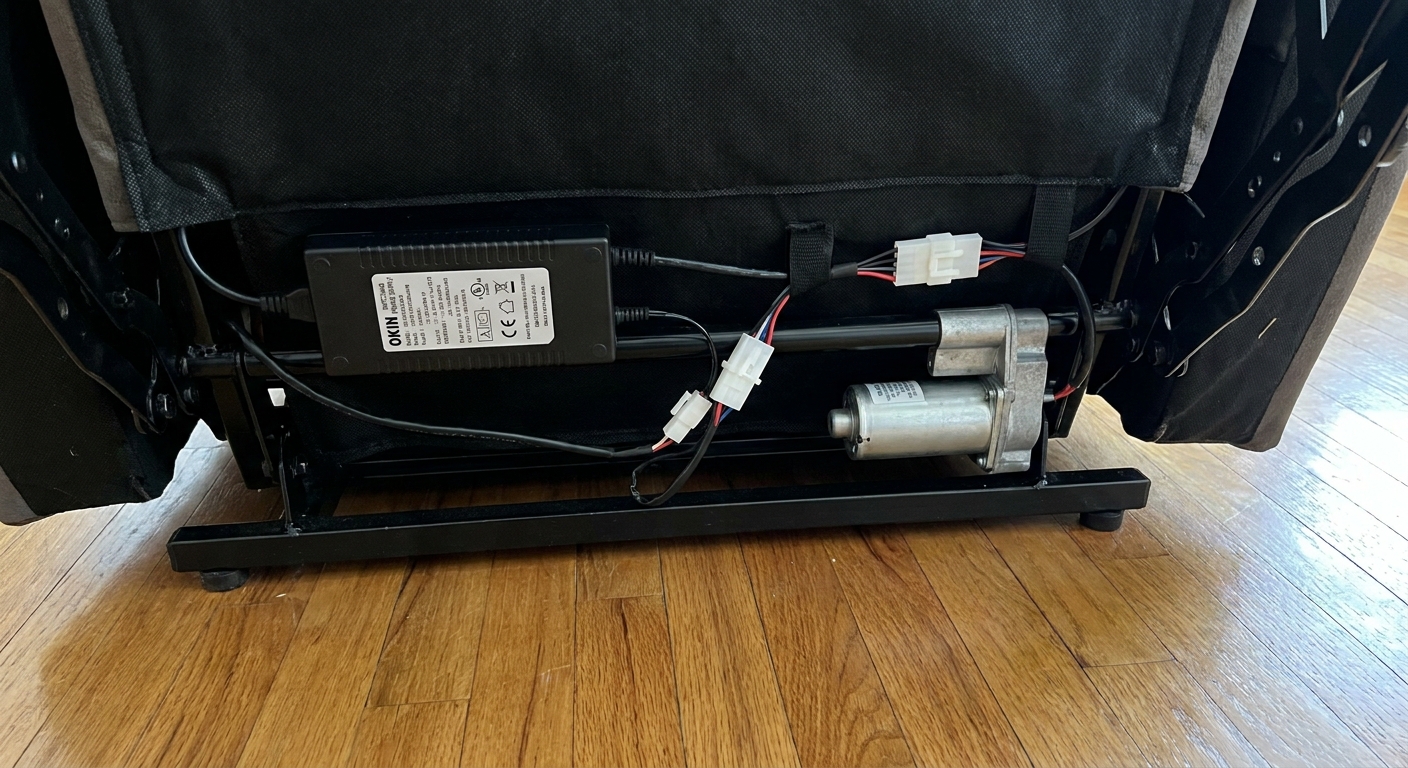
- Check the transformer brick: many have a small indicator light. If there is no light, try a different outlet.
- Inspect connectors under the chair. Look for a loose plug between the motor and control box, or a connector partially pulled apart.
- Check the hand control cord: follow the wired remote (wand) cord from the buttons down into the chair. Look for pinches, cuts, or fraying, especially where it passes under the arm or through a tight gap.
- Let it cool: if the motor/actuator has thermal protection (many do), it may shut off after repeated use. Wait 15 to 30 minutes, then try again.
- Battery backup: if your chair has one, confirm it is charged and seated properly. A half-connected battery can cause intermittent stopping.
If your power recliner section just felt a bit more “robot manual” than the rest of this article, you are not wrong. Electricity has less patience for improvisation than we do.
If it is stuck halfway
A recliner can bind when there is pressure on the mechanism. Your goal is to remove tension, not overpower it.
Manual recliner
- Stand to the side and lightly lift the footrest a hair while pulling the handle, then release. Sometimes the latch is caught under load.
- Try the opposite: press the footrest down slightly while pulling the handle. Use steady pressure, not a slam.
- If the back is reclined, gently bring the backrest forward while you try to close the footrest. Some designs want the back to return first.
Power recliner
- Release pressure by standing up and ensuring nothing is leaning on the footrest or back.
- Press and hold the button in the opposite direction for a few seconds. If it strains or stalls, stop.
- If you hear the motor hum but nothing moves, do not keep holding the button. That can overheat the motor or damage gears.
Check the back locks
Many recliners ship with a removable back that slides into locking brackets. If the back is not fully seated on one side, you can get odd motion, new noises, or a “crooked” feel.
- Only do this if your model is designed with a removable back (you will usually see locking tabs or brackets at the lower back).
- With the chair stable and unplugged (if power), check that both sides are fully engaged and locked.
- If you are unsure, stop and consult the manual. Forcing a back into the wrong bracket is a fast way to bend something expensive.
Grinding, clicking, or popping
Noise is information. The type of noise can tell you whether you should keep investigating or call for service.
- Grinding (manual or power): often metal-on-metal contact from misalignment, a bent linkage, or damaged gears in a power unit. Stop forcing movement. Inspect for scraping marks and loose hardware.
- Rapid clicking (power): commonly a stripped gear, a failing motor, or a control issue where the motor tries to engage and slips. Unplug and inspect connections. If it persists, it likely needs parts.
- Single loud pop: can be a bracket shifting back into place, but it can also be a rivet or fastener failing. If the chair now moves crookedly, stop.
- Squeaking only: squeaks can be lubrication-related, but squeaking plus sticking usually points to binding or misalignment first.
If your recliner is making new grinding noises, skip the temptation to “just add oil.” Lubrication helps a healthy mechanism move quietly. It does not fix a mechanism that is fighting itself.
If it moves but squeaks
Once the recliner is moving smoothly (no binding, no uneven motion), a light lubricant can quiet the last of the drama.
- Use a dry PTFE or silicone spray in light bursts. Avoid soaking anything.
- Target pivot points and hinges in the metal linkage, not the upholstery, wood, or springs.
- Wipe overspray immediately and cycle the mechanism a few times (from the side, hands clear).
Avoid heavy grease unless the manufacturer specifically recommends it. Too much sticky lubricant tends to collect dust and turn into grit over time.
When to stop DIY
I am all for a confident home fix, but recliners can bite back. Consider professional repair, warranty service, or replacement parts if any of these are true:
- The frame or linkage is visibly bent or twisted.
- A power recliner hums but will not move, especially with clicking or grinding.
- You see broken cable strands, cracked plastic housings, or a snapped spring.
- The recliner only moves on one side, or the footrest lifts unevenly.
- There is a burning smell or a warm transformer brick after short use.
- The chair is under warranty. It is usually smart to contact the manufacturer or retailer before opening panels or adjusting hardware, so you do not complicate a claim.
Tip before you call: take a few well-lit photos of the underside mechanism, the handle area, and any labels. If you can find a model number tag under the footrest or on the base, write it down. It speeds everything up.
Common fixes recap
- Footrest will not deploy at all: obstruction, handle cable disconnected (manual handle models), or latch not releasing.
- Footrest starts then stops halfway: jammed object, rug interference, linkage binding, or a power issue.
- Handle goes loose: cable slip, stretch, or break (manual handle models).
- Power recliner stopped mid-recline: loose connector, hand control cord damage, overheating motor (may have a thermal cutoff), transformer/outlet issue, or a control box needing reset.
- Grinding or repeated clicking: stop forcing, inspect for misalignment or failing gears, consider service.
If you want, tell me whether your recliner is manual handle, manual push-back, or power, what it does when you try to recline, and whether there is any noise. Those three details usually narrow the diagnosis fast.