Recliner Rocks or Leans to One Side

Clara Townsend
Clara Townsend is an interior stylist, vintage furniture enthusiast, and the creative voice behind Velvet Abode. With over a decade of experience transforming both cramped city apartments and sprawling fixer-uppers, she believes that a beautiful home is built on personal stories rather than massive budgets. When she isn't hunting for the perfect brass sconce at a local flea market, she can usually be found rearranging her living room for the third time this month.
A recliner that rocks, tips, or leans to one side can make a room feel off, even if everything else is perfect. It is also one of those “small” problems that can turn into a bigger one if you keep forcing the mechanism while the base is unstable.
The good news: tilt issues often come down to a handful of common causes, and you can troubleshoot them safely in a calm, logical order. Think of this like styling a bookshelf. You do not start by hammering nails. You start by checking whether the shelf is level.
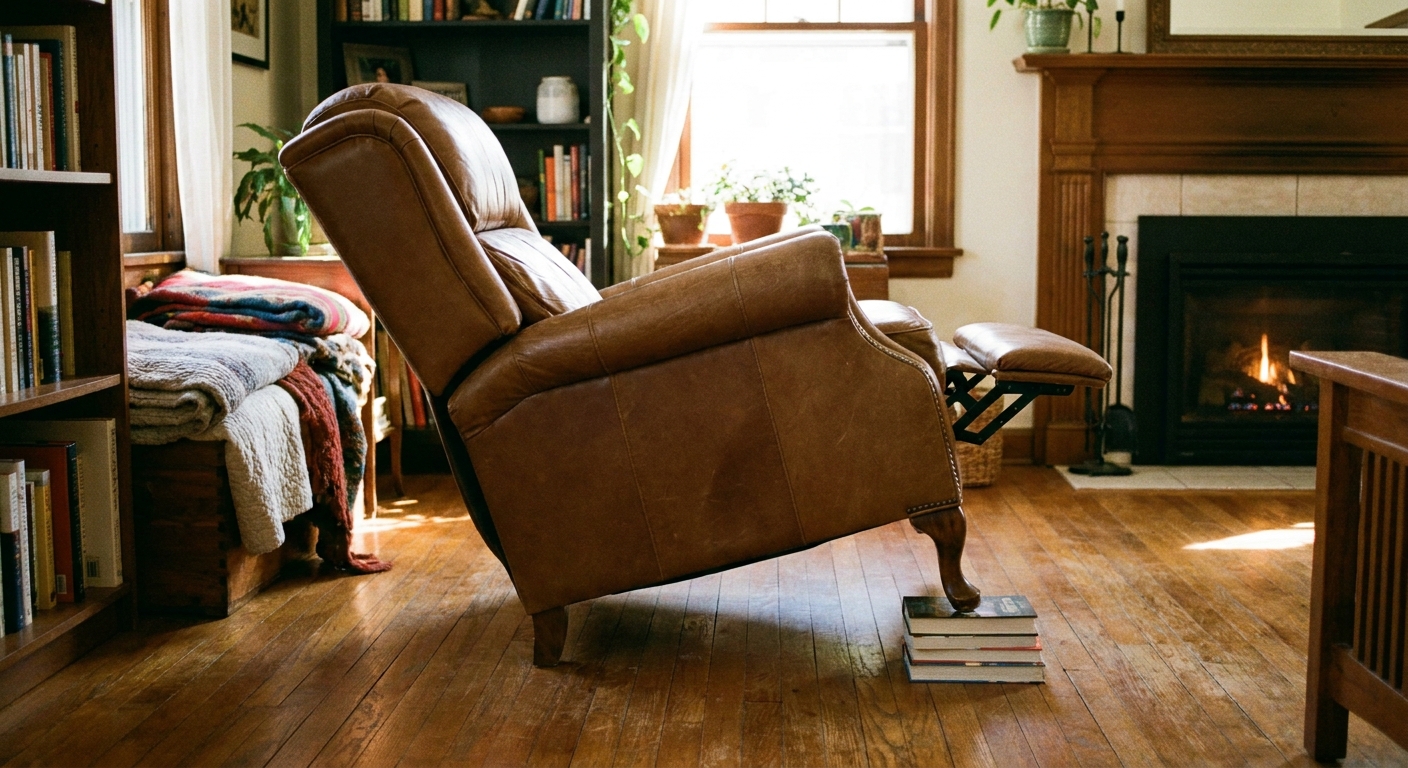
Why a recliner leans or rocks
When a recliner feels like it has a “favorite corner,” it is usually one of these:
- Uneven flooring: Common with older hardwood, thick carpet with a soft pad, tile transitions, or an area rug edge sitting under one side.
- Worn or missing feet and glides: Glides are the small plastic or metal pieces that help the chair slide smoothly and protect the floor. They can crack, felt pads can compress, and rubber feet can peel off.
- Loose base bolts or hardware: The base and reclining mechanism are held together with bolts that can loosen over time from normal motion.
- Frame flex or damage: A bent metal bracket, cracked wood, or a warped base can create a persistent lean.
One quick clue: if the recliner only rocks when someone sits in it, suspect loose hardware or frame flex. If it rocks even when empty, suspect flooring or feet.
Safety first
Recliners are heavier than they look, and the mechanism has pinch points. A few small habits keep this from turning into a painful hand or finger situation.
- Unplug power recliners. If it has a cord, pull it from the wall before you do anything else.
- Keep hands clear of linkages. Even unplugged, the mechanism can shift when you tip or move the chair.
- Clear the area. Remove throw pillows, side tables, and anything breakable within arm’s reach.
- Get help if you can. Many recliners are a two-person lift, especially if you need to tip it.
- Protect your floor. Use a folded blanket or cardboard under the arms if you have to gently tip the chair.
- Do not recline it while it is unstable. Test upright first. For power recliners, avoid running the motor while the chair is tipped.
If you feel resistance, grinding, or a sudden “pop” during any step, stop and move to the red flags section near the end.
Warranty note: If your recliner is new or still under warranty, check the manufacturer or retailer guidance before adding shims, replacing feet, or applying any adhesives.
Inspection order
Do this before buying anything.
Step 1: Rule out the floor
This is the simplest fix and the most overlooked.
- Slide the recliner 6 to 12 inches in a few directions. If the lean changes or disappears, the floor or rug is more likely the culprit.
- Check transitions. A rug edge under one front corner can cause a surprising tilt.
- Try a flat test surface. If possible, move the recliner to a different room with a different flooring type. If it is stable on a hard, flat surface like tile or concrete, that points more strongly to a floor or rug issue in the original spot (though it does not rule out chair problems entirely).
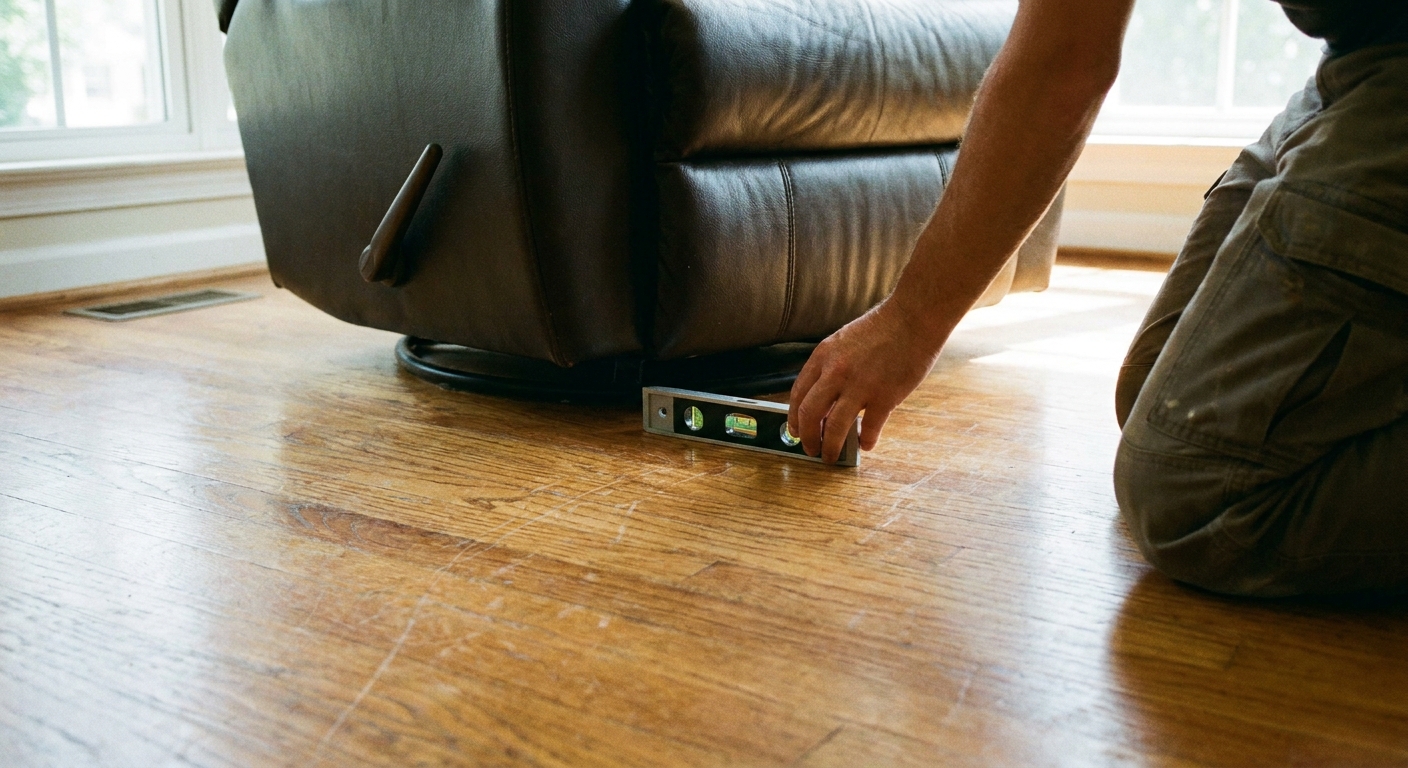
Step 2: Inspect the feet, glides, and pads
With the chair upright and empty, get down at eye level and look at each corner. You are searching for anything that changes the height from one side to the other.
- Missing plastic glides or cracked rubber feet
- Compressed felt pads, especially on thick carpet
- Staples or tacks under one corner (often from a loose staple in the upholstery dust cover underneath)
- A caster that no longer swivels freely (on some swivel recliners)
Quick test: press down firmly on each arm. If one corner “gives” more than the others, that foot may be worn, or the mounting point may be loose.
Step 3: Check base bolts and mounting points
If the feet look fine and the floor is not the issue, it is time to check for loose hardware.
How to do it safely:
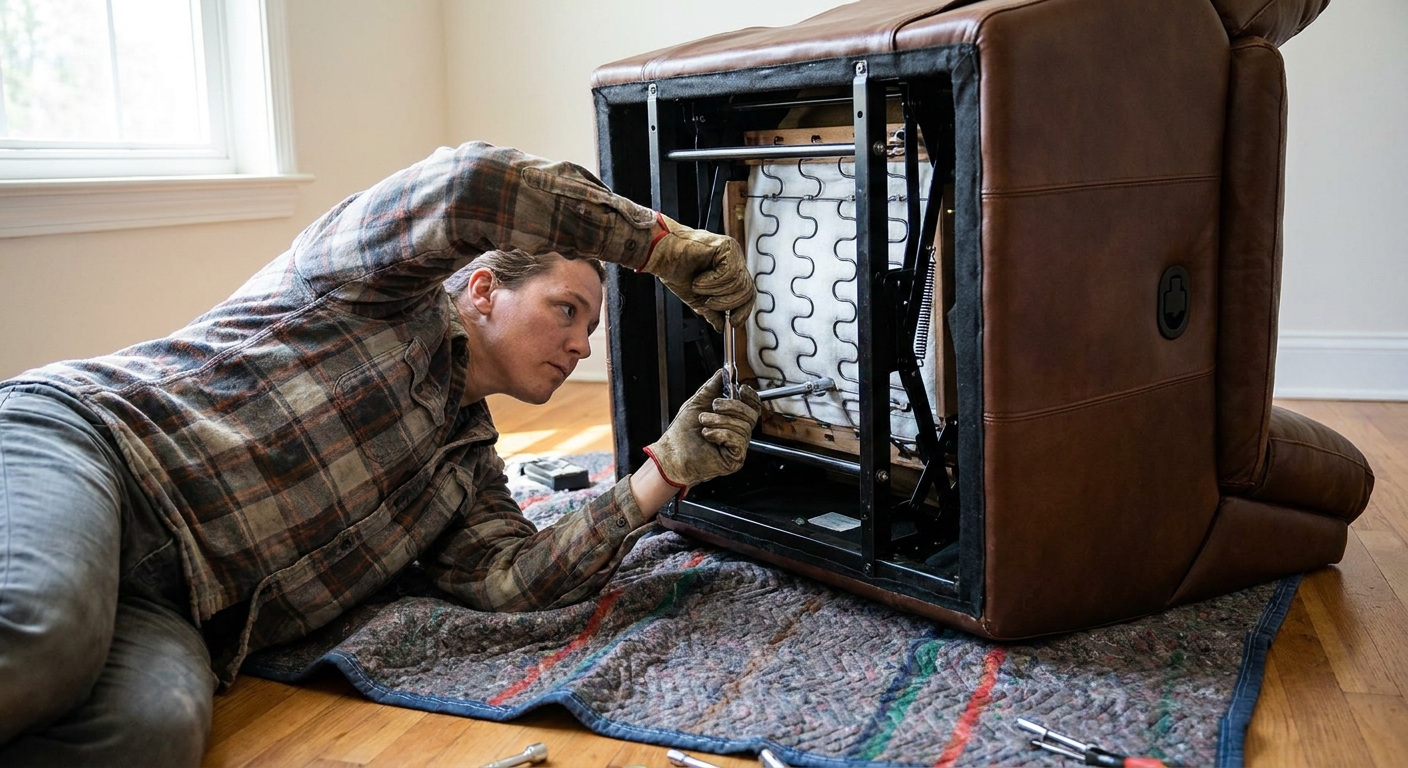
- With help, gently tip the recliner back or to the side onto a blanket so you can see underneath.
- Use a flashlight to locate the metal base, scissor mechanism, and the points where metal meets wood.
- Look for bolts or screws that have backed out, shiny rub marks, or elongated holes in brackets.
Most recliners use a mix of bolts (often hex head) and wood screws. If you see a bolt that is not fully seated or a bracket that looks slightly separated from the frame, that can create a lean.
Step 4: Check for frame damage
This is where you shift from “DIY leveling” to “structural issue.” Signs to look for:
- Cracked wood rails along the base or near the front corners
- Split plywood where a screw is pulling through
- Bent brackets near the reclining mechanism
- Weld breaks or hairline cracks in metal
If you see damage, do not try to muscle the recliner into alignment. Reinforcing a frame is possible, but it is a repair job, not a shim job.
How to level it
Option 1: Shims
Furniture shims are a quick way to stop rocking, but the goal is stability, not height for height’s sake.
- Use rubber or composite shims when possible. They grip better than smooth plastic.
- Use the smallest shim that solves the problem. Stacking multiple shims can shift over time.
- Place the shim fully under the foot. A partially supported corner can slip out, create a trip hazard, and add stress to the base.
Pro tip: once it feels stable, trim any visible shim (if it is the cuttable kind) so it disappears under the base.
Option 2: Gripper pads
If your recliner “walks” or slowly migrates while rocking, gripper pads can help. They are also useful if the recliner sits on an area rug and one side is catching the rug pile differently.
- Choose non-slip rubber pads for hardwood or laminate.
- Choose wide, load-rated pads for plush carpet so the feet do not sink unevenly.
Option 3: Replace worn feet or glides
If one glide is cracked or missing, leveling the chair without replacing it is like balancing a table with one shorter leg. Many feet and glides are inexpensive and can be replaced with basic tools.
- Match the mounting style (screw-in, nail-on, plate-mounted).
- Match the height. Even a few millimeters can bring back a wobble.
- If you cannot find an exact match, replace both front or both back feet as a pair to keep things even.
Tightening tips
Loose hardware is common, especially on recliners that get daily use. Tightening can help, but it needs to be done thoughtfully.
- Use the right tool. A socket wrench fits bolts better than an adjustable wrench and reduces stripping.
- Tighten evenly. If a bracket has two bolts, alternate between them so the bracket pulls down flat.
- Do not overtighten into wood. Wood screws can strip the hole. If a screw spins without grabbing, it needs repair (see below) or professional help.
- Recheck after a week. Once the recliner settles back into normal use, a quick re-snug can help. If it loosens repeatedly, suspect worn hardware, stripped holes, or bracket wear.
Optional: If a metal-to-metal bolt repeatedly loosens, a medium-strength threadlocker can help. Skip this on screws going into wood, and avoid it if you may need frequent disassembly for warranty service.
If a wood screw hole is stripped: the reliable fixes are a slightly longer or thicker screw (only if it still bites solid wood), or a wood plug and glue repair (often best handled by a repair shop if the mechanism mount is involved).
If you find washers missing, bolts mismatched, or holes elongated, you are likely looking at wear that needs a more robust repair.
Special cases
Swivel recliners
A swivel base can feel like a lean when the swivel plate is loose or the bearings are worn. If the chair wobbles at the center column rather than at a corner, focus your inspection on the central swivel mechanism and its mounting bolts.
Rocking recliners
Rockers can develop a side-to-side sway if the mechanism arms loosen or if one side has more wear. A tiny difference left versus right becomes noticeable because rocking amplifies it. Start with bolt checks and bracket inspection before you add shims.
Red flags
Some recliner instability is a safety issue, not an annoyance. Stop troubleshooting and avoid sitting in the chair if you notice:
- Grinding, loud popping, or metal-on-metal screeching during normal rocking or reclining
- A bracket that is visibly bent or a weld that looks cracked
- Wood that is split near a load-bearing corner or where the mechanism mounts
- Bolts that will not tighten because the hole is stripped or enlarged
- The recliner suddenly leans more than before after you try to adjust it
These are “call a professional” moments. A furniture repair shop can often reinforce the frame or replace a mechanism component, and it is far safer than hoping it will settle back.
Stability checklist
- Does it wobble in more than one spot on the floor? If yes, suspect chair hardware.
- Does the tilt change when you rotate or move it? If yes, suspect the floor or rug.
- Do all feet touch the floor evenly? If no, replace feet or add a minimal shim.
- Do bolts look seated and brackets sit flat? If no, tighten evenly and recheck.
- Any cracks, bends, or grinding noises? If yes, stop and get a repair quote.
For more help, note whether your recliner is manual or power and what type of flooring it sits on, then contact the manufacturer, retailer, or a local furniture repair shop with those details. It speeds up diagnosis and helps you choose the most durable fix.