Quartzite Countertop Care: Etching, Stains, and Heat Marks

Clara Townsend
Clara Townsend is an interior stylist, vintage furniture enthusiast, and the creative voice behind Velvet Abode. With over a decade of experience transforming both cramped city apartments and sprawling fixer-uppers, she believes that a beautiful home is built on personal stories rather than massive budgets. When she isn't hunting for the perfect brass sconce at a local flea market, she can usually be found rearranging her living room for the third time this month.
If you have ever typed “quartzite care” and ended up reading a bunch of advice for quartz, you are not alone. The names are annoyingly similar. The countertops are not.
Quartzite is a natural stone slab that can look dreamy and watery, like marble’s cooler, tougher cousin. Quartz is an engineered countertop made from ground quartz and resins. They age differently, and they fail differently. So let’s get you the care routine that actually matches what is in your kitchen.
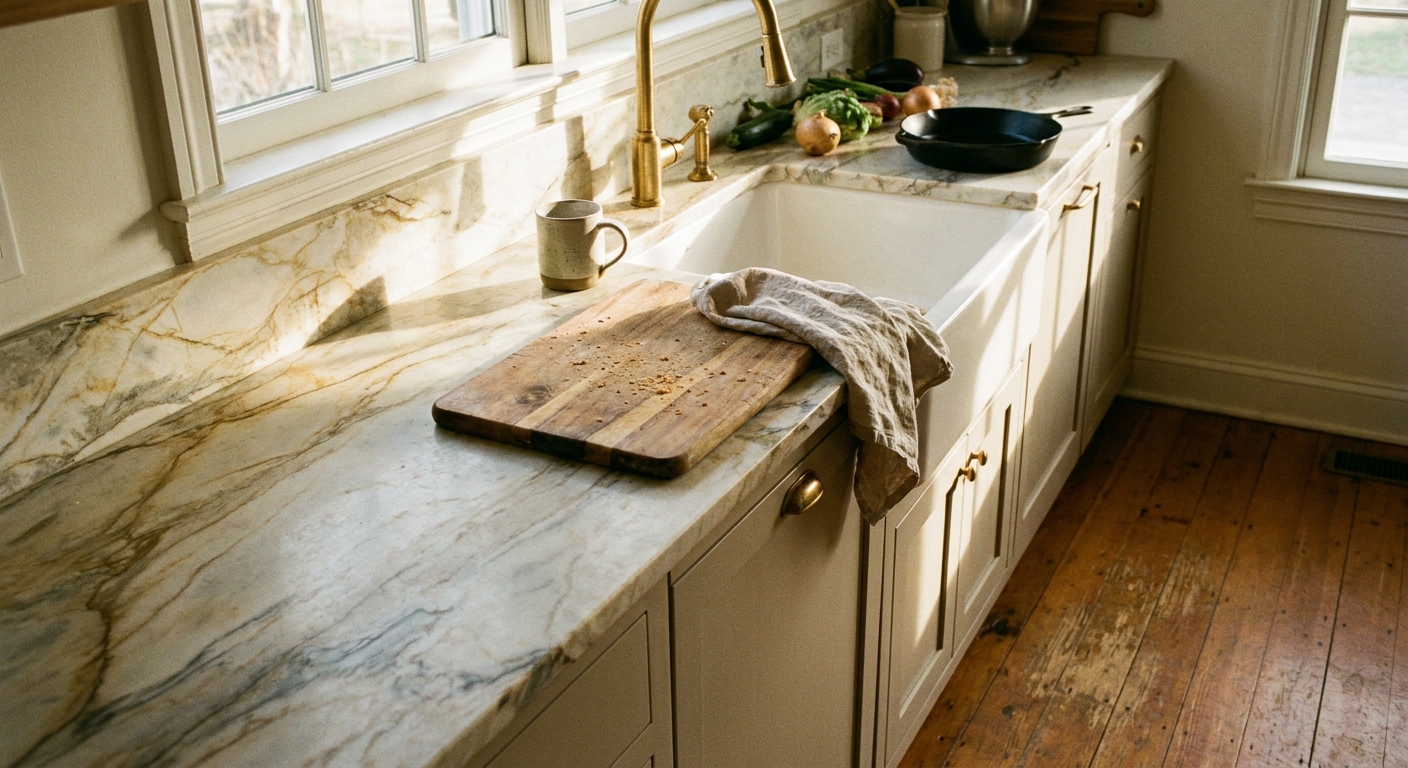
Quartzite vs quartz
Quartzite
Quartzite starts as sandstone and becomes a hard metamorphic stone under heat and pressure. It is mostly quartz minerals, but it is still a natural stone with variability from slab to slab, including tiny fissures and pockets that can absorb liquids (some quartzites are very low-porosity, others are not). Most quartzite countertops are sealed to slow down staining.
One extra wrinkle worth knowing: some stones sold as “quartzite” are not true quartzite. A few are dolomitic marble or mixed-composition stones that behave more like marble when acid shows up. If your “quartzite” seems unusually etch-prone, that may be why.
Quartz
Quartz countertops are engineered stone: crushed quartz plus binders and pigments, pressed into a slab. Many are very stain resistant and do not need sealing, but they can be sensitive to heat because resins do not love hot pans. Most manufacturers still recommend trivets and hot pads as standard practice.
Quick cheat sheet
- Etching (dull spot from acid): True quartzite is generally very acid-resistant, so etching is uncommon. But it can still happen on certain slabs (especially if the stone contains carbonate minerals, has a reactive vein, or was mislabeled as quartzite).
- Staining (darkened spot that soaks in): Quartzite can stain if unsealed or if the sealer is worn. Quartz is typically more stain resistant.
- Heat marks: Quartzite handles heat better than quartz in general, but thermal shock is still a thing. Quartz can discolor, scorch, or crack from heat because of resins.
What etching looks like
Etching is a surface change, not a “spill that soaked in.” Think of it like a faint, cloudy fingerprint or a spot that looks slightly matte compared to the surrounding shine. You notice it most when sunlight hits the counter at an angle.
Here’s the tricky part: many people call any mark an “etch.” On quartzite, what you are seeing might actually be:
- Loss of sealer performance in one spot (especially near sinks where cleaners get used more).
- A residue haze from citrus, wine, vinegar-based products, or soap that dried on the surface.
- True dulling or etching if your slab has reactive minerals or veins, or if it is not true quartzite.
If the spot looks different but feels perfectly smooth, you are likely dealing with a surface issue. If it feels rough or catches your fingernail, you might be looking at a tiny chip, scratch, or a fissure opening up.
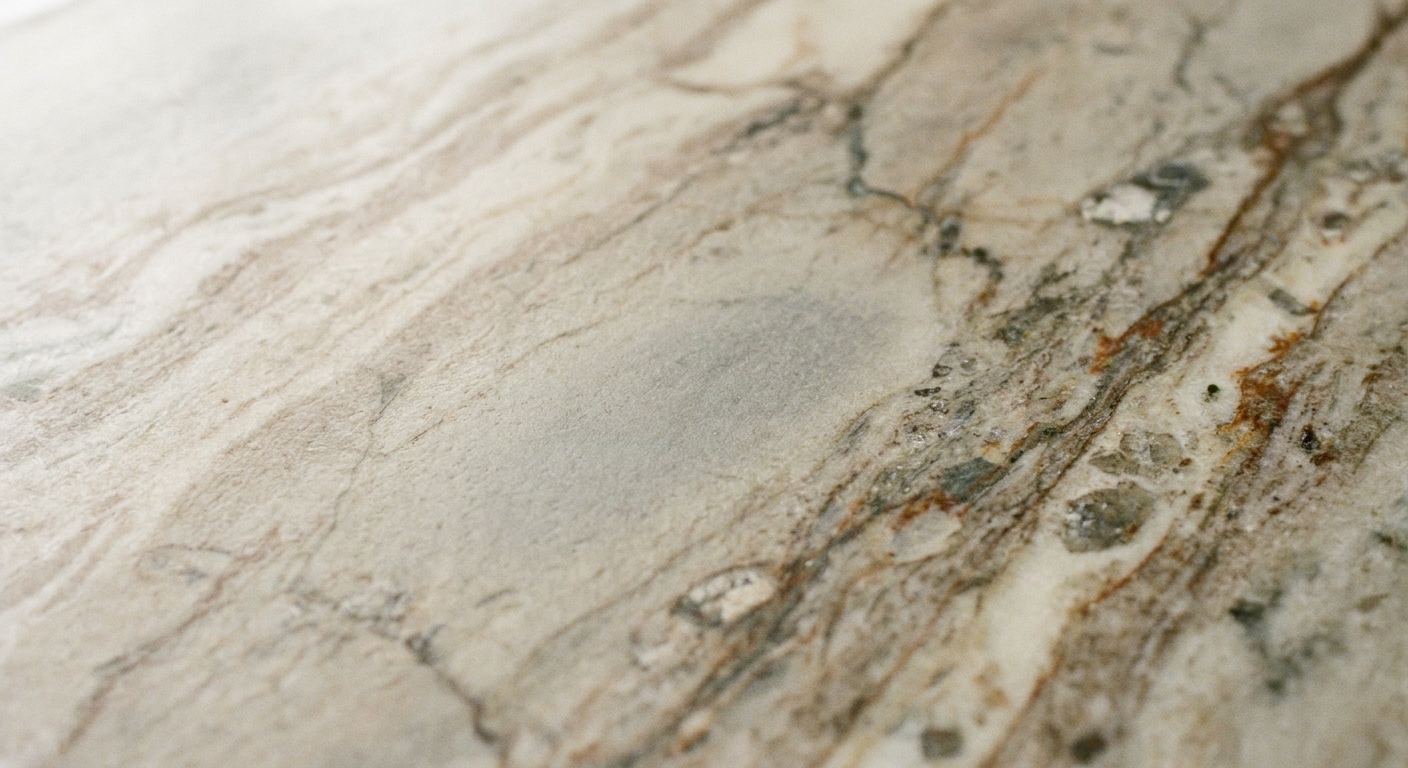
Stains vs heat marks
Stains (absorption)
On quartzite, stains often look like a slightly darker spot that does not change much when you view it from different angles. Common culprits:
- Olive oil and cooking grease
- Coffee and tea
- Red wine and berries
- Turmeric and curry
- Rust rings from cans or cast iron left to “dry” on the stone
Heat marks (thermal stress or discoloration)
Quartzite is generally happy with heat, but sudden temperature swings can still cause problems. Heat damage can show up as:
- A lightened or slightly “fried” looking patch
- A network of tiny cracks (rare, but possible with thermal shock)
- A change in finish, especially on polished surfaces
On quartz countertops, heat marks are more common and can include resin scorching or permanent discoloration.
Daily routine
If you do only three things, do these:
- Wipe daily with warm water and a pH-neutral soap, then dry with a soft cloth.
- Blot spills fast, especially oil, wine, and citrus.
- Use trivets under hot pans and small appliances, even if your stone “can take it.”
Avoid harsh, acidic, or abrasive cleaners. Anything with vinegar, lemon, or “limescale remover” energy tends to cause trouble over time, either for the stone, the finish, or the sealer.
Common household products to keep off your quartzite (and off your quartz, too):
- Glass cleaners (many are ammonia-based, like Windex-style sprays)
- Bleach and bleach sprays
- Disinfecting wipes (like Clorox-style wipes, especially as an everyday cleaner)
- Magic Erasers (melamine is a micro-abrasive and can leave dull patches)
- Bathroom cleaners and CLR-type limescale removers
- Degreasers and highly alkaline cleaners
Spills
This is the kitchen equivalent of not rubbing a stain into a vintage linen napkin.
Do this
- Blot with a clean, dry cloth or paper towel.
- Clean with a little mild dish soap and warm water.
- Rinse with clean water.
- Dry the area fully. Leaving water to air-dry can leave a dull film, especially near the sink.
Not this
- Do not let citrus, wine, vinegar, or tomato sauce sit “until after dinner.”
- Do not use abrasive powders, scrubby pads, or Magic Erasers.
- Do not mix DIY “stone cleaner” recipes from the internet. Many are basically acid in a trench coat.
Heat
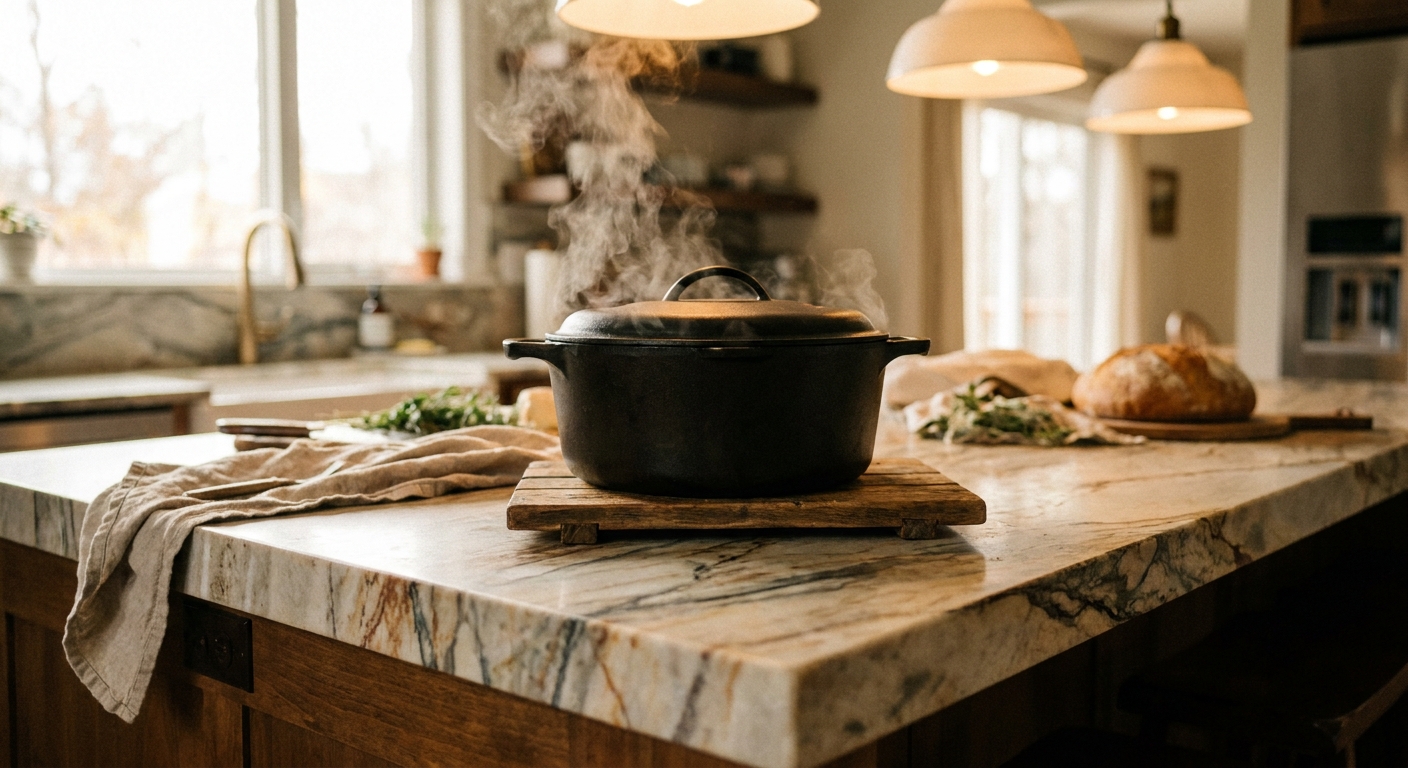
I know. Quartzite feels like the countertop that can survive a small apocalypse. And most of the time, it can handle a warm pot without drama. The issue is not just maximum temperature, it is thermal shock: going from cold to very hot quickly, or concentrating heat in one spot for a long time.
Use protection for:
- Cast iron straight from the oven
- Sheet pans
- Slow cookers, air fryers, and toaster ovens (they radiate heat for hours)
- Hot mugs sitting in the same spot every morning
A pretty wood board or a vintage trivet becomes part of your styling anyway. Form and function, happily holding hands.
Scratches and cutting
Quartzite is hard, but “hard” is not the same as “scratch-proof.” Grit under a plate, a dragged ceramic mug, or a knife used directly on the stone can leave marks, especially on honed finishes.
- Use cutting boards for knives (your knives will thank you).
- Lift, do not drag heavy pots, small appliances, and rough-bottomed ceramics.
- Watch the grit: crumbs and sand-like debris are tiny sandpaper.
Chips and edges
Quartzite is hard, but edges are still vulnerable because that is where impact concentrates. The most common chip zones are:
- Sink cutouts
- Dishwasher corners
- Overhangs and breakfast bar edges
- Right by the trash pullout, where life gets a little chaotic
If you spot a chip
- Save the fragment if you find it.
- Do not pick at it or try to “sand it smooth.”
- Call a stone pro for a fill and polish. Small chips are usually repairable and can disappear beautifully when done right.
If you are renting, document it with a clear photo in daylight and notify your landlord. Repairs are often less expensive than you think, and the sooner you address it, the cleaner the repair.
Sealer basics
Many quartzite countertops are sealed at installation, but sealers wear down with cleaning and daily use.
A quick at-home clue (not a laboratory test, but helpful): place a few drops of water on the surface and watch for about 10 to 15 minutes.
- If the stone darkens noticeably within that window, it is absorbing water and the sealer may be worn.
- If it stays looking the same, your surface is resisting absorption well (some sealers bead dramatically, some do not, so darkening is the more useful signal).
How often to reseal? It depends on the stone, finish, sealer, and how you live. Many households land around every 1 to 3 years, but your countertop gets the final vote. Do not rush to reseal constantly. Overapplying or using the wrong product can create haze or streaks that look like “etching” but are really just unhappy chemistry on the surface.
Dull spots
Because quartzite and quartz get lumped together online, this is where people accidentally do the most damage. Quartzite is stone, and restoring a finish is more like refinishing wood than wiping down glass.
Try this first
- Wash with warm water and a drop of gentle dish soap.
- Rinse thoroughly.
- Buff dry with a clean microfiber cloth.
- If you suspect residue, use a stone-safe, pH-neutral cleaner and follow label directions.
Avoid risky DIY fixes
- No DIY grinding, honing, or sanding. Even “fine” abrasives (including Magic Erasers and abrasive creams) can create a bigger, more obvious low-sheen patch.
- No acidic cleaners to “cut the haze” (vinegar, lemon, bathroom descalers, CLR-type products). They can worsen dulling and degrade sealer.
- No harsh chemicals like bleach or ammonia-based sprays. They can discolor or degrade finishes and sealers over time.
- No random polishing compounds meant for cars or metal. Different world, different chemistry.
When to call a pro
If the spot persists after gentle cleaning and drying, a stone restoration pro can assess whether you need a localized polish, a light hone, or simply a reseal. Especially on polished quartzite, matching sheen is an art. Paying for expertise here is often cheaper than living with a permanently “different” patch you see every morning.
Stain removal
If a stain has moved in and unpacked its bags, stop escalating the cleaner strength and switch strategies.
- Start simple: gentle soap, rinse, dry.
- For true absorption stains, consider a commercial stone poultice made for natural stone. Follow the product directions closely (yes, the boring part matters here).
- Know when to stop: if the stain is spreading, the finish is changing, or you are considering bleach, CLR-type removers, or abrasive scrubbing, tap out and call a pro.
Bonus tip: take a photo before you treat it. Stains can lighten slowly, and your eyes will play tricks on you day to day.
If you own quartz
Welcome, friend. Quick notes so you do not apply stone advice to engineered quartz:
- Do not put hot pans directly on quartz. Use trivets faithfully. Most brands recommend protection regardless of “how quick” the pan contact is.
- Quartz does not etch like marble, but harsh chemicals and strong acids can still dull the surface or discolor it.
- Skip sealing. Most quartz does not need it.
- Avoid abrasives (including Magic Erasers) if you want that factory sheen to stay looking factory.
If you are unsure what you have, look at an underside seam or ask for the installation paperwork. Quartz often has a more uniform pattern repetition, while quartzite has natural variation and depth that feels almost like a landscape.
Fast rules
- Blot fast: wine, citrus, oils, coffee.
- Soap and water wins: pH-neutral, gentle, and consistent.
- Skip the usual suspects: glass cleaner, bleach, disinfecting wipes as daily cleaner, Magic Erasers, CLR-type descalers.
- Trivets always: hot pans, small appliances, cast iron.
- Cutting boards always: protect the finish and your knives.
- Do not DIY hone: call a pro for finish restoration.
- Know your material: quartzite is sealed natural stone, quartz is engineered.
Your countertops should be beautiful, yes. But they should also be lived on. The goal is not perfection, it is confidence. A calm routine, a couple of good habits, and the right expectations will keep quartzite looking like itself for years.