Pressed-Wood Furniture Smell: How to Get Rid of It

Clara Townsend
The first time I brought a brand-new flat-pack dresser into a tiny apartment bedroom, I was so proud of myself. Clean lines, plenty of storage, shockingly affordable. Then the smell hit. Not “fresh wood” cozy. More like a sharp, plasticky, nose-tingly cloud that made the whole room feel thick and chemical.
If you're dealing with that chemical smell from a new bookcase, dresser, nightstand, or desk made with particle board, MDF, or laminate, you're not alone. The good news is that most of the time it fades, and you can speed it up with a few practical steps before the piece perfumes your whole home.

Why pressed-wood furniture smells
Most budget-friendly “wood look” furniture is made from engineered wood. Common types include:
- Particle board (small wood chips pressed into a board)
- MDF (medium-density fiberboard, made from very fine wood fibers)
- Plywood (thin wood layers glued together)
These materials are held together with resins and adhesives. On top, you often have laminate, melamine, or a veneer finish, plus edge banding and sometimes a factory coating. All of those components can release a mix of volatile organic compounds as they cure and adjust to your home's air. That release is often called off-gassing.
Two important realities:
- Heat and humidity often make it stronger. A boxed piece in a warm room can smell intense the first few days.
- More enclosed spaces hold odors longer. Which is why drawers are usually the worst offenders.
Where the odor comes from
If you sniff around (gently, no need to huff your furniture like it's a wine tasting), you'll usually notice the odor is strongest in a few spots:
- Drawer boxes and interiors: lots of unfinished pressed wood surface area, plus adhesive from slides and edge banding, all trapped in a closed space.
- The back panel: often thin fiberboard or hardboard, sometimes with a strong “factory” smell that drifts forward when the piece sits against a wall.
- Cabinet interiors and adjustable shelves: especially if the interior is unsealed or only lightly coated.
- Any exposed cut edges: these can off-gas more than sealed faces.

Air it out first
My best advice is boring, but it's the one that works most consistently: air it out aggressively before it lives where you sleep. If you can, do your “break-in” phase in a garage, covered patio, spare room, or a well-ventilated living area.
Step-by-step plan (48 hours to 2 weeks)
- Unbox outside if possible. Packaging can hold odors too, and you do not want that concentrated smell blooming indoors.
- Assemble, then open everything. Remove drawers, open doors, and take out shelves.
- Give it airflow on all sides. Pull it away from walls. If you can safely tilt it slightly so the back panel is exposed to moving air, even better.
- Create cross ventilation. Open windows on opposite sides of the room, or open one window and run a fan pointing out to exhaust air.
- Keep the room cool and dry when you can. Lower humidity often helps the space feel less intense. If you have a dehumidifier or AC, this is their moment.
Timing: Some pieces calm down in 2 to 4 days. Others take 1 to 3 weeks, especially dressers with many drawers or anything that arrived very tightly shrink-wrapped.
Odor reducers that help
Ventilation is the main event. Odor reducers are the supporting cast. They can help, especially inside drawers and cabinets where air barely circulates.
What helps
- Baking soda: Place a shallow bowl or an open jar in each drawer or cabinet. Leave 24 to 72 hours, then swap for fresh.
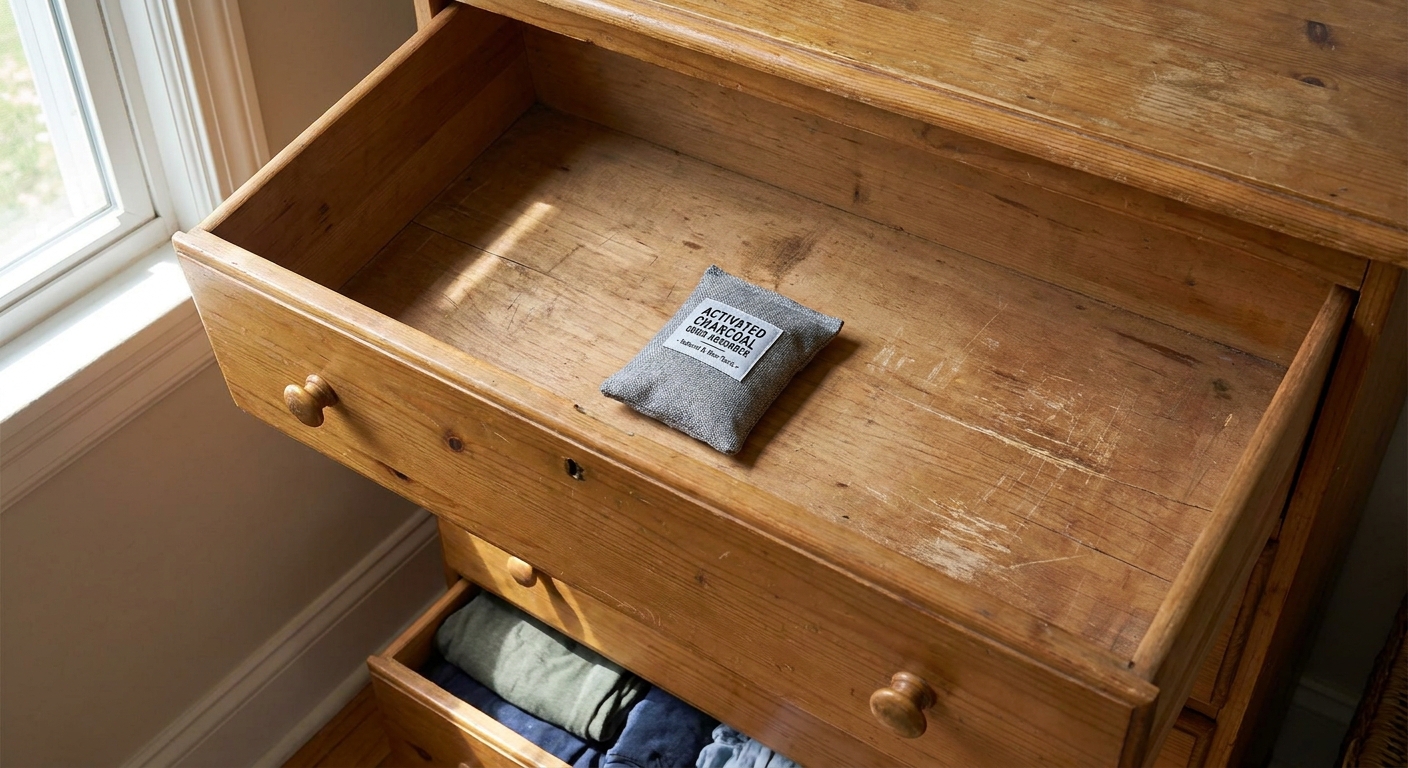
- Activated charcoal: Charcoal odor absorbers can be more effective than baking soda in tight spaces. Put one in each drawer and close the drawer to let it work.
- Crumbled kraft paper or plain brown paper bags: This is an old-school trick, and I have had decent luck with it in stubborn drawers. Stuff drawers loosely with paper and replace every day or two.
- Sunlight (with caution): A few hours of indirect sun and fresh air can help drawers a lot. Avoid harsh direct sun for long periods, which can warp thin panels or fade finishes.
- An air purifier with a carbon filter: If you already have one, running it near the piece can help with lingering odors in the room. Carbon filters vary a lot, and they eventually saturate, so this is a helper, not a magic eraser.
What I skip
- Scent sprays to mask it: You end up with chemical smell plus perfume. Also, some sprays can leave residue inside drawers.
- Vinegar wipedowns on laminate: Lightly diluted vinegar is fine for many surfaces, but it does not neutralize off-gassing. It can also dull certain finishes if overused.
- Ozone generators: Ozone is a lung irritant and is not recommended for occupied spaces. It can also degrade rubber and some plastics over time. Not a casual home hack.
If you want the inside of drawers to smell pleasant once the chemical odor is mostly gone, line them with paper or fabric liners and add a cedar block or sachet. Do this after the off-gassing phase, not instead of it.
Drawer odor reset
Drawers are notorious because they're little odor vaults. Here's the routine I use when a dresser is otherwise perfect but the drawer smell is lingering:
- Remove all drawers and set them upright (so air can move inside them).
- Sprinkle baking soda in a bowl, or use activated charcoal pouches inside each drawer box.
- Point a fan so it moves air across the drawer openings (aim across, not straight in).
- Repeat for several days, rotating drawers so each one gets equal airflow.
- Wipe the drawer interior lightly with a barely damp cloth, then dry immediately. You're not washing out the smell, you're removing any dusty manufacturing residue that can hold odor.
If you must use the dresser right away, keep clothes in breathable bins or fabric organizers inside the drawers for the first week. It creates a buffer so your clothing does not pick up the smell.
What labels really mean
Furniture listings love reassuring language, and some of it does matter. Here's how I read common labels, in plain English.
CARB Phase 2 compliant
This generally refers to limits on formaldehyde emissions from certain composite wood products. It's a good sign, but it does not mean “zero smell” and it does not cover every possible VOC from coatings, edge banding, and packaging.
TSCA Title VI compliant
This is the federal US rule that aligns with similar formaldehyde emission limits. Again, helpful. Not a guarantee that you will not notice an odor when it's brand new.
Low-VOC or no added formaldehyde (NAF)
These can be meaningful, but they're not always standardized across brands. “No added formaldehyde” typically refers to the resin system used in the engineered wood, not necessarily every finish or adhesive in the whole piece.
Greenguard and Greenguard Gold
These certifications are often associated with stricter testing for chemical emissions, including use in sensitive environments. If odor is a major concern for you, looking for these labels can be a smart shopping filter.
One more note from experience: a piece can be compliant with emission limits and still smell stronger than you expected at first, especially if it was sealed in a box for weeks in transit.
Can you seal in the smell?
Sometimes, yes, but I treat sealing as a last step, not the first. You want to off-gas what you can first, then seal if you still have a stubborn problem area.
Where sealing can help: unfinished drawer bottoms, raw interior panels, and exposed cut edges.
What to use: A low-odor water-based sealer can reduce emissions from raw composite wood surfaces. If you go this route, follow the product directions closely and let it cure fully with strong ventilation before the furniture returns to a bedroom.
Important: Sealing can change sheen or texture, and it's not always recommended on laminated surfaces. If your piece is under warranty, sealing could also affect returns. I'd only do it when you're sure you're keeping the item.
How long it should last
There's a normal range and then there's a “something is off” range.
- Typical: Strong odor the first 2 to 7 days, then noticeably better week by week.
- Stubborn but still plausible: 2 to 4 weeks for dressers, large wardrobes, and pieces with lots of enclosed storage.
- Concerning: No improvement after 2 weeks of real ventilation, or the smell is so strong it causes headaches, burning eyes, nausea, or triggers asthma symptoms.
Your nose is not being dramatic. Bedrooms are small, and we spend hours there with the door closed. If the furniture makes the room feel uninhabitable, it's worth taking seriously. If symptoms are severe or persistent, prioritize fresh air, remove the source, and consider talking with a clinician.
When to return it
I'm all for making budget pieces work, but I'm not interested in toughing it out with an odor that affects your health or daily comfort.
Consider returning the item if:
- The odor is overpowering right out of the box and smells sharply solvent-like, not just “new product” smell.
- You have strong symptoms (headaches, dizziness, wheezing, eye irritation) that stop when you leave the room.
- It does not improve after 10 to 14 days of proper airing out, drawers removed, and odor absorbers used.
- You see damage or dampness: a piece that got wet in shipping can hold musty chemical odors and may never fully recover.
- The smell transfers to fabrics even after a couple of weeks, especially in a nursery or a small bedroom.
If you're within the return window, I'd rather you return and choose a different piece than spend months trying to fix something that should've been livable from the start.
Small-space tips
If you live in a studio or a small apartment, you cannot always quarantine a piece. Here's the gentlest way to live with it while it calms down:
- Keep windows cracked for short periods throughout the day, even 10 minutes at a time.
- Run an exhaust fan in the bathroom or kitchen to pull air out.
- Do not store textiles inside immediately: towels, bedding, and sweaters are odor magnets. Give it a few days at least.
- Leave drawers slightly ajar when you can, especially during the day.
- Use charcoal in every drawer for the first week.
FAQ
Is the smell formaldehyde?
It can be, but “new pressed-wood smell” is usually a mix of emissions from resins, finishes, and adhesives. Some products specifically limit formaldehyde emissions, but odor alone cannot identify one chemical.
Will the smell ruin my clothes?
It can temporarily transfer, especially to natural fibers like cotton and wool. Air the furniture out first, use charcoal or baking soda inside drawers, and consider drawer liners once the odor has mostly faded.
Do coffee grounds work in drawers?
Coffee grounds can absorb some odors, but they can also spill, stain, and add their own strong scent. I prefer activated charcoal or baking soda for clean, predictable results.
Can I speed it up with heat?
Heat can increase off-gassing, which might sound helpful, but it can also make the room air feel worse if ventilation is not strong. I get better results with airflow first, plus cooler temps and lower humidity when possible.
Should I worry more in a nursery?
I'd be extra cautious in any room where someone sleeps for long stretches, especially babies and kids. Air it out thoroughly before it goes in, prioritize stricter certifications when you can, and return the piece if the odor is intense or persistent.
Once it smells normal
After the smell fades, this is when I make it feel like home: crisp drawer liners, a little cedar block, maybe a sachet that smells like actual life and not a shipping container. The goal is not to cover a chemical odor. The goal is to start fresh once the furniture is truly ready to live with you.