Pet Urine Stains on Area Rugs

Clara Townsend
Clara Townsend is an interior stylist, vintage furniture enthusiast, and the creative voice behind Velvet Abode. With over a decade of experience transforming both cramped city apartments and sprawling fixer-uppers, she believes that a beautiful home is built on personal stories rather than massive budgets. When she isn't hunting for the perfect brass sconce at a local flea market, she can usually be found rearranging her living room for the third time this month.
Area rugs are the soft landing spots of a home, which also makes them prime real estate for pet accidents. The tricky part is that urine does not just sit on the surface. It travels down through the pile, into the foundation of the rug, and sometimes into the pad and even the floor beneath. That is why “it looked clean” can still smell like regret a day later.
The good news: enzyme cleaners can work beautifully on area rugs when you use them like a slow, patient recipe instead of a quick spray-and-pray. The key is moisture control (especially around backing and fringe), the right dwell time for your rug’s fiber, and a reliable odor recheck once everything is truly dry.
Before you start: rug type and risk
Enzyme cleaners are often dye-safe, but not universally. Some formulas include surfactants, solvents, or fragrance that can affect dyes or finishes, and the process around them can cause damage too (over-wetting, scrubbing, and letting moisture sit in the backing). Take two minutes to figure out what you are working with and follow the label.
Quick fiber clues
- Wool: feels springy and warm, often has a subtle “sheep” scent when damp, may shed a little fuzz. Wool dislikes high alkalinity, aggressive agitation, and lingering moisture.
- Synthetics (nylon, polypropylene, polyester): usually feel slicker and more uniform. They are more forgiving, but urine can still soak into the backing and pad.
- Jute, sisal, seagrass: looks matte and plant-like with thick, ropey strands. These fibers stain easily with water and can brown or warp if over-wet.
- Viscose/rayon (“art silk”): looks silky and shiny, often very soft. It can water-spot, lose sheen, or get pile distortion from moisture. DIY urine treatment is risky here.
Do a dye test every time
Even “colorfast” rugs can surprise you, especially vintage pieces and hand-dyed wool.
- Choose a hidden spot (under a sofa leg is perfect).
- Apply a tiny amount of your enzyme cleaner diluted as directed.
- Press with a white cloth for 10 to 20 seconds.
- If you see color transfer or a finish changes (sticky, dulled, stiff), stop and switch to a professional cleaner experienced with rugs.
Blotting helps, but it is not enough
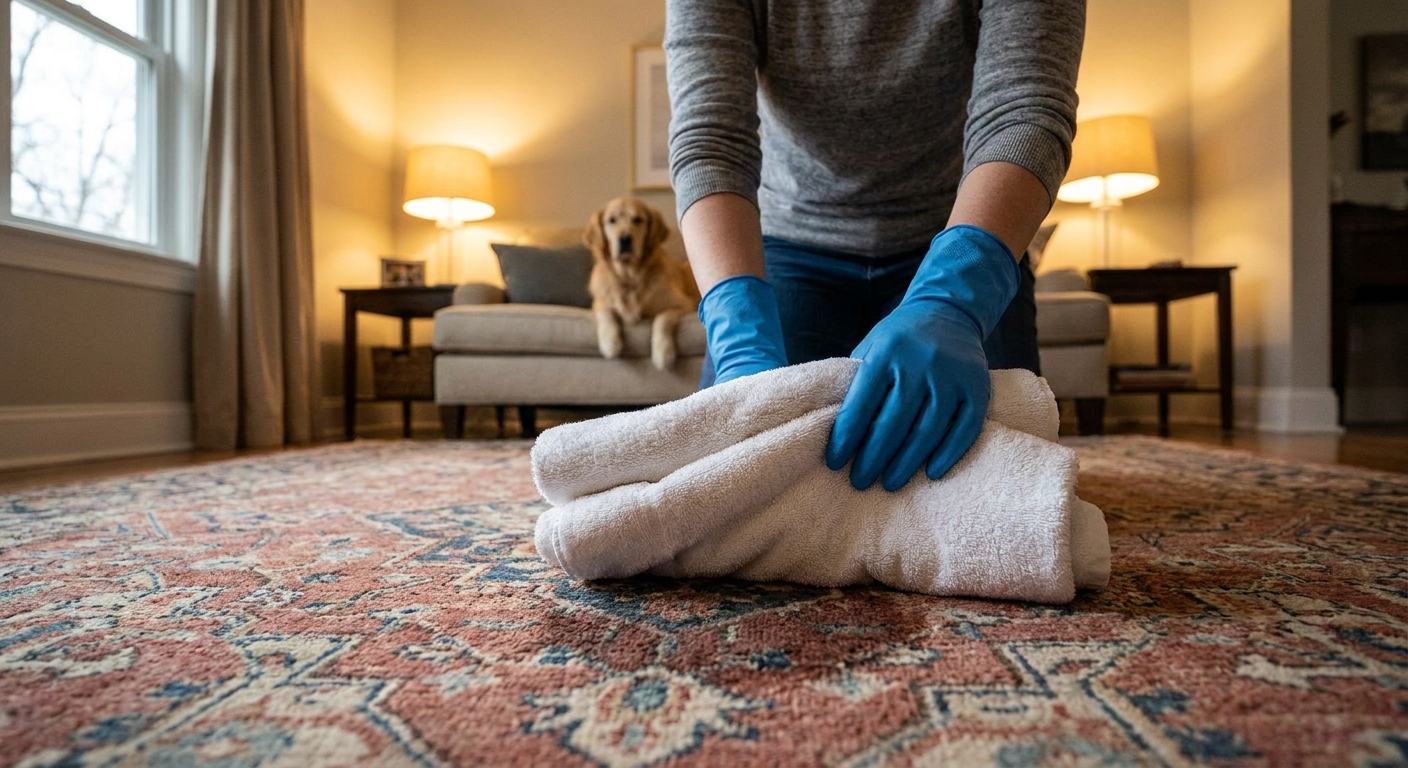
Blotting is essential, but it cannot pull urine out of the rug’s lower layers once it has traveled down. Think of the pile like a little forest and the backing like the soil. A towel can drink what is on the “leaves,” but the problem often lives in the “ground.”
Blot correctly first
- Do not rub. Rubbing pushes urine deeper and roughs up fibers.
- Use pressure. Stand on a stack of clean white towels to pull up as much liquid as possible.
- Work from the outside in. This keeps the stain from spreading.
Once you have blotted as much as possible, the next step is not more elbow grease. It is controlled saturation with enzymes, followed by controlled extraction with towels.
Enzyme cleaners 101
Pet urine odor comes from uric acid crystals and other waste compounds. Enzyme cleaners use enzymes (sometimes paired with beneficial bacteria) to break those materials down. They are not instant, and they need moisture and time to do their job.
- Enzymes need contact. If you only mist the surface, you only treat the surface.
- Enzymes need time. If you blot too soon, you remove the cleaner before it finishes working.
- Enzymes do not like other cleaners. Avoid mixing with vinegar, ammonia, bleach, peroxide, or heavy detergent unless the product label specifically allows it. Residues can reduce effectiveness or increase dye risk.
Choose a pet-specific enzyme product with clear directions. If your rug is valuable, vintage, or hand-knotted, pick an enzyme cleaner that is labeled safe for wool and natural fibers.
Step-by-step: enzyme cleaning
1) Find the full spread
Urine spots are often larger underneath than they look from above. If you have a UV flashlight, dim the room and check. UV can show likely contamination, but it is not a perfect lie detector. Some detergents, optical brighteners, and rug adhesives can glow too. Use it to map where to treat, then trust your nose on the recheck.
2) Protect what is under the rug
This is the step most people skip, and it is how you end up with a clean rug and a smelly pad or damaged floor.
- Slide a sheet of plastic or a trash bag under the stained area.
- If there is a rug pad, consider lifting the rug and separating the pad so moisture does not get trapped.
3) Apply enzyme cleaner to match the depth
The goal is to reach the same depth the urine reached. For most accidents, that means the pile and at least into the base of the rug.
- Lightly blot again if the area is still damp.
- Apply enzyme cleaner so the area is evenly damp through the pile, not puddling or flooding outward.
- Use your fingers (gloved) to gently lift and separate fibers so the solution can sink in. No scrubbing.
4) Let it dwell (cover to keep it active)
Enzymes work best when they stay damp. Covering slows evaporation and helps the cleaner keep working.
- Cover the area with plastic wrap or a clean plastic bag.
- Set a timer for your fiber type (see the dwell-time section).
5) Blot and towel-extract
After dwell time, blot with clean towels until you are no longer pulling up moisture. Replace towels as they get wet. For thicker rugs, place towels over the spot and stand on them for 30 to 60 seconds at a time.
6) Rinse lightly if the label says so
Some enzyme products are designed to be left to dry. Others recommend a light water rinse after treatment. Follow the label. If rinsing is recommended, use as little clean water as possible and blot thoroughly. Residue can attract dirt later.
7) Dry fast and evenly
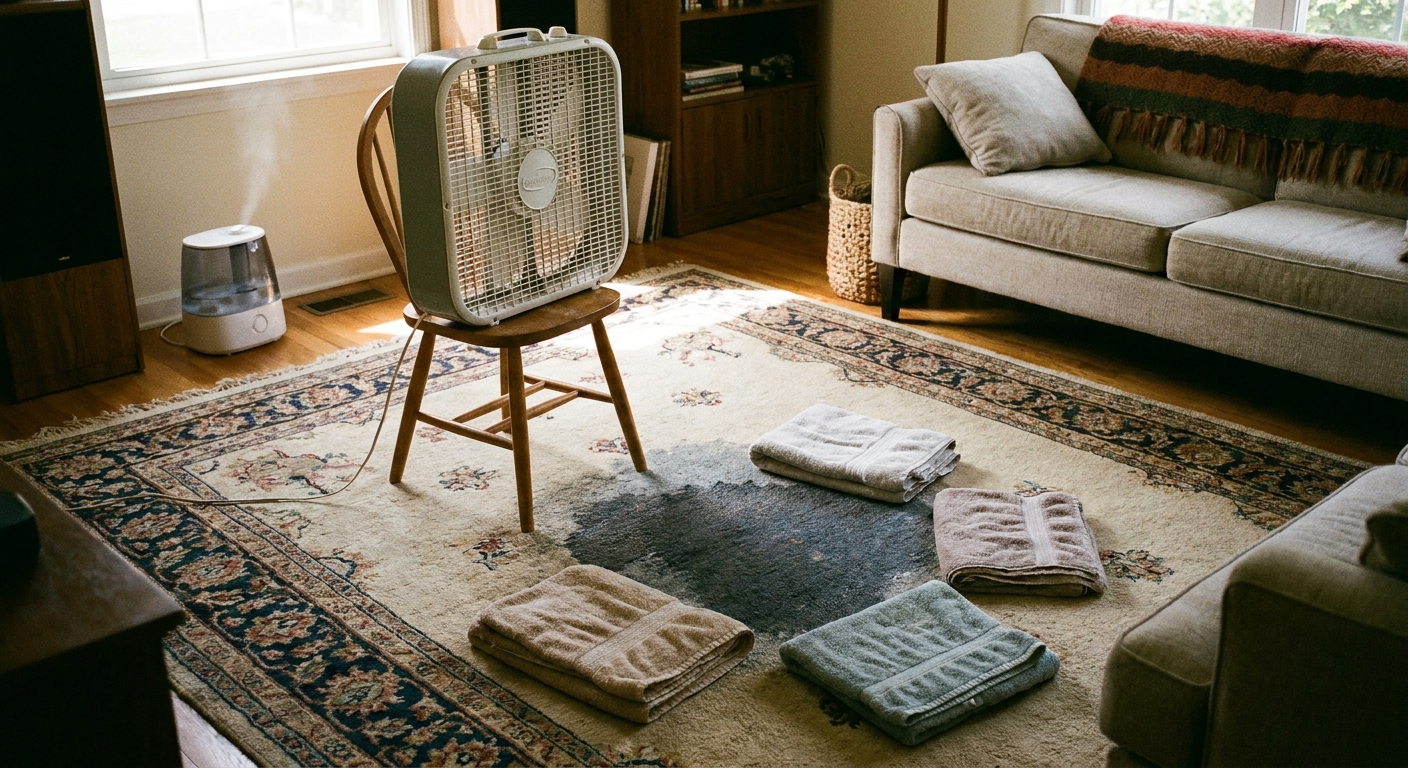
- Set up a fan so air moves across the surface.
- If possible, lift the rug slightly so air can circulate underneath.
- A dehumidifier helps a lot in humid climates.
- Avoid high heat on wool and natural fibers. Heat and moisture together can increase risks like felting, shrinkage, dye movement, and slow drying.
Fresh vs. old urine
Fresh accidents are usually the easiest win: blot, treat, dwell, extract, dry.
Old or dried urine is different. The odor source can be set deeper, and the area may need rehydration to let enzymes reach what they need to break down. In real life, that often means a longer dwell time (if fiber-safe), multiple careful applications, or professional flushing and extraction if the backing or pad is involved.
Dwell times by fiber
Always follow your product’s label first. Use these ranges as typical starting points for many pet enzyme formulas, especially when directions are vague. Some set-in odors need longer contact times or repeated treatments, but your rug’s fiber and dyes set the safety limits.
Wool rugs
- Dwell time: 15 to 30 minutes for fresh urine, up to 45 minutes for older spots if dye testing was good.
- Why shorter: Wool is more sensitive to prolonged moisture, and some dyes can shift if left wet too long.
- Extra tip: Keep the area just damp, not soaked. Better to repeat a second treatment than over-wet once.
- Avoid: Oxygen bleach or peroxide on wool unless the product label explicitly says it is wool-safe.
Synthetic rugs
- Dwell time: 30 to 60 minutes, sometimes up to 90 minutes for stubborn odor (or repeated applications).
- Why longer: Synthetics tolerate moisture better, and urine often wicks into the backing.
- Extra tip: Pressing with towels after dwell time makes a huge difference. Odor hangs out where moisture hangs out.
Jute, sisal, and plant fibers
- Dwell time: 10 to 20 minutes maximum, with minimal product and minimal water.
- Why cautious: These fibers can darken, brown, or water-mark. They also dry slowly, especially over a pad.
- Best practice: If the urine reached the backing or pad, consider professional rug cleaning. DIY spot cleaning on jute can create a bigger “clean” circle than the original stain.
Viscose/rayon
- Dwell time: Not a great DIY candidate.
- Why: Moisture can cause water spotting, texture change, and pile distortion that looks worse than the stain.
- Best practice: Blot immediately, protect the floor, then call a rug specialist.
Backing and pad: the hidden trap
Many area rugs have a latex or adhesive backing, and many sit on thick felt or rubber pads. That combo is cozy underfoot and terrible for drying. When urine or cleaner gets trapped, bacteria keep working and the smell can return even after a “successful” surface clean.
Signs the backing or pad is involved
- The spot feels cool or damp hours later.
- Odor is stronger when you sniff close to the floor level.
- The stain keeps reappearing as a faint yellow ring.
What to do
- Separate rug and pad. Clean and dry them independently whenever possible.
- Check the floor. Sealed hardwood is easier to clean than unfinished wood, which can absorb urine.
- Dry from both sides. If the rug is small and flexible, flip it once you have blotted so airflow can reach the foundation.
If the rug has a thick backing that seems to hold moisture, that is a strong hint that professional extraction will outperform home methods.
Odor recheck steps
Urine odor is sneaky because it can disappear while the rug is wet and come roaring back as it dries. Recheck in a way that actually tells you the truth.
When to recheck
- First check: once the rug feels fully dry to the touch.
- Second check: 24 hours later, especially in humid weather.
How to recheck
- Get your nose close to the rug and sniff from multiple angles.
- Smell the underside if you can safely flip a corner.
- If you used a UV light at the start, check again in a dark room and remember it shows “likely,” not “certain.”
If odor remains, repeat the enzyme treatment once. If odor persists after two careful rounds, it is usually because contamination reached the pad, backing, or floor, or because the rug needs deeper extraction than towels can provide.
What not to do
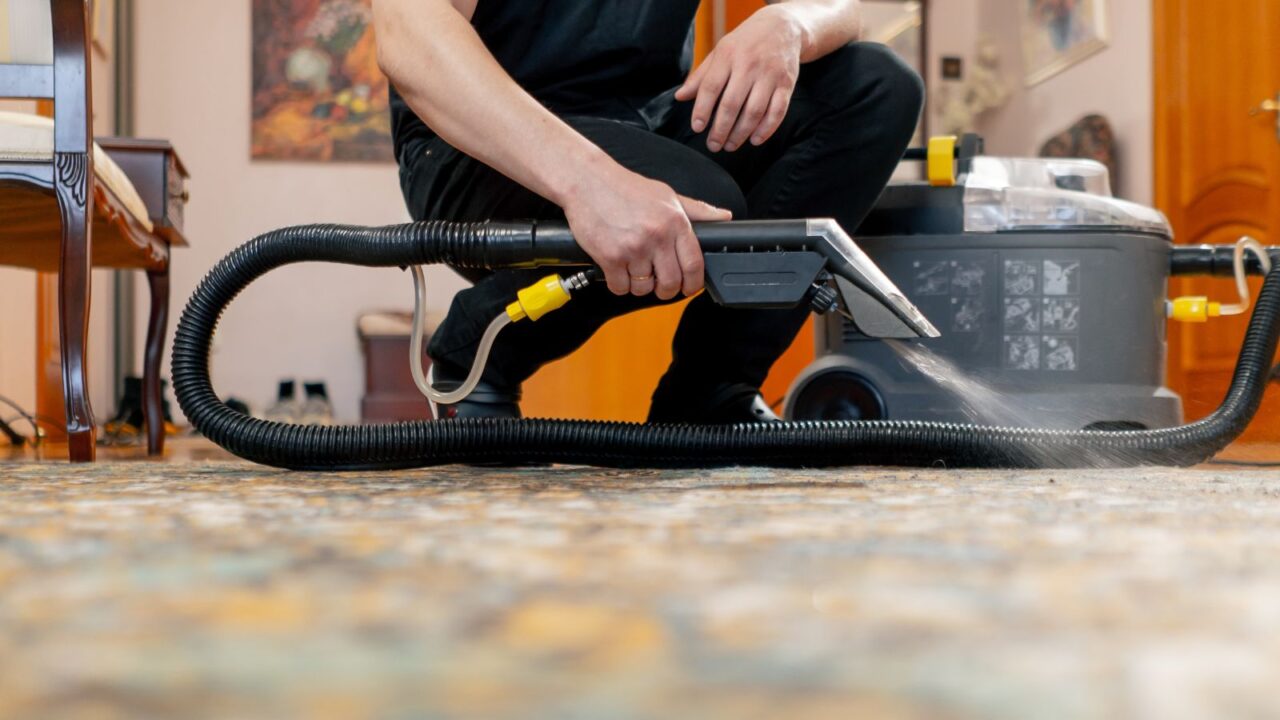
- Do not steam clean wool or natural fiber rugs at home. The bigger risks are felting/shrinkage, dye bleed, and over-wetting that dries too slowly.
- Do not use ammonia-based cleaners. Ammonia smells like urine to pets and can encourage repeat marking.
- Do not dump vinegar on wool. A small, controlled rinse is one thing, but soaking can stress fibers and it is not a substitute for enzymatic treatment.
- Do not scrub fringe. Fringe is often cotton and can fray, twist, or grey out quickly. Blot only.
- Do not over-wet jute. Water marks are heartbreakingly easy to create and hard to reverse.
- Do not reach for peroxide or oxygen bleach on wool. Unless the label clearly says wool-safe, it is not worth the risk.
Aftercare and repeat accidents
- Block access until fully dry. Pets are more likely to remark damp spots and drying odors can be confusing.
- If accidents are sudden or frequent: consider a vet check. Changes in urination can be medical, not behavioral.
- Deterrence helps: once the area is clean and dry, a pet-safe deterrent spray (label-approved for your rug) and a routine reset can reduce repeats.
When a pro beats DIY
I love a good DIY save, but there is a point where home methods become a long, damp cycle that never fully clears the odor. Professional rug cleaners and some carpet pros with proper equipment can flush and extract urine from deeper layers in a way towels simply cannot.
Call a pro if
- The rug is hand-knotted, antique, vintage, viscose/rayon, or heavily dyed and you cannot risk color movement or texture change.
- The accident was large or repeated in the same spot.
- The rug sits on a thick pad and the smell is strongest near the floor.
- You are cleaning a rented rug and need the most reliable outcome with the lowest risk of dye damage.
- You see browning, rippling, or waviness developing from moisture.
What to ask for
- Experience with your fiber type (wool, jute, viscose blends).
- Rug-appropriate deodorization and rinse methods.
- Whether they can clean both rug and pad, or recommend pad replacement.
Save this checklist
- Blot, do not rub.
- Dye test in a hidden spot.
- Protect the floor and separate pad if possible.
- Apply enzyme cleaner to reach the same depth as the urine (evenly damp, not puddling).
- Cover and let it dwell based on fiber type and label instructions.
- Blot thoroughly, replace towels as they get wet, and dry fast with airflow.
- Recheck odor once fully dry, then again at 24 hours.
- After two careful rounds with lingering smell, switch to professional extraction.
If you want your rug to smell like your home again, not like an accident you are trying to forget, patience is the secret ingredient. Slow enzymes plus fast drying is the sweet spot, and it protects dyes far better than aggressive scrubbing ever will.