Pet Stains on Wall-to-Wall Carpet: Renter-Safe Spot Cleaning

Clara Townsend
Clara Townsend is an interior stylist, vintage furniture enthusiast, and the creative voice behind Velvet Abode. With over a decade of experience transforming both cramped city apartments and sprawling fixer-uppers, she believes that a beautiful home is built on personal stories rather than massive budgets. When she isn't hunting for the perfect brass sconce at a local flea market, she can usually be found rearranging her living room for the third time this month.
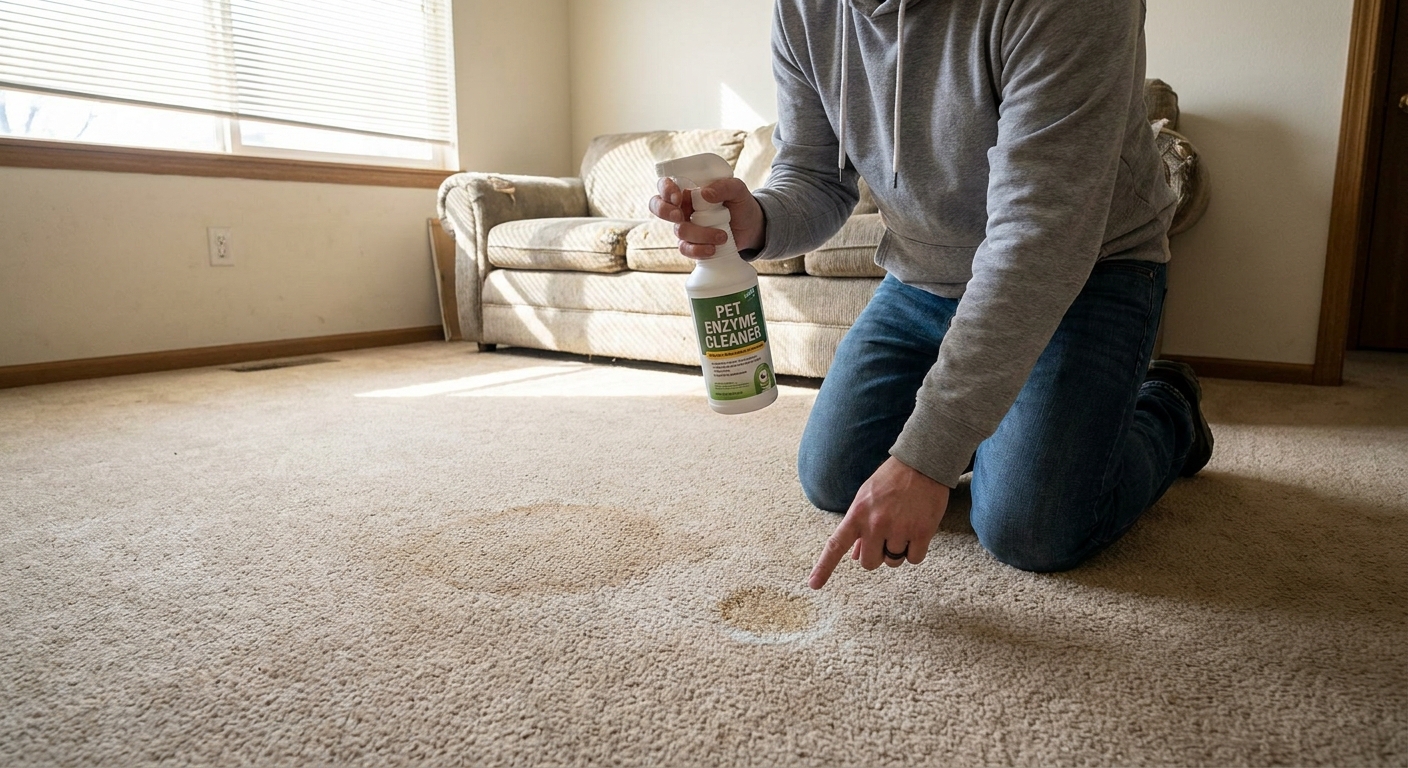
If you rent and you share your home with a pet, this moment is practically inevitable: you notice a suspicious spot on the wall-to-wall carpet and your brain immediately jumps to deposit. Take a breath. Installed carpet can be spot-cleaned very successfully, but the rules are different than an area rug because there is padding underneath and that padding loves to hold moisture and odor like a secret.
This guide is built for renters: minimal soaking, enzyme cleaner timing that actually works, a realistic limit on how deep you can clean without extraction equipment, and a calm plan for when to document and ask for professional help.
First, identify the mess
You will clean differently depending on whether the mess is fresh or dried, and whether it is mostly liquid or has fats and solids involved.
- Fresh urine: priority is pulling up as much liquid as possible before it reaches the pad.
- Dried urine: you need a controlled re-wet so enzymes can reach the crystals, then time to work.
- Vomit: remove solids first, then address fats and residue, then odor. Vomit often needs a tiny bit of mild soap before enzymes.
- Feces: remove solids, then enzyme treatment for residue and odor.
If you are not sure what it is, an enzyme cleaner is often a good choice for organic pet messes, but do a quick patch test first in a closet corner or along a baseboard edge. Some carpets and dyes can react to certain formulas.
Your renter-safe kit
You do not need a closet full of products. You need the right sequence.
- White paper towels or clean white cotton towels (white helps you see transfer and avoids dye)
- A spray bottle with cool water
- Enzyme cleaner labeled for pet urine (check that it is meant for carpet)
- A small bowl of mild dish soap solution (a few drops in 2 cups cool water)
- Soft brush or clean toothbrush (optional for textured carpets)
- A stack of dry towels plus something heavy and flat to weigh them down (a cutting board plus books works)
- Fan (highly recommended)
- Nitrile gloves
Avoid: heavy shampooing and lots of hot water. Heat can worsen odor and can make some organic stains harder to remove, especially if the area is not extracted thoroughly.
Quick safety notes: ventilate the room, keep pets and kids off the damp area, and wash hands after handling soiled towels.
Blot first (with limits)
Here is the truth that deposit panic rarely tells you: you can only blot so deep without extraction. Your goal is to remove what is in the carpet fibers and as much as possible before it saturates the pad.
What counts as “small”? As a rough guide, a spot smaller than a dinner plate is usually realistic for towel-based DIY. Bigger, repeated accidents are where extraction starts to matter.
How to blot correctly
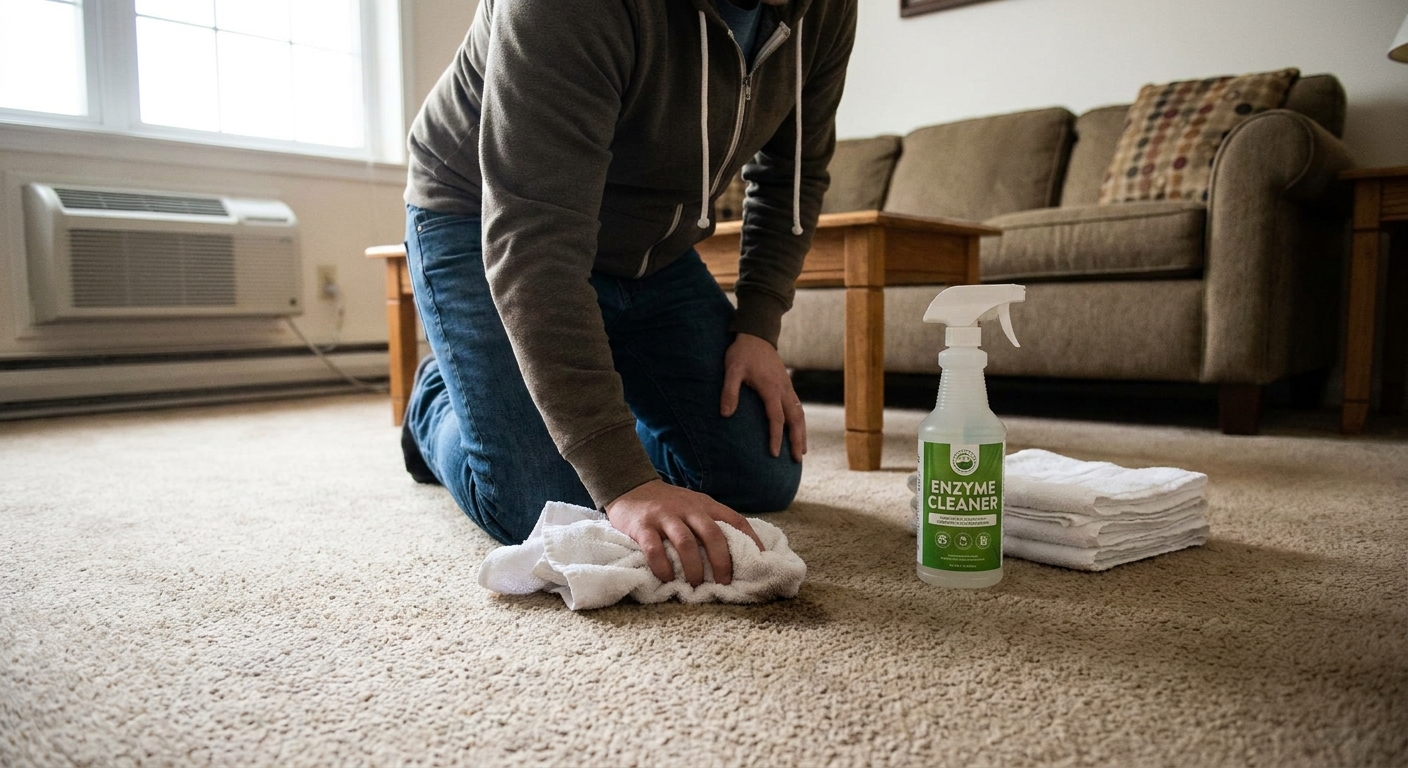
- Press, do not rub. Rubbing pushes mess outward and frays carpet fibers.
- Work from the outside in to keep the spot from spreading.
- Use steady pressure. Kneel and press with both hands, or stand on a folded towel only if you can do it safely and without slipping.
- Hold pressure for 20 to 30 seconds. Then lift and move to a dry section.
- Swap towels often. If the towel is damp, it is not absorbing anymore.
Depth limit cue: if you keep getting moisture transfer after several towel changes, odds are the pad is wet. At that point, your mission becomes preventing lingering moisture and odor.
Use mild soap when needed
The dish soap solution is not for urine. It is for the greasy, sticky part of vomit (and sometimes feces residue) that enzymes can struggle to penetrate if the surface is slick.
When to use it
- Vomit that leaves a greasy-looking shadow
- A spot that still feels tacky after basic blotting
How to use it (gently)
- Blot up moisture and remove solids first.
- Dampen a towel with the mild dish soap solution and dab the area. Do not pour it directly onto the carpet.
- Lightly agitate with a soft brush only if needed, then blot.
- Rinse lightly with a mist of cool water, then blot again. You want to remove soap so it does not attract dirt later.
- Then move on to enzyme cleaner for odor and remaining organic residue.
Enzymes: timing matters
Enzyme cleaners are not instant deodorizers. They need contact time to break down the organic material. If you spray and immediately blot, you basically just rinsed and walked away.
Two rules that help: follow your bottle, and keep the area at the dampness level the label expects. Some formulas want 10 to 15 minutes. Others perform best if the area stays damp longer.
For fresh urine
- Blot first until you are no longer pulling up much moisture.
- Patch test if you have not already. Especially on darker carpets or unknown fibers.
- Apply enzyme cleaner to the affected area. Use enough to dampen the fibers, not flood the carpet.
- Let it sit for the full label time. If the label suggests keeping it damp, do that.
- Blot again with clean towels.
- Rinse lightly with a mist of cool water, then blot. This helps prevent residue that attracts dirt.
For dried urine
Dried urine turns into crystals. Enzymes need moisture to reach and digest them.
- Mist with cool water just enough to rehydrate the area.
- Apply enzyme cleaner and allow full dwell time per the label (often longer than fresh spots).
- Keep it slightly damp during dwell if the product instructions suggest it. A piece of plastic wrap over the spot can slow evaporation. Remove it after the dwell time.
- Blot thoroughly and then do a very light cool-water mist rinse, then blot again.
Important: do not cocktail cleaning products. Avoid bleach or ammonia entirely on pet urine. If you want to try another approach after enzymes, rinse with water and blot between steps so you are not mixing residues. (Vinegar is not typically dangerous on its own, but it can reduce enzyme effectiveness for some formulas.)
If you can extract, do it
The article used to sound like there are only two options: towels or a professional. Real life has a middle step, and it can be a game changer for renters.
Consumer-grade options
- Spot extractor: a small upholstery and carpet machine that sprays and extracts. This is the best bridge between towels and a pro.
- Wet/dry vac: can help pull moisture out after you have treated the spot, but do not use it with foamy soap. (Foam can damage some vacs.)
How to use an extractor without making things worse: use minimal liquid, do your enzyme dwell time first, then extract slowly with multiple dry passes. The drying passes matter.
If you can borrow a spot extractor from a friend or rent one for a day, it is often the most cost-effective upgrade for recurring pet issues.
Padding moisture risk
Installed carpet is a layered system. When the pad gets wet, it becomes an odor sponge, and it can also encourage mildew. Over-wetting is the fastest path from “small spot” to “why does my whole living room smell weird.”
Signs the padding is wet
- The spot feels squishy or cool after blotting
- Odor returns strongly a few hours later, especially when the room warms up
- Towels keep picking up moisture even after several rounds
Renter-safe drying steps
- Press-dry: stack dry towels, place a flat board on top, and weigh it down for 30 to 60 minutes. Replace towels and repeat once.
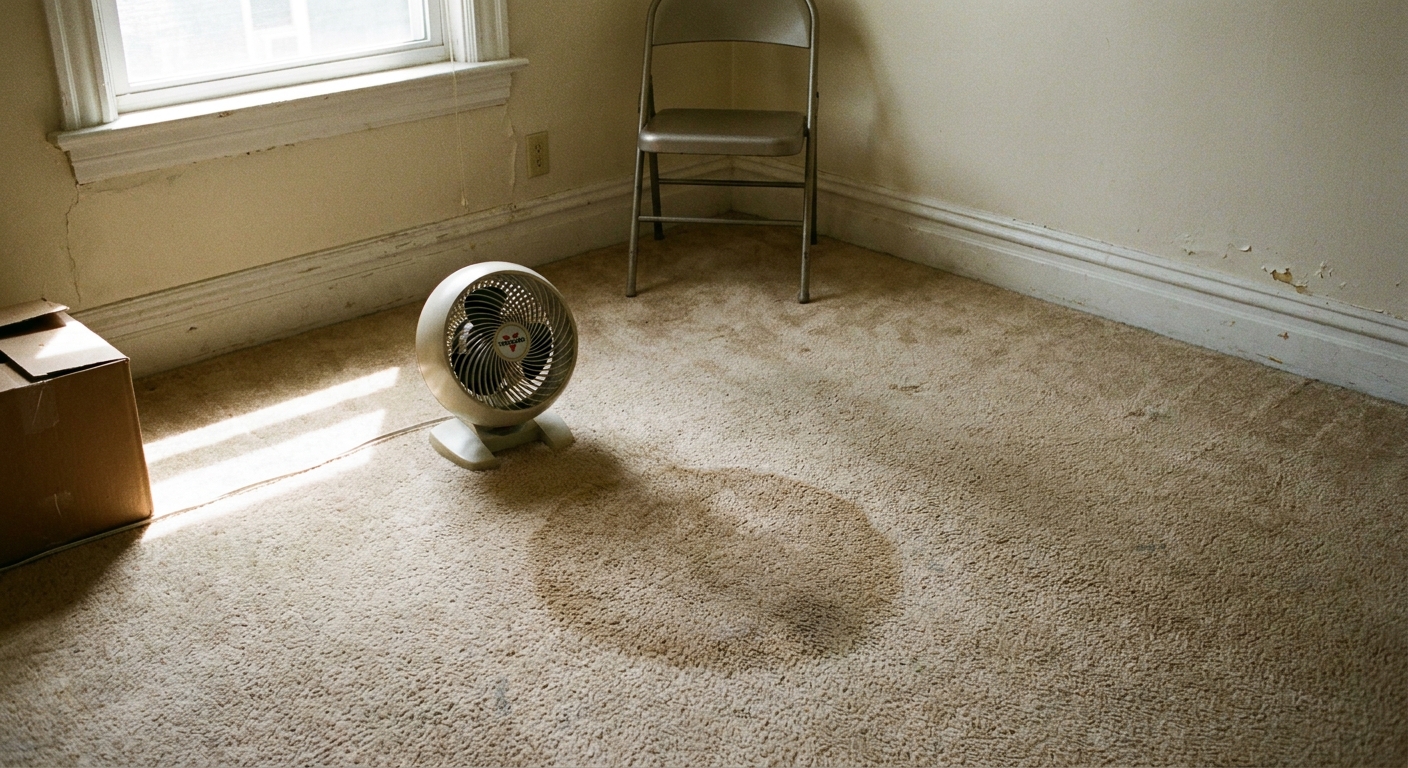
- Airflow: aim a fan directly at the spot for several hours.
- Skip heavy powders: baking soda can help mild odor, but if the carpet is still damp it can clump, turn gritty, and be hard to vacuum out. Use it only when the area is genuinely dry.
Odor recheck
Right after cleaning, your room can smell like the product and you may think you won. The real test is later, when everything dries and warms.
Do this simple recheck
- Wait 24 hours after drying.
- Warm the area: turn up the heat a couple degrees or let sun hit the spot if possible. Odor often blooms with warmth.
- Do a close sniff test: yes, it is awkward. Put your nose near the fibers.
- Do the sock test: wear clean socks and walk over the spot. If you pick up odor, it is not fully resolved.
If odor returns, it usually means the contamination reached the pad. You can do one more controlled enzyme treatment (or enzyme plus extraction if you have a machine), but if it persists, it is time to escalate.
DIY recipes?
I love a pantry trick as much as the next homebody, but pet urine in wall-to-wall carpet is a different beast.
- Vinegar: can help with some odor, but it does not digest urine crystals the way enzymes do. It can also linger until fully dry, and it may interfere with enzymes if layered without rinsing.
- Baking soda: helpful for mild surface odor on a fully dry carpet. It is not a cure for urine in the pad.
- Hydrogen peroxide: sometimes used for stains, but it can discolor carpet. Patch test in a hidden corner first and avoid on wool.
If you want the most renter-safe path with the least risk, stick to blotting, enzyme dwell time, and fast drying. If you can extract, even better.
Find old spots
If you keep getting mystery odor, it might not be the spot you are treating. Old urine can hide and re-bloom on humid days.
- UV flashlight: in a dark room, a pet UV light can help you find missed areas (it is not perfect, but it is useful).
- Recurring accidents: if the same area keeps getting hit, the pad may be the real source. Sometimes the long-term fix is pad replacement in that section, not infinite surface cleaning.
Landlord documentation
If this is a small, successfully cleaned spot, you do not necessarily need to alert your landlord. But if the pad is likely affected, or the odor keeps returning, documenting early protects you.
Lease caveat: some properties require you to report water or pet-related issues quickly to prevent mold damage. If your lease has language like that, follow it.
What to record
- A quick photo of the area before cleaning and after cleaning
- The date and what happened (example: “cat urine near bedroom door, treated immediately”)
- The product used and steps taken (enzyme cleaner, dwell time, drying method)
- Any ongoing issue (odor returning after 24 hours, dampness)
Tip: keep the tone practical, not apologetic. You are maintaining the unit responsibly.
DIY vs extraction
Spot cleaning is perfect for what is in the fibers. Extraction is what you need when the pad is involved. As a renter, that line matters because repeated DIY soaking can make things worse.
DIY is usually enough when
- You caught it fast
- The spot is small
- No odor returns after 24 to 48 hours
- The carpet dries within a few hours with a fan
Use extraction (consumer or pro) when
- The stain is large or repeatedly happens in the same spot
- You suspect the padding is wet
- Odor returns after two careful enzyme treatments
- The carpet stays damp longer than 12 hours
- You see discoloration wicking back up as it dries
When you contact your landlord or property manager, you can specifically ask for hot water extraction performed by a professional. (Many people call it steam cleaning, but the goal is extraction, not just heat.) Mention that you are concerned about moisture in the pad and preventing odor and mildew. That signals you are protecting the property, not just hiding a stain.
One more fiber note: if your carpet is wool, specialty, or you are unsure, patch test everything and consider calling a pro sooner. Natural fibers can be less forgiving.
Quick recap
- Blot immediately and press firmly, no rubbing.
- Use mild dish soap only for greasy vomit residue, then rinse and blot.
- Apply enzyme cleaner and let it sit for the full label time.
- Blot again, then do a light cool-water mist rinse and blot.
- Dry aggressively with towel pressing and a fan.
- Recheck odor in 24 hours and again after the room warms up.
- Extract if you can (spot extractor or wet/dry vac) and escalate to pros if odor returns or padding seems wet.
If you want to feel a tiny bit more in control, put a washable runner or mat in the repeat offense zone once everything is dry. Not as a cover-up, but as a practical little buffer while your pet learns new habits and your carpet gets a break.