Kitchen Sink Sprayer Problems: Weak Pressure, Dripping, or Won’t Dock

Clara Townsend
Clara Townsend is an interior stylist, vintage furniture enthusiast, and the creative voice behind Velvet Abode. With over a decade of experience transforming both cramped city apartments and sprawling fixer-uppers, she believes that a beautiful home is built on personal stories rather than massive budgets. When she isn't hunting for the perfect brass sconce at a local flea market, she can usually be found rearranging her living room for the third time this month.
Nothing ruins the cozy rhythm of a kitchen faster than a sink sprayer that suddenly turns into a sad trickle, won’t stop dripping, or refuses to click back into its little home. The good news: most sprayer issues in rentals come down to a few predictable culprits, and you can check them without replacing valves, soldering, or doing anything that could jeopardize your deposit.
Below is my renter-safe, step-by-step flow. You will start with the easiest, most likely fixes, then work toward the “this is a maintenance ticket” clues.
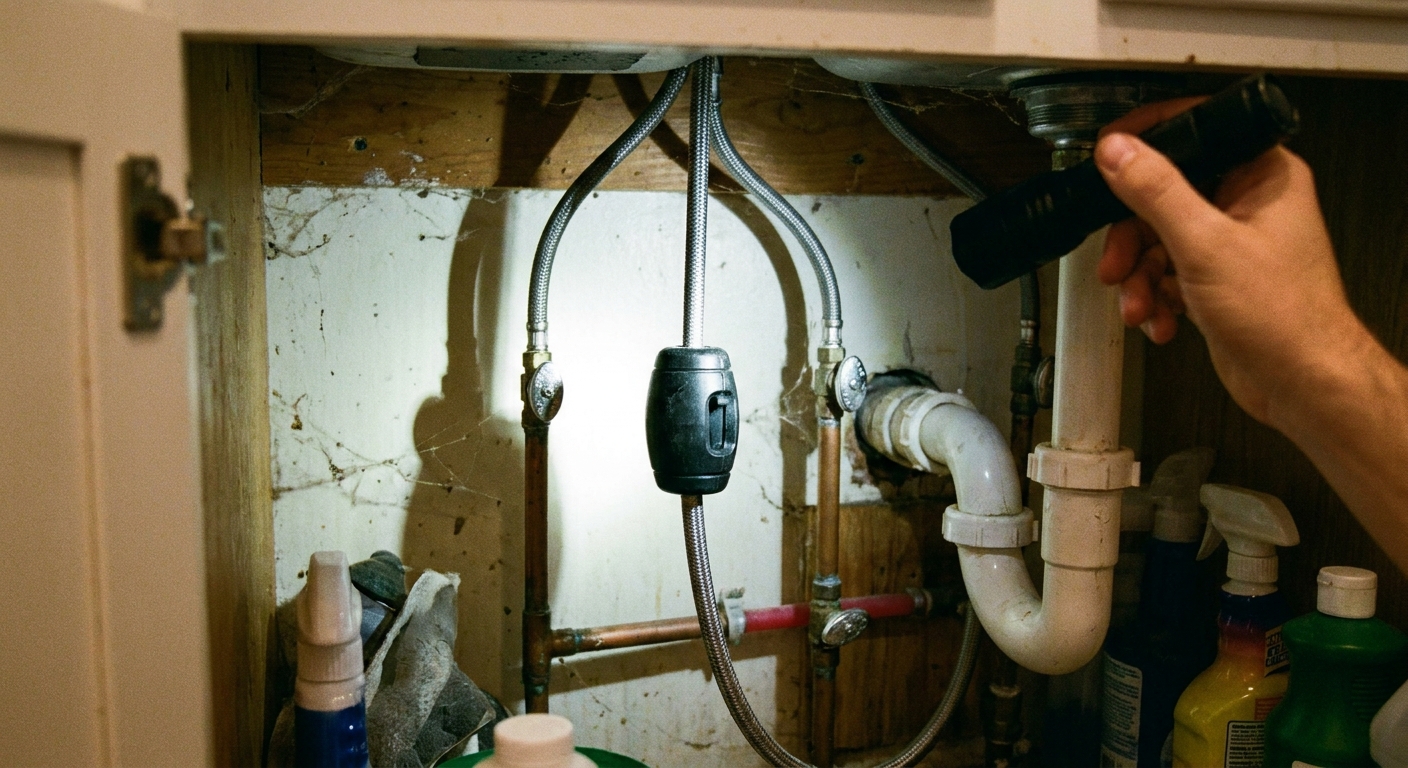
Before you start
Grab these basics
- A towel or small bowl
- A flashlight
- An old toothbrush
- Dish soap
- White vinegar (for mineral buildup)
- Zip-top bag and a rubber band (for soaking)
- Adjustable wrench or pliers only if a part is hand-tight and you feel confident
Quick safety note for renters
If you have any doubt about touching supply valves, or you see active leaking that is more than a slow drip, skip ahead to the leak containment section and contact maintenance. Water damage is not a cute accessory.
Finish note: Vinegar is great on mineral scale, but it can dull certain coated finishes if it sits too long. Keep vinegar soaks targeted to the spray face, do not soak painted or “oil-rubbed” surfaces, and rinse well afterward.
Know your faucet type
These checks work for most setups, but it helps to identify what you have:
- Pull-down or pull-out faucet: the sprayer head is the faucet tip (most common in newer rentals). There may be no separate aerator, or it may be integrated into the head.
- Separate side sprayer: a regular faucet spout (usually with an aerator) plus a separate sprayer on a hose beside it.
If you are not sure, no stress. The symptom checks below will still point you the right way.
Quick symptom triage
If you want the fastest path, match your main symptom first:
- Weak pressure only at the sprayer: think mineral buildup in the head, a clogged screen or flow restrictor, a kinked hose, or a switching mechanism that is not fully redirecting flow.
- Weak pressure at both faucet and sprayer: think building-wide pressure, a partially closed shutoff, or a clogged inlet screen in a supply connection.
- Sprayer drips after you turn water off: a little drip for a second or two can be normal, but ongoing dripping often points to debris, a worn seal, or a faucet cartridge issue.
- Sprayer won’t dock: think hose weight position, hose snagging, twist, or a docking magnet that is blocked.
Check 1: Whole faucet or just sprayer?
Run the faucet in its normal stream mode. Then switch to spray mode.
- If stream is strong but spray is weak, your problem is likely in the sprayer head (buildup, screen, restrictor) or in the switching path.
- If both are weak, you may be dealing with a supply issue, a partially closed shutoff, or a clogged inlet screen. If you have a separate side sprayer setup, a clogged spout aerator can also make the main stream weak.
This single comparison prevents you from spending your afternoon descaling a sprayer head when the actual issue is upstream.
Check 2: Switching and diverter issues
Different faucets switch water in different ways:
- On many pull-down faucets, the button on the head changes the spray pattern inside the head, not a separate valve in the faucet body.
- On some faucets (and many separate side sprayers), a diverter valve redirects water between the spout and sprayer.
Either way, a sticky or debris-filled switching mechanism can cause weak spray, inconsistent switching, or dripping.
Renter-safe switching tests
- Toggle test: With the water running, switch between stream and spray several times. If pressure improves briefly, debris or sticking is a good suspect.
- Listen test: If you hear sputtering or a slightly chattery sound when switching modes, it can hint at debris in the flow path.
- Delay test: If it takes a beat to switch modes, that lag often points to resistance, buildup, or a worn internal seal.
If these tests point to an internal diverter or cartridge, that is often a maintenance call in a rental. Some parts are accessible, but many require brand-specific parts and disassembly. Keep reading though, because a sprayer head cleaning can fix what feels like a bigger issue.
Check 3: Hose, snags, and the weight
This is the most common “won’t dock” issue, and it can also cause weak pressure if the hose is partially pinched. Picture the hose as a long scarf. If it’s twisted and snagged on the plumbing, it will not glide back up smoothly.
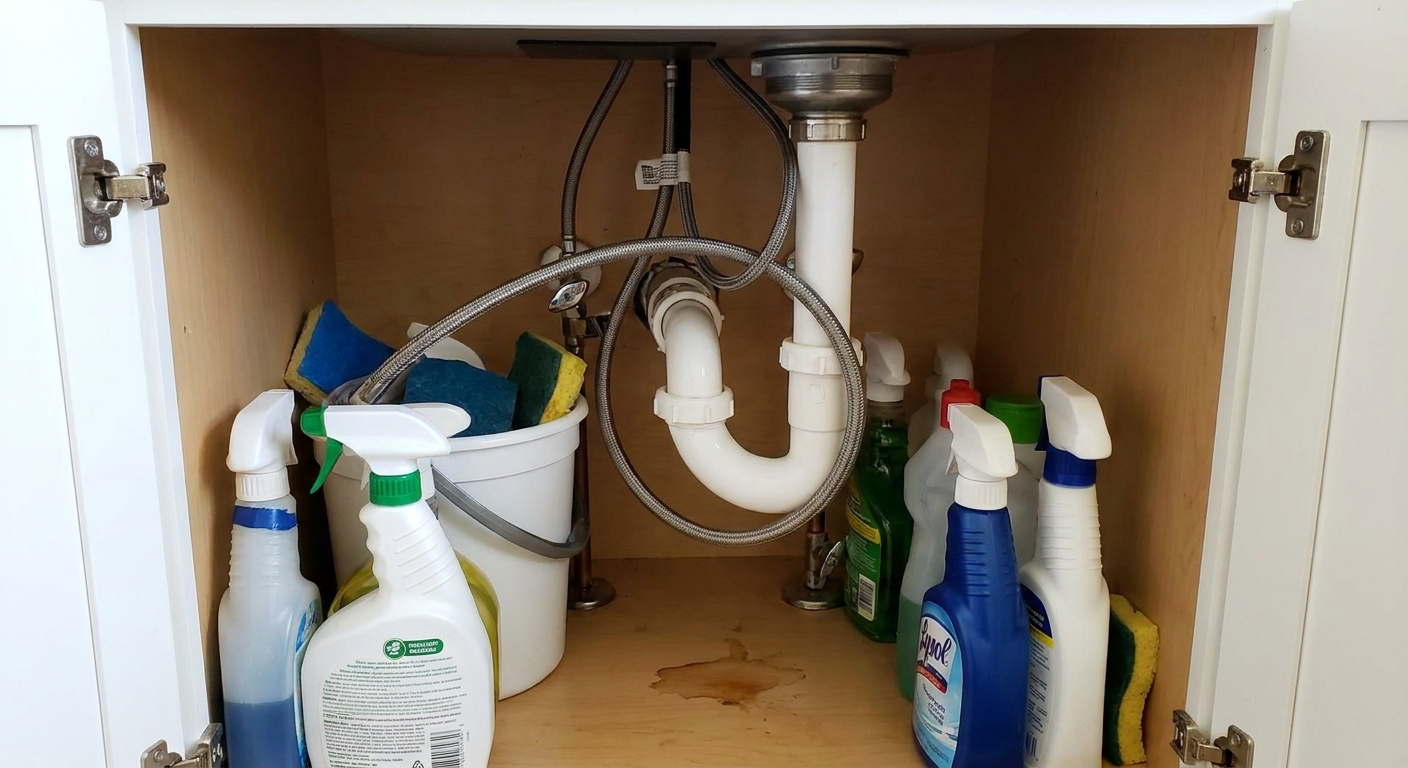
What to look for
- The hose weight: a chunky weight clipped to the sprayer hose. Placement varies by brand, but it is typically clipped partway down the hose. Look for clip marks or the current factory position and return it there if it slipped.
- Snags: hose rubbing against the P-trap, supply lines, or stored cleaning bottles.
- Kinks: a sharp bend in the hose when the sprayer is extended.
- Twist memory: the hose looks corkscrewed, often from rotating the sprayer head repeatedly in one direction.
Fix it
- Clear the cabinet space. Move bottles and bins away from the hose path.
- Pull the sprayer out fully, then guide the hose by hand. With the sprayer extended, look under the sink and straighten the hose gently.
- Check the weight position. If it slid, reclip it to its prior position (or visible clip marks). Too low or too high can both mess with docking.
- Test the retract. Let the sprayer retract slowly while you watch the hose. You want a smooth, centered glide.
Quick docking check
- Magnet ring: Some heads dock with a magnet. Wipe the docking area and remove any tiny metal debris (like a stray steel-wool shaving).
- Orientation: Make sure the head is rotated the way it “wants” to sit. If it docks only when you twist it just so, the hose may be twisted under the sink.
If the sprayer docks when you manually guide the hose but not on its own, the weight or a snag is almost always the answer.
Check 4: Mineral buildup and screens
Mineral buildup is the quiet villain of so many rental kitchens. It starts as a soft white crust and ends as weak pressure that makes you do a double take.
If your faucet has an aerator
If you have a separate spout with a screw-on aerator (common on non-pull-down faucets), a clogged aerator will weaken the main stream. It will not always affect the sprayer, depending on how your faucet is built, but it is still worth cleaning if the spout is weak.
- Unscrew the aerator (usually by hand; wrap a cloth around it if you need grip).
- Rinse and brush. Use an old toothbrush to scrub off debris.
- Soak in vinegar for 30 to 60 minutes if it has scale.
- Rinse and reinstall.
If the sprayer is weak: descale the sprayer head
Most sprayer heads have a screen and tiny spray ports that clog with calcium. You do not need to take it apart to do a first-pass clean.
- Fill a zip-top bag with warm vinegar.
- Submerge the sprayer face in the vinegar and secure the bag with a rubber band around the head.
- Let it soak for 15 to 30 minutes (up to 60 minutes for heavy scale).
- Remove and run hot water. Toggle spray and stream to flush loosened bits.
- Rub the spray nozzles with your thumb if they are silicone.
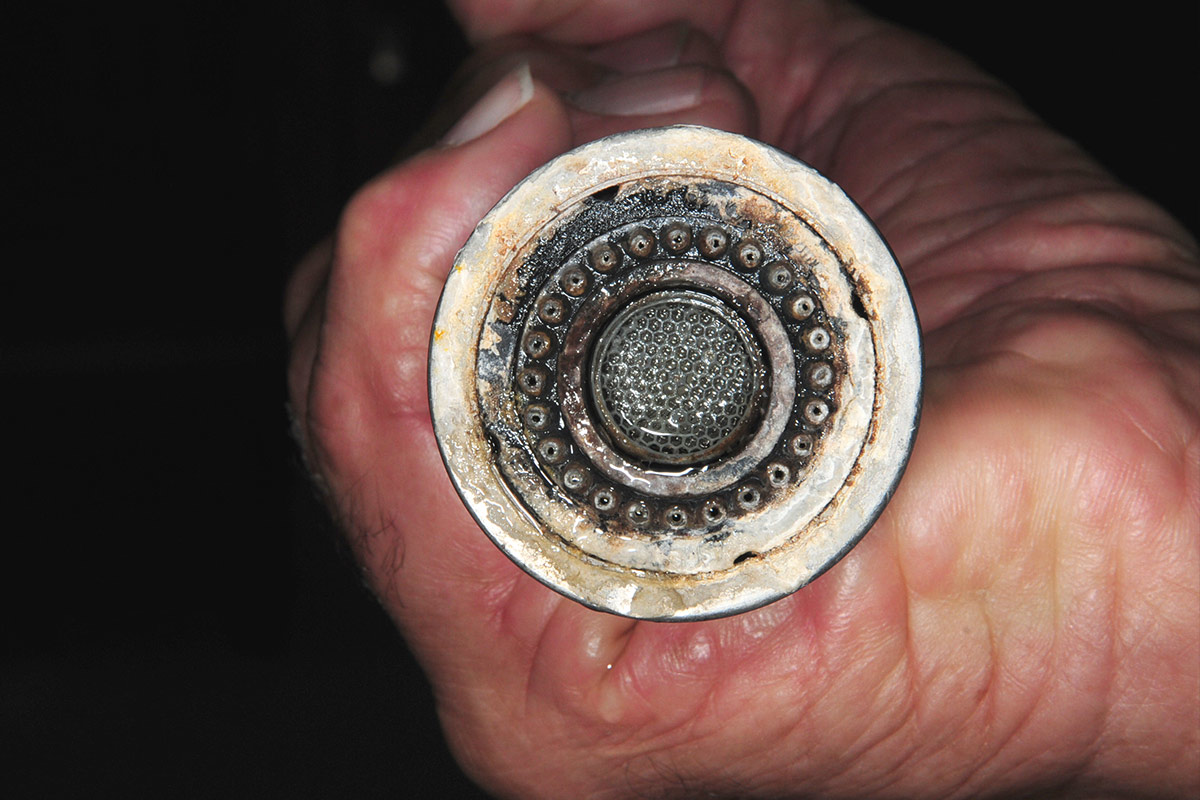
Tip: If your sprayer has a strong burst for a moment and then fades, that can indicate a partial clog or debris shifting around a screen or flow restrictor. Descaling and flushing often fixes this exact drama.
Flow restrictor note
Many newer faucets also have a small flow restrictor inside the sprayer head or connection. If cleaning does not help and pressure is still oddly low, the restrictor or an internal screen may be clogged. Removing it can be brand-specific and may not be renter-safe, so that is a good maintenance ticket item.
Check 5: Dripping sprayer head
A sprayer that drips after the faucet is turned off is annoyingly common. Some dripping for a second or two can be normal as residual water drains, but steady dripping that continues is a sign of a sealing problem.
Common renter-safe causes
- Debris caught in the sprayer head: tiny grit can prevent an internal seal from seating.
- Worn washer or seal inside the sprayer head: this is a parts issue, not a cleaning issue.
- Faucet cartridge wear: water continues to pass slightly even when “off,” then finds the easiest exit at the sprayer.
What you can do without disassembly
- Flush it. Run water for 30 seconds in stream, then 30 seconds in spray.
- Clean and descale the sprayer face using the vinegar bag method above.
- Check the drip location. Is it dripping from the spray holes, or from the seam where the head meets the hose?
If it drips from the seam, that is often a loose connection or failing O-ring. Tightening can be simple, but in a rental I recommend photographing the drip and sending it to maintenance rather than forcing a connection and cracking plastic threads.
Check 6: Hot vs cold
This quick check can reveal supply-side clogs without you taking anything apart.
- Test cold only. Note the pressure at stream and spray.
- Test hot only. Note the pressure at stream and spray.
- If only hot or only cold is weak, it can point to a partially closed shutoff valve, debris in a supply line, or a clogged inlet screen on that side. In a rental, that is usually maintenance territory.
- If both are equally weak, look for a building-wide issue or a shared restriction upstream.
Check 7: Cartridge clues vs supply issues
Here is the simplest way to tell whether you are dealing with an internal faucet issue (cartridge, diverter, internal seals) or something about your building’s supply.
More likely a supply issue
- Pressure is weak at multiple fixtures (bathroom sink, shower).
- Both hot and cold are equally weak at the kitchen faucet.
- The problem started right after building maintenance or a water shutdown.
- One side (hot or cold) is weak in a way that suggests a shutoff or supply restriction.
More likely a cartridge or diverter issue
- The faucet does not shut off crisply and you get ongoing dripping.
- Pressure changes when you jiggle the handle.
- Sprayer and stream behave inconsistently when switching.
In rentals, cartridge or diverter replacement is usually a landlord or maintenance job. It is normal. It is not you failing at adulthood.
Leak containment
If you see water under the sink, treat it like a candle near linen. Contain it first, troubleshoot second.
- Lay down a towel or a shallow tray under the connection points.
- Dry everything, then run water and watch to identify the first bead of moisture.
- Check the hose connection where it meets the faucet body (often above the shutoffs) and where it meets the sprayer head.
- Use a bowl test if dripping is slow: place a dry bowl under the suspected area for 10 minutes while water is off. If it collects water, you have a consistent leak.
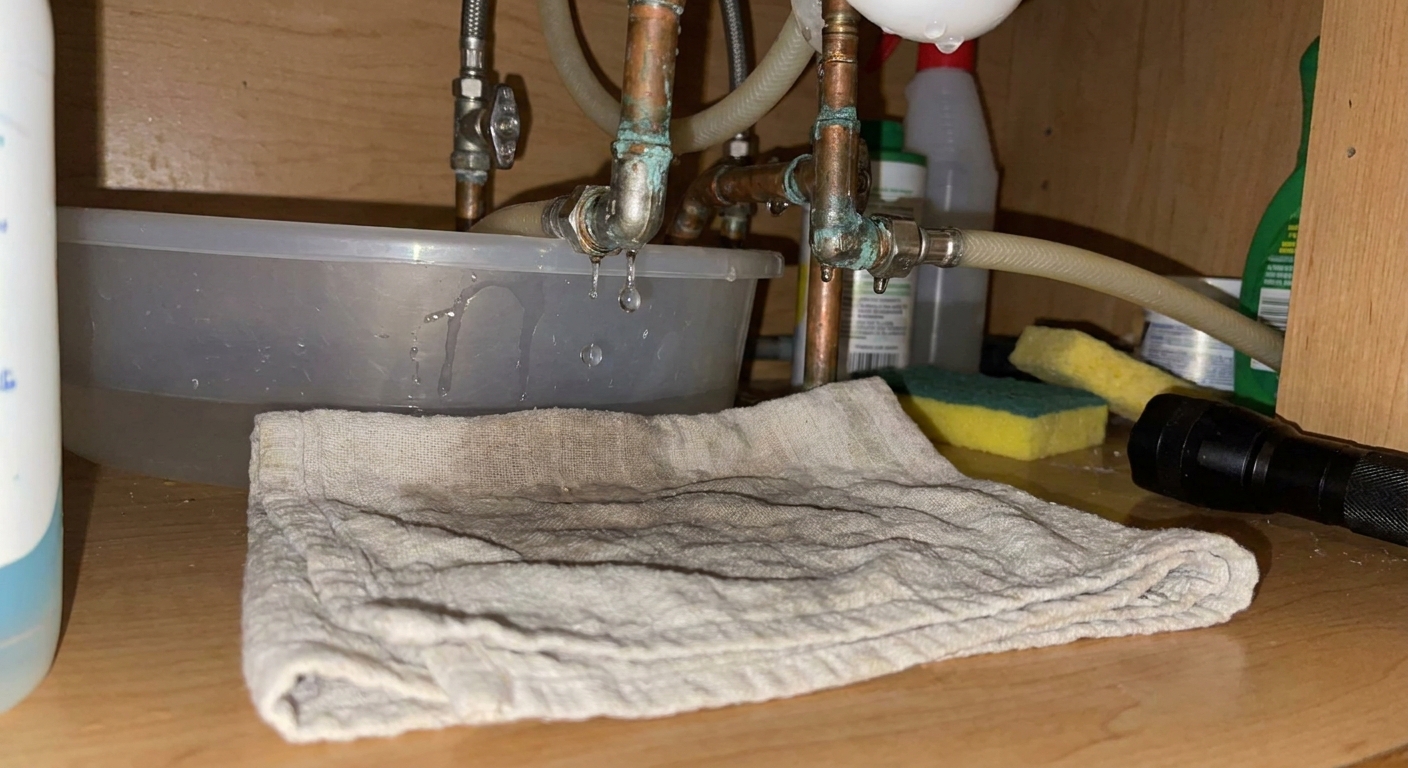
If the leak is active or pooling, stop here and contact maintenance. Water damage is expensive, and it spreads quietly.
When to call maintenance
Call maintenance if any of the following are true:
- The sprayer keeps dripping continuously after cleaning and flushing.
- The sprayer head leaks from the seam or the hose connection.
- You see water under the sink during use or while everything is off.
- The sprayer won’t switch modes consistently, suggesting an internal switching, diverter, or cartridge problem.
- Pressure is weak across multiple fixtures, suggesting a building issue.
- Only hot or only cold is weak and you suspect a supply restriction.
Copy and paste message
“Hi, our kitchen faucet sprayer has weak pressure and is also [dripping / not docking]. I checked under the sink for hose kinks/snags and confirmed the hose weight and hose path are clear. I cleaned/descaled the sprayer head and the issue persists. Hot pressure is [normal/weak] and cold pressure is [normal/weak]. There is [no leak / a small leak] under the sink at [location if known]. Could maintenance inspect the diverter/cartridge or replace the sprayer head if needed?”
Simple prevention
- Once a month: wipe the sprayer face and rub silicone nozzles to prevent buildup.
- Every 3 to 6 months: vinegar-soak the sprayer face if you have hard water (short soaks, then rinse).
- Keep the cabinet tidy: store tall bottles away from the hose path so docking stays smooth.
- Do a quick glance: if the sprayer feels sticky when retracting, check the weight before it turns into a full refusal.
Your sink sprayer should feel effortless, like closing a well-made drawer. If it does not, it is usually a kink, a little calcium, or an internal part that needs professional hands.