Hot Pan Left a Brown Mark on Quartz
Gust
A little flutter. A cozier corner.
And then, a thunk of a hot pan on quartz and suddenly your calm kitchen has a brown mark that looks like a ghost of dinner past.
Let’s translate what that mark usually means, how to figure out whether you are dealing with a cleanable stain or true heat damage, and what to document before anyone reaches for sandpaper.
What the brown or dull mark means
Quartz countertops are engineered stone. They are mostly ground quartz held together with polymer resins and pigments. The quartz itself is very heat-stable. The resin binder is the part that tends to complain first under high heat.
When a very hot pan, baking sheet, or pot comes straight from the oven or burner, the surface can heat faster than the material beneath it. That rapid spike, plus thermal shock (fast hot to cool transitions), can:
- Discolor the resin binder (often yellowing or browning, sometimes a grayish dull patch).
- Change the sheen so the spot looks hazy, matte, or “shadowed,” even if it is perfectly smooth.
- Create a subtle outline that matches the base of the pan or the rim of a pot.
- In rare cases, contribute to cracking or chipping, especially near edges, seams, and cutouts where stress concentrates.
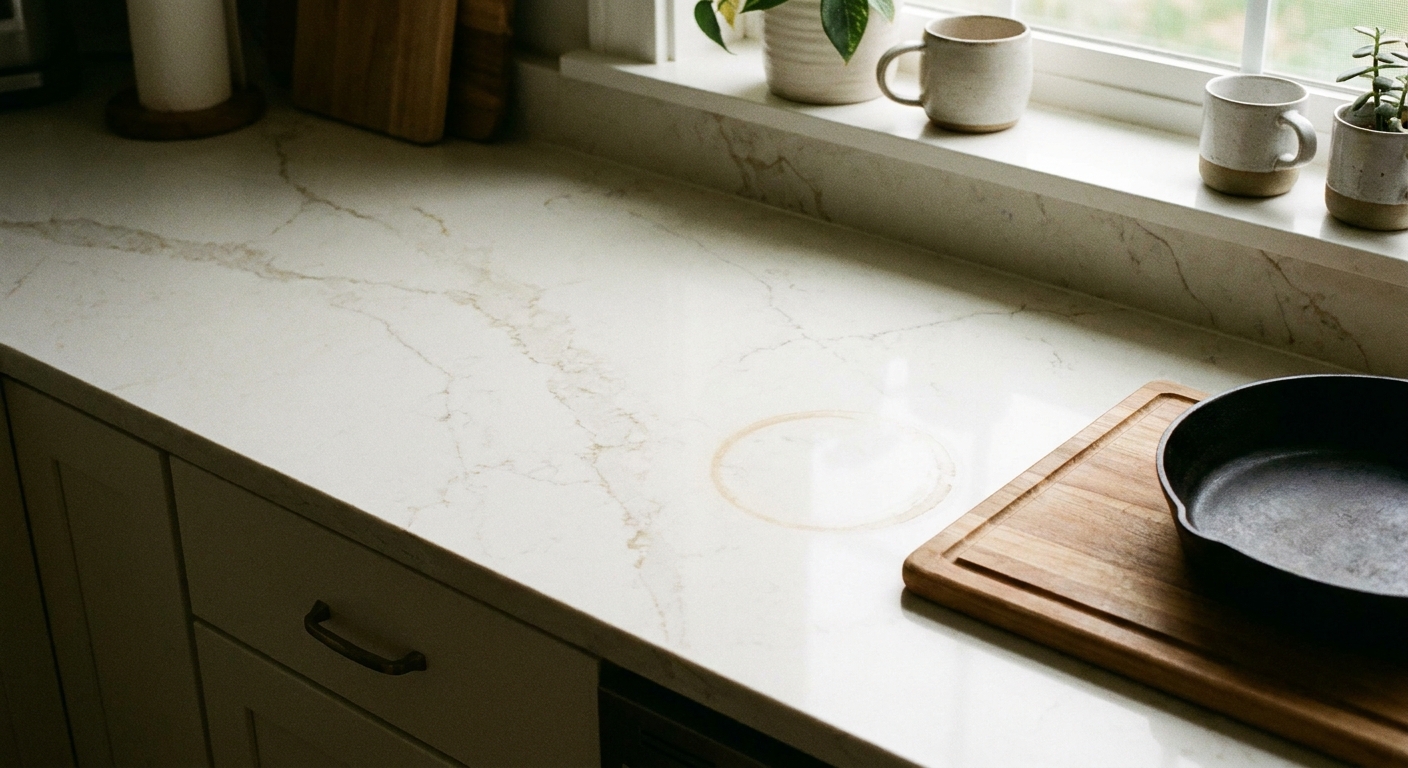
Heat marks on quartz often look like a brown ring, a dull circle, or a slightly smoky patch that seems trapped inside the surface rather than sitting on top of it. Exact heat tolerance varies by brand and resin system, so the same pan can behave differently from one countertop to the next.
Stain or heat scar?
The difference matters because stains can often be lifted. Heat scars are a material change, which is harder.
Clues it might be a surface stain
- You can feel residue with a fingernail, like a faint film or tacky spot.
- The mark changes after cleaning, even a little. It lightens, smears, or breaks up at the edges.
- The shape is messy like drips, splatter, or an irregular smear rather than a crisp circle.
- It matches a food culprit like oil, tomato sauce, curry, coffee, tea, or a spice stain.
Clues it is heat damage
- The mark is a perfect pan shape like a ring or solid circle.
- The surface feels normal with no gunk, no texture, and no “edge” to catch with a nail.
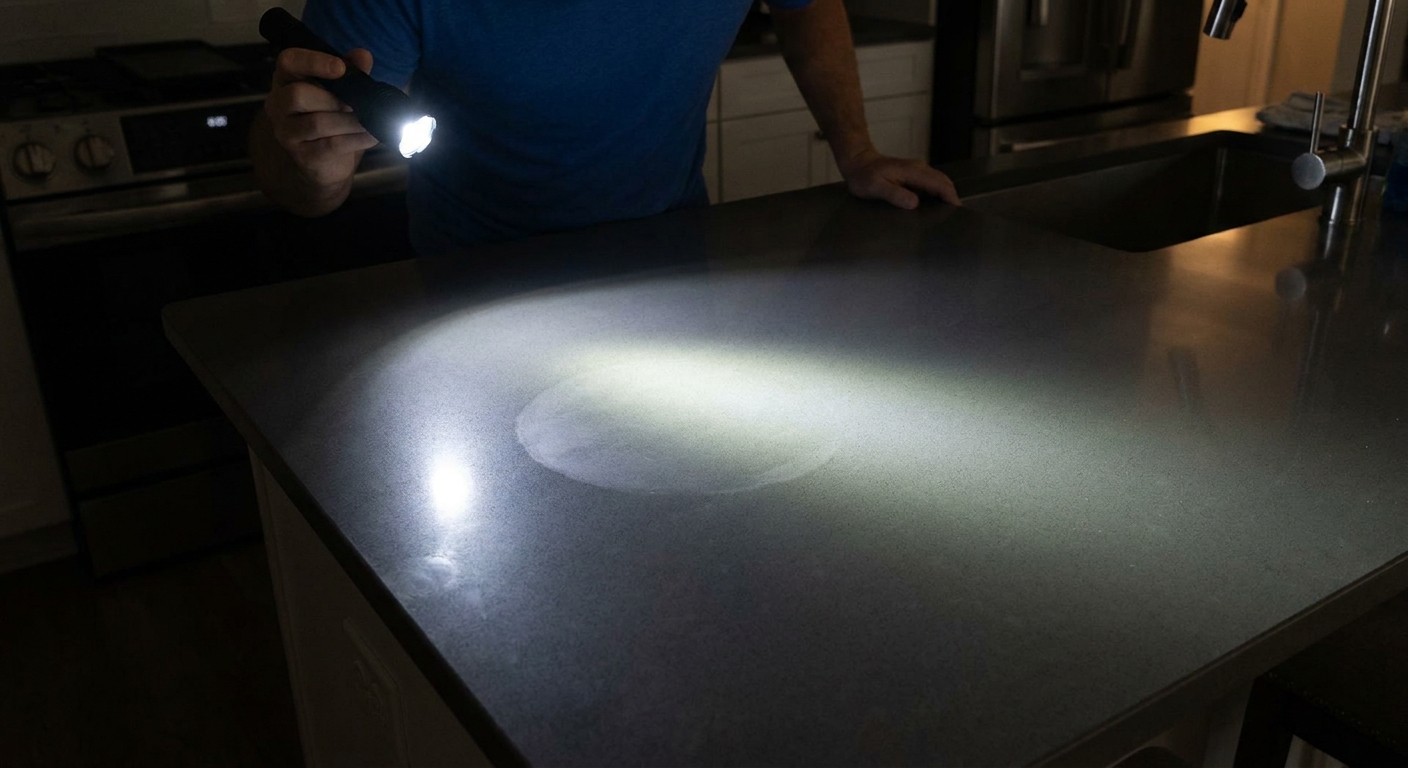
- The spot looks dull from angles especially when light rakes across it.
- Cleaning does nothing beyond removing any surrounding grime.
If you want a low-drama test: clean the area thoroughly, dry it, then look at it from several angles in strong side light (a flashlight held low works). Heat scars often reveal themselves as a change in sheen more than a “dirty” look.
Clean gently first
Even if you suspect heat damage, it is worth confirming there is no stain layered on top of it. Start with the least aggressive options.
Safe first steps
- Dish soap + warm water with a soft sponge or microfiber cloth.
- Non-abrasive surface cleaner labeled safe for quartz.
For stubborn residue or staining
If the mark is from food, dye, or oil, many manufacturers allow a small amount of isopropyl alcohol on a cloth for spot cleaning. Some also allow a short dwell time with a non-abrasive cream cleanser or other non-scratch cleaner that is explicitly quartz-safe.
Two small rules that prevent big regret: test any cleaner in an inconspicuous spot first, and do not let liquids sit and creep into seams, caulk, or around the sink cutout.
Skip these unless your countertop manufacturer explicitly says otherwise: abrasive powders (think Comet or Bar Keepers Friend), harsh scouring pads, oven cleaner, paint stripper, strong acids, and repeated heavy scraping. Also skip the “reverse it with heat” idea. No heat gun, no hair dryer, no boiling water tricks. Those can worsen discoloration and stress seams.
Why polishing often fails
This is the part that frustrates people: quartz does not behave like natural stone in repair scenarios.
If the resin binder discolored from heat, that color change is within the material, not just on the surface. Polishing can sometimes improve sheen if the top layer was slightly affected. But polishing cannot reliably “erase” a resin discoloration the way it might remove a superficial stain.
What polishing can do
- Reduce a light haze if the spot is mostly a finish change.
- Blend minor micro-scratches that make an area look dull.
What polishing cannot do
- Return discolored resin to its original color.
- Make a deep brown ring disappear if the binder has yellowed or browned.
Also, aggressive polishing and sanding can create a new problem: a shiny or matte “repair island” that is visible from across the room. Quartz slabs are typically factory-finished, and while fabricators can polish edges and sometimes field-polish small areas, matching the original sheen perfectly is tough.
Before you grind, pause
Grinding, sanding, and buffing are sometimes used by fabricators for spot repairs, but they are not harmless DIY steps. Removing material can:
- Change the profile so the area dips slightly.
- Expose a different layer of aggregate patterning.
- Alter the sheen permanently in that spot, even if the color improves.
- Void warranties depending on the brand and installer terms.
If a contractor is involved, ask what method they plan to use and what “success” looks like: complete removal, partial improvement, or blending so it is less noticeable.
What a pro might do
Expectations help. A quartz repair specialist or fabricator may try a localized hone and polish to improve sheen, or a spot blend to make the mark less obvious. In some cases, tinting or filling can help visually, but results vary a lot by color and pattern. Solids and very uniform designs can show repairs more than busy, speckled patterns. If the heat scar is deep or the location is high-visibility, replacement of the affected piece may be the only true reset.
Renter photo checklist
If you rent, documentation is your little gust of protection. Photograph before anyone cleans aggressively, sands, buffs, or applies chemicals. Once the surface is altered, it becomes harder to prove what happened and when.
Get these photos
- Wide shot of the entire counter run showing the mark’s location relative to the sink, stove, edges, and seams.
- Medium shot showing the mark and the surrounding area.
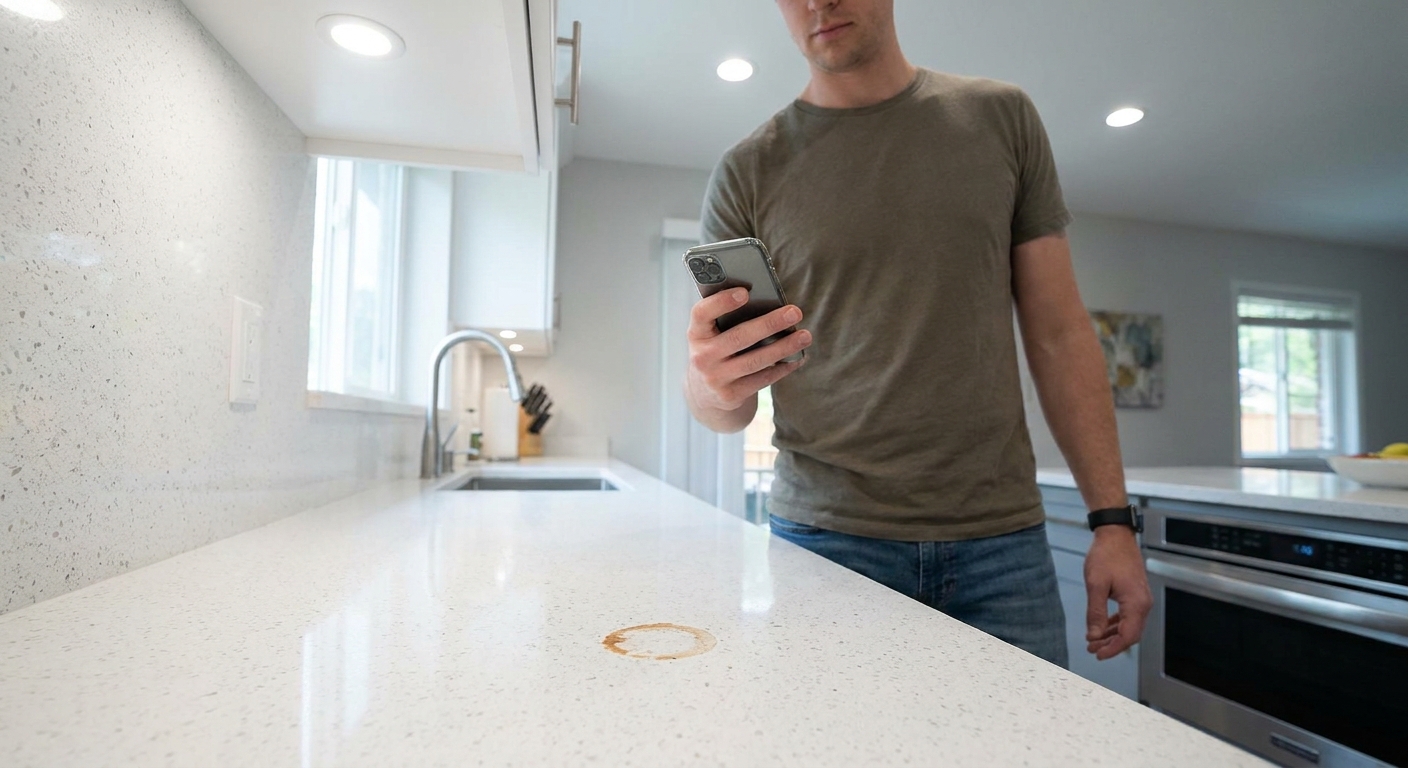
- Close-up from straight above so the outline and color are clear.
- Angle shot in raking light (flashlight held low) to capture dullness or sheen change.
- Close-up of nearby seams and edges in case the heat affected caulk lines or joints.
- Photo of the pan that caused it, including the bottom, if available and relevant.
Lock in timing
- Keep original files with metadata intact (do not screenshot if you can avoid it).
- Email the photos to yourself and your landlord or property manager the same day, so the timestamp is documented.
- Add a real-world time marker in one frame, like that day’s mail label, a dated receipt, or a newspaper front page.
- Take a quick video sweep across the surface. It often shows sheen changes better than still photos.
When to call a pro
Consider contacting a fabricator or stone and quartz repair specialist if:
- The mark is dark brown, clearly pan-shaped, and unchanged after gentle cleaning.
- The area is noticeably dull or looks softened.
- The damage is near a seam, edge, or sink cutout where structural issues matter more.
- You see any cracking, chipping, or lifting at the edge of the spot.
Describe it as a heat mark on quartz and mention whether it is a color change, a dullness change, or both. Photos taken in raking light help pros give more accurate expectations.
Preventing a repeat
Quartz is tough, but it is not a trivet. If you want your counters to stay calm and un-haunted:
- Keep a trivet where heat happens near the stove and the oven landing zone.
- Use a wooden board or a silicone mat as a buffer for hot baking sheets.
- Make it automatic by storing trivets upright next to the range so they are easier to grab than “just setting it down for a second.”
I love “for a second” energy, but quartz does not.
Quick FAQ
Will a Magic Eraser remove a heat mark on quartz?
Melamine sponges can act like a very fine abrasive. They might remove a surface film, but they can also dull the finish, especially if you scrub hard. For suspected heat damage, they usually do not fix the color change.
Can a heat mark get worse over time?
The discoloration itself typically does not spread, but the spot can become more noticeable if the surrounding finish stays glossier while the damaged area reads duller in certain lighting.
Is quartz heat resistant?
Quartz surfaces tolerate brief warmth better than many materials, but direct contact with very hot cookware can exceed what the resin binder can handle. The result is often discoloration or a sheen change, though thermal shock and vulnerable areas (edges, seams, cutouts) can sometimes crack or chip.
If the mark is only dull, is it heat damage?
It can be. Heat can alter the surface sheen without an obvious brown color shift. The best clue is that the dullness matches the shape of the hot item and does not change after normal cleaning.