Curtain Rod Blocked by Crown Molding or a Soffit

Gust
A little flutter. A cozier corner.
Sometimes you do everything “right” with curtains, then the room does a small, smug cough. Crown molding. A soffit. A bulkhead. That chunky edge up top that refuses to let your curtain rod reach the usual higher-and-wider spot.
Good news. You can still get that taller, calmer look. You just do it with the space you actually have, not the space you wish you had.
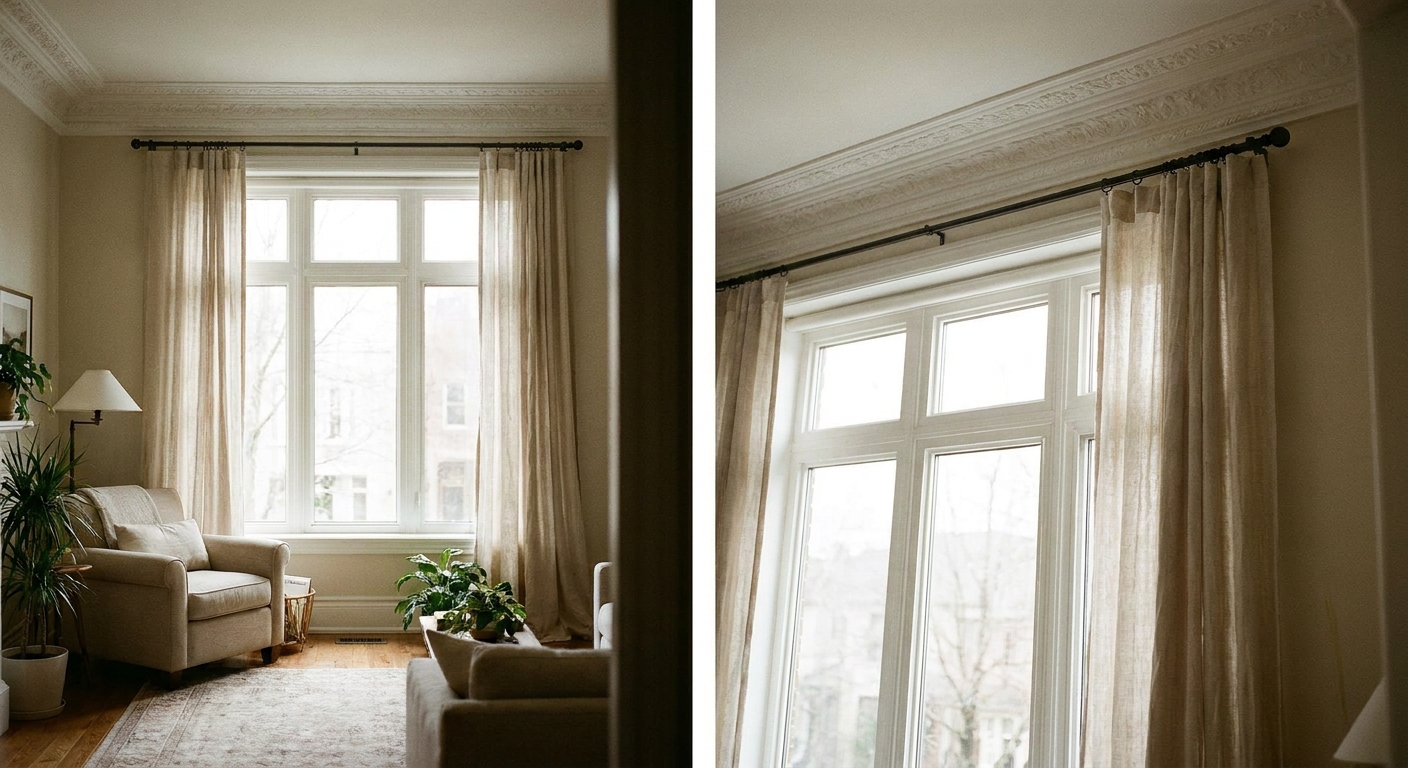
First, name the blocker
These three get lumped together, but they behave a little differently when you are choosing hardware.
- Crown molding: Decorative trim where wall meets ceiling. Usually continuous across the room, which limits how high brackets can sit.
- Soffit: A boxed-in drop, often over cabinets, ducts, or pipes. It can run along one wall or wrap a corner.
- Bulkhead: In everyday use, often used to mean any ceiling drop or boxed beam. Some trades use the terms differently, so treat it as “whatever is boxing you in” and move on with your plan.
Whatever the label, your goal is the same: mount the curtains in a way that looks deliberate and lets the fabric move freely.
Measure the blocked height
Instead of starting from the ceiling, start from the obstruction. This keeps the process simple and prevents the rod from fighting the trim.
What to measure
- Obstruction bottom edge: Find the lowest point of the crown or soffit over the window area.
- Clearance you need: You need space so rings, grommets, carriers, or the rod itself do not scrape the trim.
How to do it
- Stand at the window and find the lowest “no-go” edge. For crown, that is usually the bottom of the crown profile. For a soffit, it is the flat underside.
- Measure down from that edge. Use a tape measure and mark the wall lightly with painter’s tape.
- Plan a small safety gap. As a starting point, aim for about 1 to 2 inches of clearance between the obstruction and the top of your hardware or rings. If you are using larger clip rings, thick grommets, or a bulky rod diameter, you may need a bit more. The goal is glide, not grit.
That mark is the highest realistic zone for your rod and brackets.
A quick example: If the soffit underside sits 6 inches above the top of your window casing and you want 1.5 inches of clearance, plan your bracket tops about 1.5 inches below the soffit line. That leaves you roughly 4.5 inches above the casing to work with.
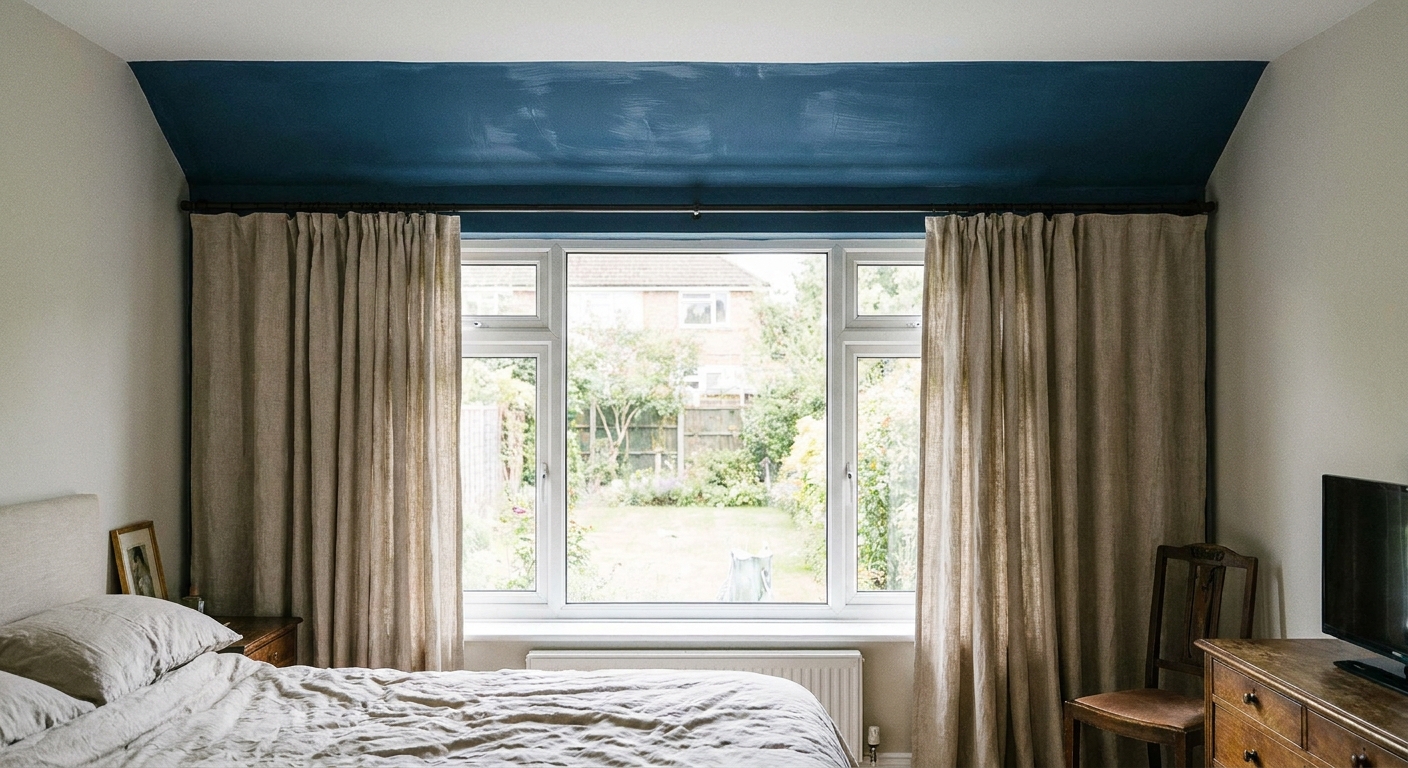
Option 1: Mount under the trim
This is the simplest fix and often the best looking, because it reads as intentional: the trim stops, then the drapery begins.
When it works
- You have at least a little wall space between the top of the window trim and the bottom of the crown or soffit.
- You can keep both brackets level without hitting the obstruction.
- You want to use a normal rod and normal curtain panels.
Placement tips
- Go as high as you can without rubbing. The highest workable spot is usually right under the obstruction with a small gap.
- Still go wider if you can. If the soffit only blocks height, you can often extend the rod beyond the window frame so the curtains stack mostly off the glass.
- Choose low-profile hardware. Slim brackets and a narrower rod diameter can buy you precious clearance.
- Check projection. If you have thick window casing, blinds, or a Roman shade, you may need brackets that project farther from the wall so the fabric clears everything instead of rubbing along the trim.
- Watch finials and end caps. Some finials poke upward or outward and can collide with crown returns at the corners.
Option 2: Use a ceiling track
If the crown or soffit leaves you basically no mountable wall above the window, a ceiling track can be the cleanest answer. It moves the support point to the ceiling surface under the soffit, or to the ceiling just in front of the window wall, depending on your layout.
When a track wins
- The crown molding is very deep and you cannot mount brackets without hitting it.
- The soffit drops low enough that a wall-mounted rod would sit awkwardly close to the window trim.
- You want a smooth glide for blackout curtains or heavier fabric.
- You have a corner situation where rods would crash into trim returns.
What to watch
- Fastening: Tracks still need a solid bite. Confirm you can fasten into framing, or use anchors rated for your ceiling material and curtain weight. Plaster, drywall, and soffit undersides can behave very differently.
- Stack-back: Tracks need space for the curtains to gather. As a simple planning rule, assume the stacked curtain will take up roughly 20 to 30 percent of the track length per side (more for thick fabric, less for ripplefold). If you hate losing glass, you may need to extend the track past the window if the wall allows it.
- Projection: If you have deep window trim or a chunky sill, position the track so the fabric clears it instead of rubbing.
- End stops: Tracks use end caps or stops to keep carriers from sliding off. Plan where you want the curtains to stop when open.
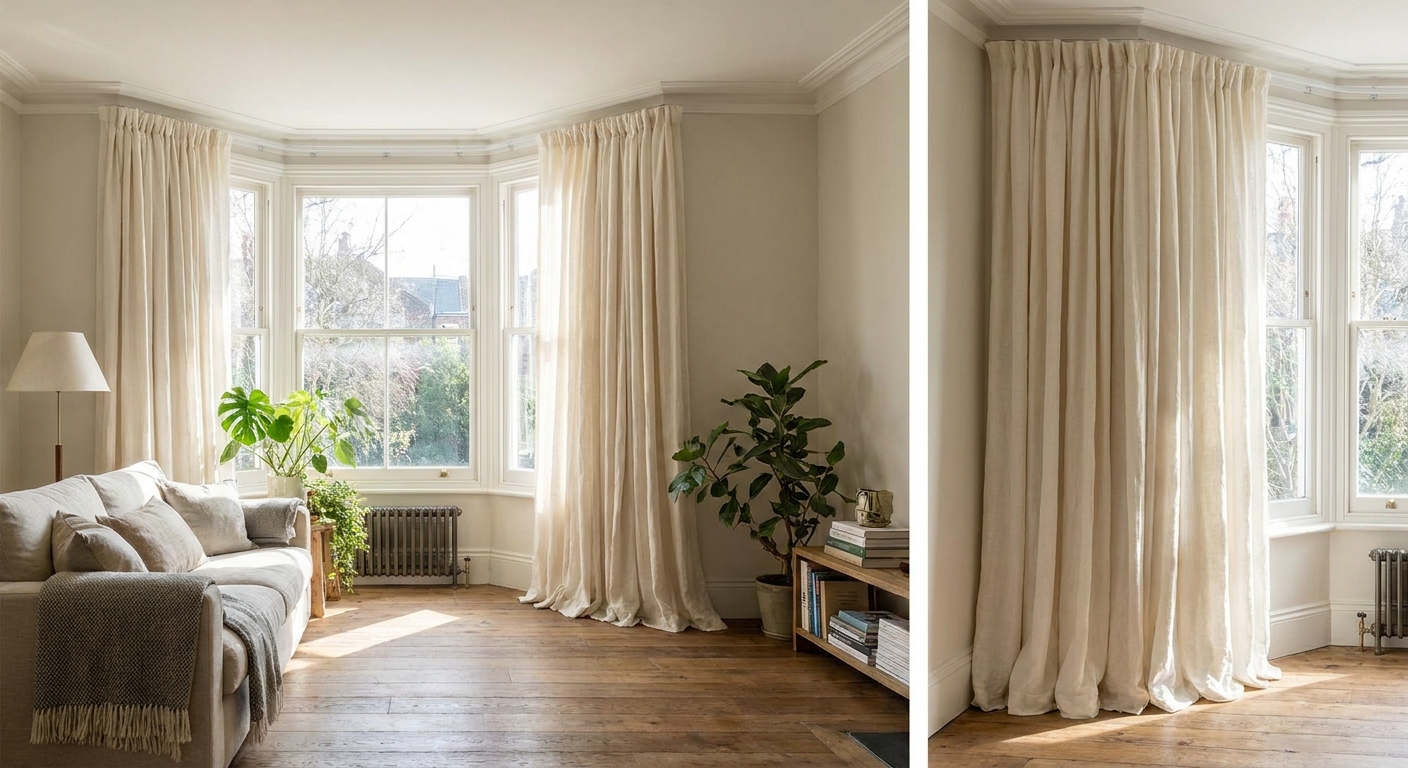
Option 3: Go shorter on purpose
Sometimes the obstruction forces the rod down, and the math of “full-length drapes” gets cranky. Instead of forcing a too-long panel to puddle in a weird way, pick a length that looks designed for that exact height.
When it works
- The rod lands only a little above the window trim, creating a compact vertical space.
- There is a radiator, baseboard heater, or deep sill you need to keep clear.
- You are dressing a kitchen or breakfast nook window under a soffit where long drapes feel heavy.
Easy targets
- Just to the sill: Neat and tailored, good for kitchens and tight spaces.
- Just below the sill: Softens the window without crowding what is underneath.
- To the floor: Still possible with a lower rod, but measure carefully so the hem does not bunch.
If you already own panels that are too long, you have two easy “no drama” fixes: raise them with clip rings (which can also help clearance), or hem them so the bottom lands cleanly where you want it.
Quick decision guide
- If you have a few inches of wall above the window: Mount the rod just under the crown or soffit.
- If the obstruction leaves no usable wall space: Use a ceiling track.
- If the rod must sit noticeably low: Consider shorter panels so the proportions feel deliberate.
Common snags and fixes
My rings scrape the crown
- Lower the rod slightly to add clearance.
- Switch to a slimmer rod or lower-profile rings.
- If you are using grommets, consider clips or a track system for a tighter top profile.
One side is blocked, the other is open
Uneven top lines are where curtains start to look accidental. Two options usually behave best:
- Match the lower side: Mount the whole rod at the height that clears the soffit, even if the other side could go higher.
- Use a ceiling track: Especially helpful if the soffit creates a hard stop on one end.
The brackets would land on trim
It can be okay to mount into wood trim if it is solid, thick, and well-anchored, but avoid “half in trim, half in air.” Pre-drill to prevent splitting, use screws that actually bite, and be realistic about weight. Heavier drapes do best when your fasteners hit studs or blocking, or you use anchors rated for the load.
I cannot widen the rod because the soffit returns
In that case, prioritize a clean open-and-close path. A slightly narrower installation that works smoothly looks better than a wider one that constantly catches.
FAQ
Should I cut crown to hang curtains higher?
Usually, no. Crown is there to make the room feel finished, and altering it becomes a bigger project fast. It is almost always easier to treat the crown or soffit as the “ceiling line” for your curtain plan and mount just beneath it, or switch to a ceiling track.
Can I mount a rod under a soffit?
Sometimes. If the underside is solid and you can fasten into framing, it can work. Just make sure the curtains will clear the window trim and that the brackets or supports are meant for that orientation. When in doubt, a ceiling track designed for overhead mounting is usually the cleaner solution.
What if the soffit covers only part of the wall?
Keep the rod level across the whole window. Pick the highest point that clears the soffit and run the entire rod or track at that height so the curtains hang evenly.
If the room gives you a hard ceiling line, treat it like a design feature. Hang the curtains right under it, keep everything level, and let the fabric do the softening.