Concrete Countertop Care for Rentals

Clara Townsend
Clara Townsend is an interior stylist, vintage furniture enthusiast, and the creative voice behind Velvet Abode. With over a decade of experience transforming both cramped city apartments and sprawling fixer-uppers, she believes that a beautiful home is built on personal stories rather than massive budgets. When she isn't hunting for the perfect brass sconce at a local flea market, she can usually be found rearranging her living room for the third time this month.
Concrete countertops are the cool, matte, quietly confident cousin in the countertop family. They are also a little thirsty, meaning they can absorb stains if the sealer is worn or compromised. If you are renting, that porous nature can feel stressful because every coffee ring starts whispering, “security deposit.” The good news is you do not need fancy products or aggressive scrubbing. You need a calm routine, the right kind of cleaner, and a very clear line between maintenance and modifications.
Concrete basics renters should know
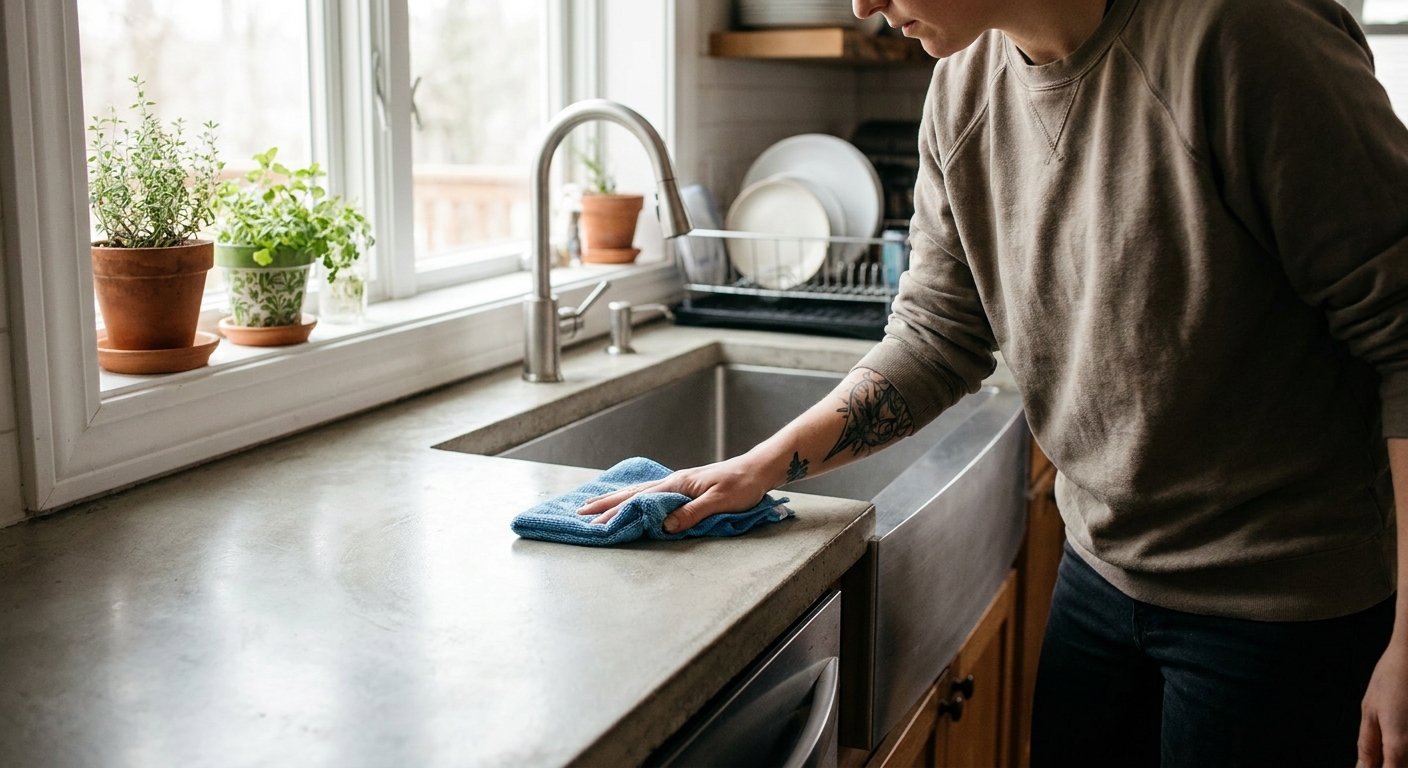
Concrete looks solid, but most concrete counters have tiny pores. Those pores can grab onto oils, pigments, and acids, especially if the sealer is worn or if the countertop was sealed lightly to keep that raw, velvety look.
- Porous surface: Can absorb coffee, tea, wine, turmeric, berries, and cooking oils.
- Sealer-dependent: Your daily success depends on the condition of the sealer more than the concrete itself.
- Etching is real: Acidic liquids often attack the sealer layer first, which can dull, lighten, or leave a “shadow” even after cleaning.
- Patina happens: Some concrete counters are meant to develop gentle variation. In a rental, you still want to minimize obvious stains and damage.
Quick sealed vs unsealed check
Try a few drops of water in an inconspicuous spot.
- If it beads and sits: It is likely well-sealed.
- If it darkens quickly or soaks in: The sealer may be worn, thin, or missing in that area.
If you are unsure what finish you have, assume it is sealed but not invincible and treat it gently.
Daily cleaning that actually works
If I could tape one note above every concrete counter, it would be this: wipe fast, wipe soft, keep it pH-friendly. Most day-to-day grime is surface-level and comes off easily if you do not give it time to settle in.
The 60-second reset
- Wipe crumbs and spills with a dry microfiber cloth first (so you are not turning grit into sandpaper).
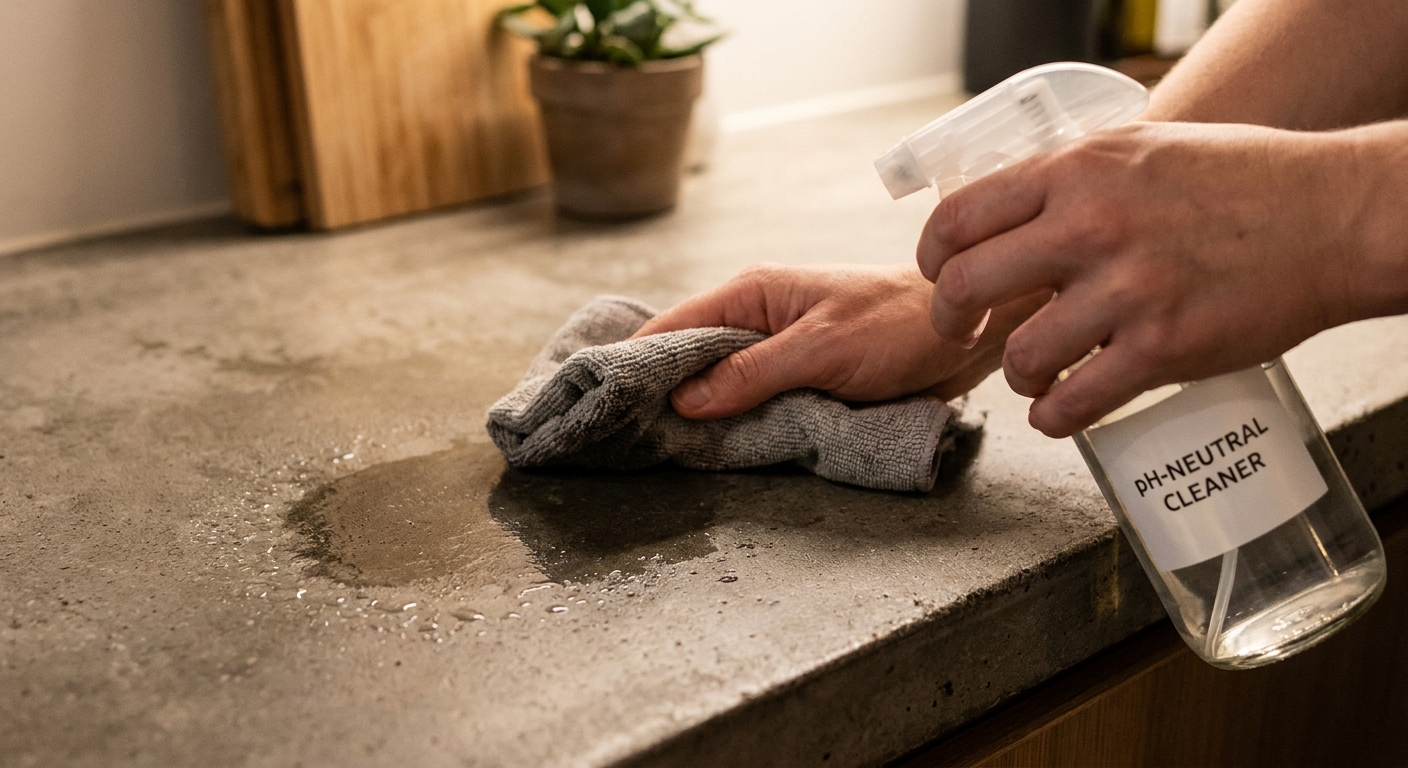
- Follow with a damp microfiber cloth and a small amount of pH-neutral cleaner.
- Finish with a quick dry buff if your water is hard or you notice haze.
Spill protocol (do this first)
- Blot immediately (especially coffee, wine, oil, citrus, tomato sauce).
- Wipe with clean water to dilute what is left.
- Follow with pH-neutral cleaner, then buff dry.
What “pH-neutral” means in real life
Choose a cleaner labeled pH-neutral and preferably safe for sealed concrete. If you cannot find that, a pH-neutral cleaner labeled safe for sealed natural stone is usually a good backup, but read the label and avoid anything citrus-based, acid-based, or “scale cutting.” “Stone-safe” is not a magic phrase, and some formulas include solvents or additives that can leave residue on matte sealers.
Mild dish soap diluted in warm water is often fine for quick wipe-downs, but use a tiny amount. Some soaps can leave a surfactant film that dulls matte finishes, so do a quick follow-up wipe with clean water and buff dry.
Stain removal without finish damage
Concrete stains are usually either pigment stains (coffee, wine, berries) or oil stains (olive oil, butter, greasy takeout). Your goal is to lift the stain without roughing up the finish.
Step 1: Start gentle
- Blot, do not rub. Rubbing can push pigment deeper.
- Use warm water plus a pH-neutral cleaner on a soft cloth.
- Let it dwell for 2 to 5 minutes, then wipe. Do not let cleaner dry on the surface.
Step 2: Poultice for stubborn spots
A poultice is basically a paste that sits and slowly pulls staining out. It is slower than scrubbing, but much kinder to concrete finishes.
- Gentle first try (oil or pigment): Make a paste with baking soda and water (peanut butter consistency). Spread a thin layer over the spot.
- If oil stains keep laughing at you: Many pros use an absorbent powder (like diatomaceous earth or talc) with an appropriate solvent, but that is also where rental rules and ventilation become a factor. If the baking soda method underperforms, pause and ask your landlord how they want it handled (or whether they prefer a pro-grade poultice).
- For pigmented or organic stains (only with approval): A small amount of 3% hydrogen peroxide mixed into baking soda can help, but it can also lighten the concrete or the sealer and create uneven spots. Test first, stop if you see color change, and document what you used.
- Cover with plastic wrap and tape the edges to slow drying (poke a few tiny holes if you want a little airflow). Let sit 12 to 24 hours.
- Remove paste, wipe with a damp cloth, then dry buff.
Always spot test in a less visible area. Concrete finishes vary wildly, and what is safe on one counter can lighten another.
What if it is a water mark or dull spot?
If a ring looks lighter or hazy rather than darker, you may be seeing etching in the sealer or a sealer reaction, not a stain. Cleaning harder will not fix it, and can make it worse. In rentals, that is the moment to pause and loop in your landlord before you try polishing compounds, magic erasers, or resealing.
Disinfecting without drama
Sometimes you need to disinfect after raw meat or a leaky chicken package. Many common disinfectants are harsh on sealers, so take the safer path:
- Use a disinfectant labeled safe for sealed stone or sealed concrete (and follow the listed contact time).
- Rinse or wipe with clean water after disinfecting if the label recommends it, then buff dry.
- Avoid vinegar, straight lemon cleaners, and bleach unless your countertop manufacturer or landlord specifically confirms they are safe for your sealer.
If you have no idea what sealer is on the counter, send your landlord a quick message and ask what disinfectant they prefer. That single text can save you a lot of guesswork.
Sealing in a rental: when to do it
Sealing is often the difference between “cute concrete” and “why does everything look like a spill map.” But in a rental, applying a new sealer can be considered an alteration, and some sealers change sheen or color. Some counters also have a wax or topical coating that needs different care, and the wrong cleaner can strip it and change the look.
Resealing might make sense if
- The countertop absorbs water quickly (a few drops darken the surface within 1 to 2 minutes), which may indicate sealer wear.
- You see frequent darkening around the sink, soap area, or coffee station.
- Your landlord gives written approval for a specific product and finish level.
Resealing is risky if
- You do not know what sealer was used originally (some sealers do not play nicely together).
- You are near move-out and cannot wait through cure times.
- You are hoping sealing will “hide” etching or existing marks (it usually does not).
- The counter has a specialty finish (waxed, burnished, or intentionally matte) and you do not want a surprise gloss.
A renter-friendly path forward
If water is soaking in and staining is happening, email your landlord with a short, calm note: what you are seeing, when it started, and that you want to prevent permanent damage. Ask whether they prefer to handle resealing or if they will approve you doing it. This protects you and the countertop.
What to document for your landlord
Concrete is one of those surfaces where “normal wear” can be subjective, so documentation is your best friend.
- Move-in photos: Take clear, well-lit photos of the full countertop and close-ups of any existing marks.
- Spill incidents: If something dramatic happens (wine, dye, nail polish), take a quick photo before and after cleaning.
- Maintenance notes: Keep a simple note in your phone: “Wiped daily with pH-neutral cleaner, no abrasives, no acidic cleaners.”
- Permission in writing: If resealing is approved, get the exact product, finish, and who is responsible in an email or text.
Simple maintenance checklist
Print this, save it, tape it inside a cabinet. Consistency is what keeps concrete looking calm and even.
Daily
- Wipe spills ASAP, especially coffee, citrus, wine, oil, and tomato sauce.
- Clean with a damp microfiber cloth and a pH-neutral cleaner labeled safe for sealed concrete (or sealed stone as a backup).
- Dry buff if you notice water haze.
Weekly
- Do a slightly more thorough clean around the sink and stove where oils and soap build up.
- Check for new dull spots, cloudiness, or darkening that could signal sealer wear.
Monthly
- Do a quick “water drop test” in an inconspicuous area. If it darkens quickly, it may be a sign the sealer is tired.
- Review your photos if you are worried about changes, and message your landlord early rather than at move-out.
Avoid list
- Acidic vinegars and lemon cleaners: They can etch or dull the sealer and leave light spots.
- “Stone cleaners” that are citrus-based or acid-based: The label might say stone, but the formula can still be too aggressive for concrete sealers.
- Harsh scrub pads or steel wool: They can scratch the sealer and open the door to staining.
- Bleach or high-alkaline cleaners: Can discolor or weaken some sealers.
- Abrasive powders: Even “gentle” ones can haze matte finishes.
- Leaving wet items: Damp dishcloths, wet sponges, and sweaty cups can leave marks over time.
- Heat without protection: Use trivets. Some sealers can soften or discolor with hot pans.
Little habits that help
Concrete counters can be wonderfully low-drama when you set them up for success.
- Park a small tray under oils and spices near the stove.
- Use coasters for iced drinks, especially on warm days.
- Keep a microfiber cloth in a drawer so wiping feels effortless.
- If your sink area constantly darkens, use a small drying mat and swap it out often.
Think of it like caring for linen: not fragile, just happier with gentle handling and quick attention.
When to stop DIY
Reach out to your landlord or property manager if:
- A stain keeps returning after gentle cleaning and poultice attempts.
- You suspect etching, peeling sealer, or cloudy patches that look like finish damage.
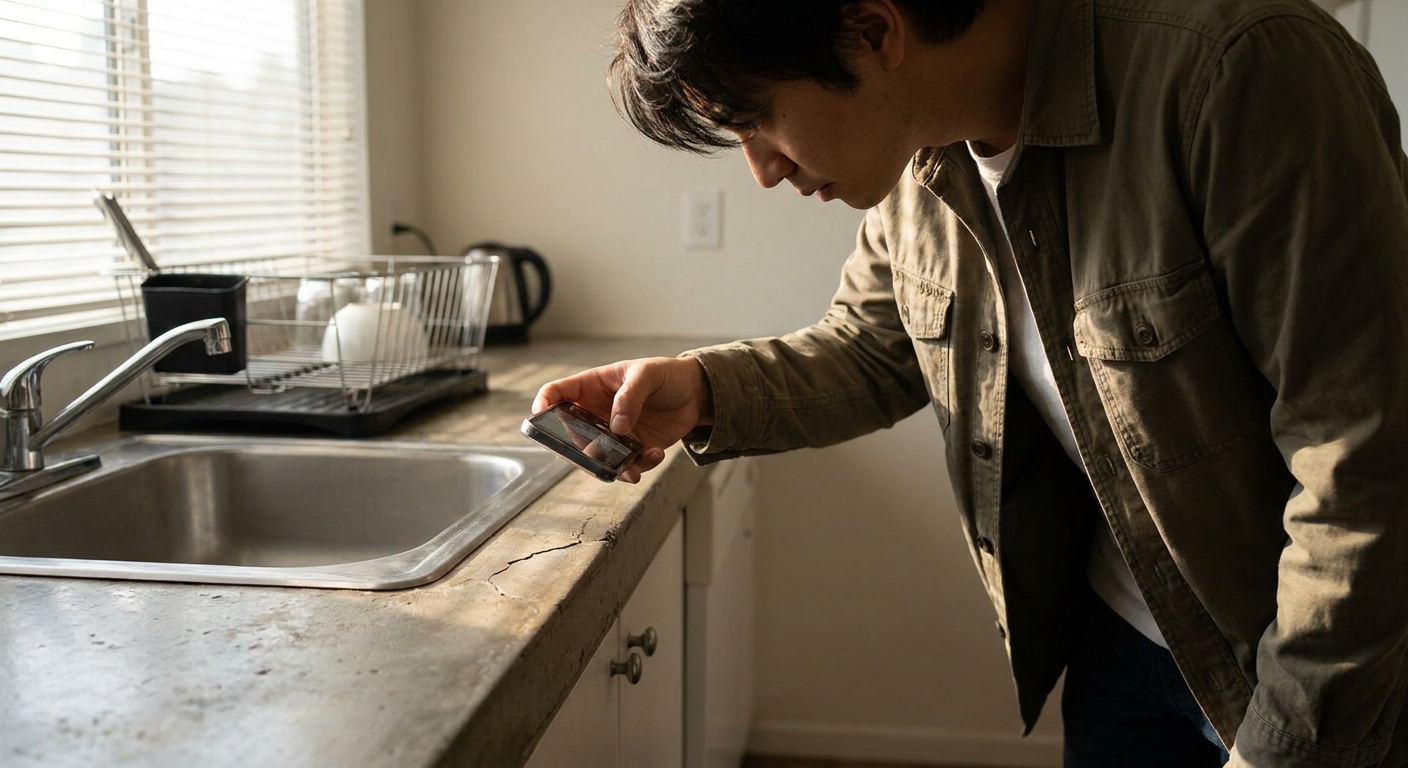
- You notice cracks that are new or expanding.
- Water soaks in immediately across large areas (likely reseal time).
In rentals, the smartest care is the kind that keeps you from accidentally turning a small issue into a “you altered the surface” conversation.