Carpet Beetles in Couches

Clara Townsend
Clara Townsend is an interior stylist, vintage furniture enthusiast, and the creative voice behind Velvet Abode. With over a decade of experience transforming both cramped city apartments and sprawling fixer-uppers, she believes that a beautiful home is built on personal stories rather than massive budgets. When she isn't hunting for the perfect brass sconce at a local flea market, she can usually be found rearranging her living room for the third time this month.
Nothing turns a cozy movie-night couch into an emotional support situation faster than finding tiny bugs or mystery “crumbs” in the seams. Before you panic (or set the whole sofa on the curb), take a breath. Carpet beetles are common, they behave very differently than bed bugs, and in many cases you can handle them with patient, low-tox cleaning and a little detective work.
This guide walks you through what carpet beetles look like in real life, where they hide in couches, how to clean without fogging your living room in chemicals, and when it is time to escalate to your landlord or a pest pro.
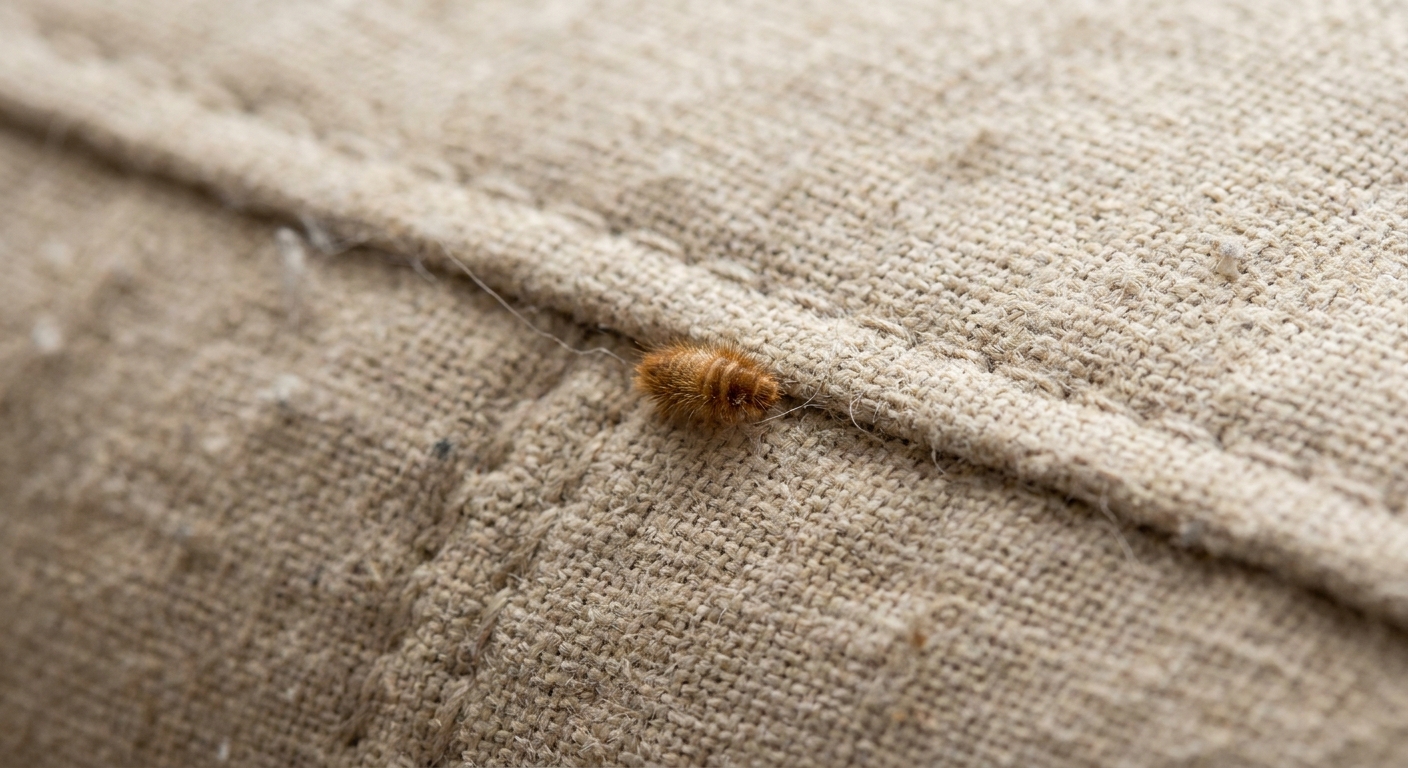
First: carpet beetles vs. bed bugs
These two get mixed up constantly because both can show up near upholstery. The treatment path is different, so identification matters.
How carpet beetles behave
- They do not live on you. Carpet beetles feed on natural fibers and organic debris, not blood.
- Larvae are the real culprits. Adults often wander near windows and lights. The larvae are the ones that chew textiles.
- They cause fabric damage, not bite lines. People sometimes get a rash from the tiny hairs on larvae (a contact irritation), which can be mistaken for bites.
How bed bugs behave (in contrast)
- They hide close to where people sleep and sit because they feed on blood.
- They leave signs like ink-like spots and shed skins along mattress and couch seams.
- Bites are common (though not everyone reacts), often in clusters or lines.
Quick couch ID checklist
If you are standing there with your phone flashlight and a rising sense of dread, look for this:
- Carpet beetle signs: small fuzzy larvae (brown or tan), bristly shed skins, tiny holes or thinned patches in wool, silk, feather stuffing, or blends, and gritty, sand-like frass pellets mixed with lint under cushions and along edges.
- Bed bug signs: flat reddish-brown bugs, pale shed skins shaped like a bug, dark ink-like spotting that looks like a felt-tip pen dot, and white rice-like eggs tucked into tight seams.
If your main sign is “my couch fabric looks eaten,” think carpet beetles. If your main sign is “something is biting us at night,” take bed bugs seriously and consider professional confirmation.

What carpet beetles look like
Adults
Adult carpet beetles are small (typically a few millimeters). Depending on species, they can look mottled black, brown, and cream, or more uniformly dark. You may spot them on windowsills because adults are attracted to light.
Larvae
Larvae are the couch villains. They are tiny, slow-moving, and often described as “fuzzy” or “bristly,” sometimes with a little tail-like tuft. They like dark, undisturbed spots where lint and hair collect.
Shed skins and “crumbs”
Many people never see a live larva. Instead, you find:
- Shed skins that look like small, dry, brown husks
- Frass (bug debris) that can look like tiny gritty pellets mixed with lint
- Localized fabric thinning on natural fibers
Where to check in a couch
Carpet beetle larvae love the same places we never clean until we move. Your mission is to find where lint, pet hair, and natural fibers are quietly piling up.
- Under seat cushions, especially along the front edge where snacks and lint migrate
- Back cushion seams and the zipper area
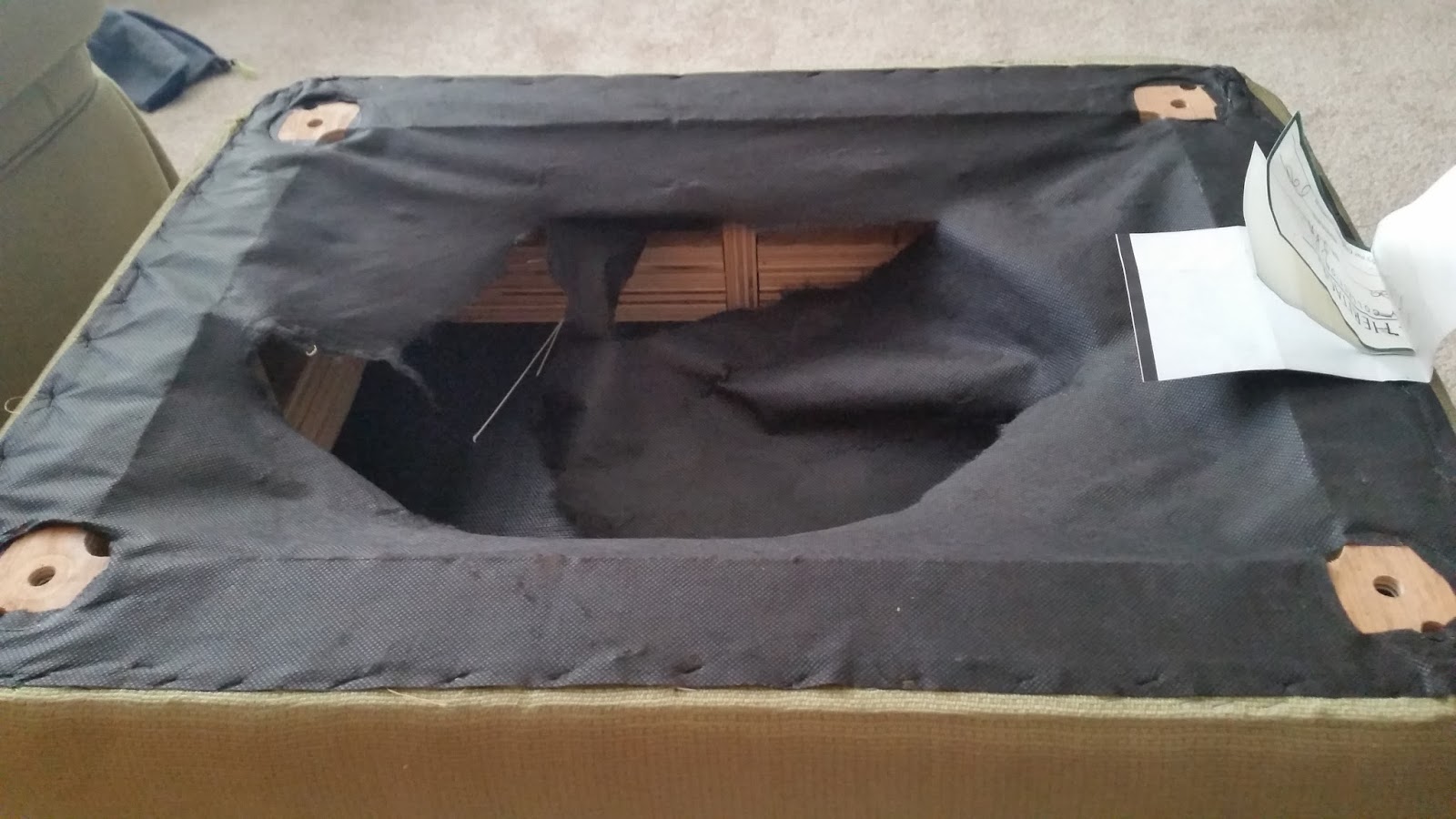
- Under the couch along the dust cover fabric (also called the cambric)
- Where the couch meets the wall, especially if there is a baseboard gap
- Inside crevices near staples and framing if the dust cover is torn
- Pet-favorite corners where fur builds up
Pro tip from someone who has flipped too many vintage sofas: if you find a torn dust cover, treat that like an open invitation. It is basically a welcome mat for lint, larvae, and old crumbs.
Why they show up in couches
Carpet beetles are not a “dirty house” moral failing. They are opportunists. Couches provide three things they love: shelter, fibers, and snacks in the form of lint and hair.
Common sources
- Natural fiber upholstery or trim (wool, silk, mohair, felted padding, jute webbing)
- Feather or down cushions
- Pet hair and dander tucked into seams
- Stored textiles nearby like wool throws, vintage blankets, or a basket of scarves beside the sofa
- Adults wandering in from outdoors through gaps around doors and window screens, or when windows and doors are open, then laying eggs in quiet areas
Low-tox cleaning plan
This is the calm, methodical approach I use in my own space. The goal is to remove larvae, eggs, and food sources. You are not trying to fog your couch into submission.
Step 1: Bag and isolate soft items nearby
Anything draped over the couch needs attention too: throws, pillow covers, slipcovers, pet blankets.
- Place items in sealed bags until you can wash or treat them.
- If it is washable, plan on hot water and high heat drying if the fabric can handle it.
Step 2: Vacuum like you mean it
Vacuuming is your MVP because it removes the larvae and their food.
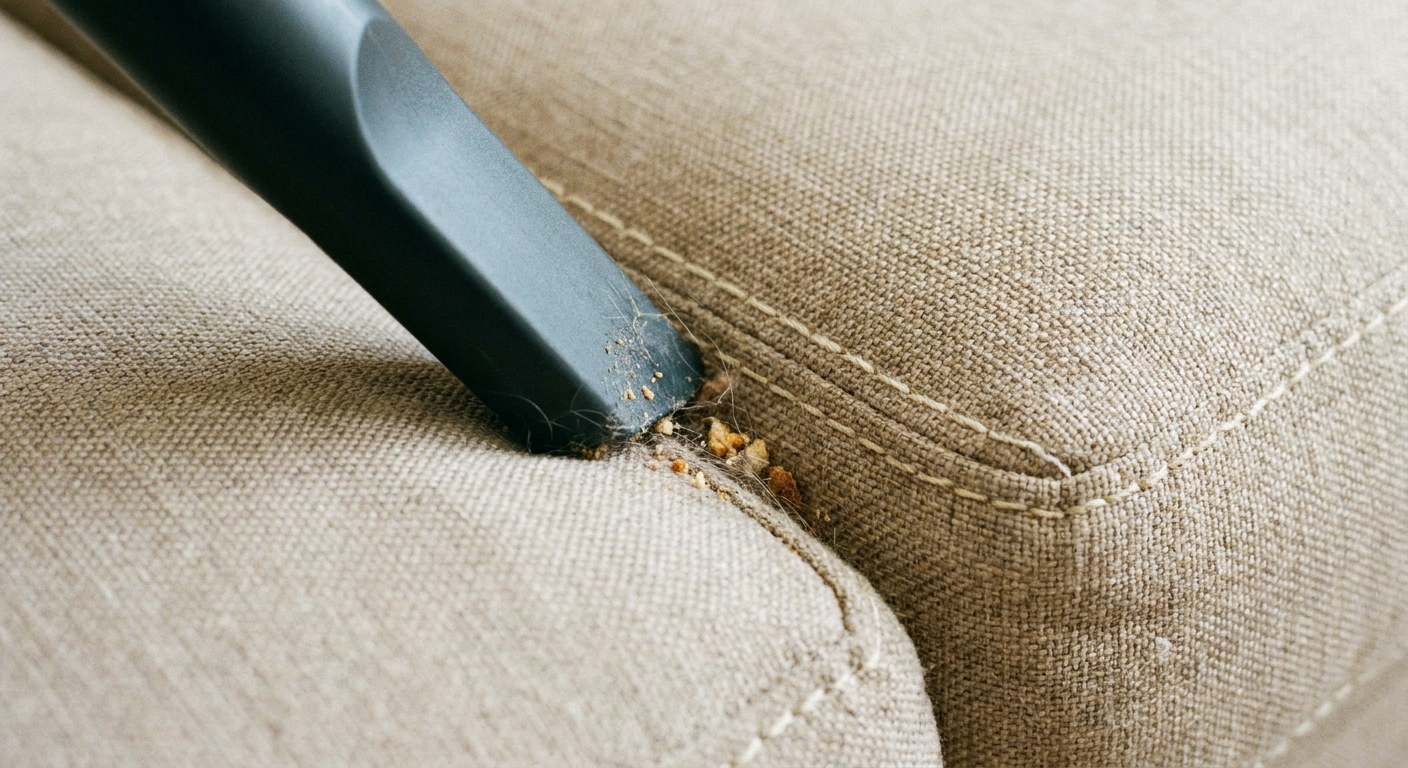
- Use a crevice tool on every seam, zipper, welt, and tuft.
- Vacuum under cushions, the base fabric under the cushions (the “deck”), and along the frame edges.
- Vacuum under the couch and the floor perimeter, especially where dust bunnies live.
- If you have pets, vacuum slowly. The goal is extraction, not a quick pass.
Important: empty the canister or remove the vacuum bag immediately after and take it outside. Seal contents in a bag before tossing. This prevents a rebound problem.
Step 3: Hot-wash what is removable
For removable covers, follow the care label, but aim for:
- Wash: hot water when allowed (heat helps)
- Dry: high heat for 30 to 45 minutes if the fabric tolerates it
What matters most is the item reaching a lethal internal temperature (commonly cited around 120 to 130°F / 49 to 54°C) for long enough, not just the dryer dial.
If you cannot wash hot, use the hottest safe setting and extend dry time, or consider a professional cleaner for delicate vintage textiles.
Step 4: Freeze delicate items (great for vintage)
If you have wool, silk, or vintage textiles that cannot be hot-washed or steamed, freezing is a solid, low-tox option.
- Seal the item in a plastic bag (push out excess air if you can).
- Place it in a standard freezer for at least 72 hours, and up to one week if you can.
- Let it return to room temperature while still bagged (helps avoid condensation on the fabric), then vacuum gently.
Step 5: Use steam strategically (with caution)
Steam can kill larvae and eggs if the heat penetrates, but couches can also trap moisture. Use steam in short passes and let everything dry fully.
- Focus on seams, piping, and crevices.
- Do not soak cushions or padding.
- Run fans and open windows after.
Step 6: Lightly treat cracks and voids (optional)
If you want a low-tox add-on after cleaning, these are common options people use. Always spot test and keep pets and kids away until fully settled and cleaned up.
- Food-grade diatomaceous earth (DE): Apply a very light dusting in non-visible voids like along baseboards, under the couch, or inside the frame area if accessible. Do not create clouds. “Food-grade” refers to purity, not inhalation safety. Avoid applying anywhere it can become airborne.
- Boric acid powder: Effective but more toxic than DE. Use carefully, follow the label, and avoid if you have small children or pets that might contact it.
Skip essential oil recipes. They often smell nice for about ten minutes and then you are left with a couch that still has bugs and now also has oil stains.
Step 7: Clean the zone around the couch
Carpet beetle issues are usually a room issue, not a single cushion issue.
- Vacuum baseboards, radiator covers, and nearby vents.
- Wash or vacuum curtains if they pool on the floor.
- Check the closet nearest the couch for wool, felt hats, or stored blankets.
- Inspect nearby rugs, pet beds, and baskets of throws for shedding and damage.
Find the source
If carpet beetles keep coming back, it is usually because there is a steady food source somewhere nearby. A few places that deserve a quick look:
- Windowsills and light fixtures where adults collect
- Air returns, vents, and radiator covers where lint builds up
- Closets and storage (wool coats, wool rugs rolled up, craft felt, taxidermy, feather items)
- Animal nests in attics, chimneys, wall voids, or vents (bird, rodent, and even old wasp nests can be involved)
You can also place a couple of sticky monitoring traps near windows or along baseboards to track adult activity. They will not solve the problem alone, but they can confirm whether you are still seeing movement over time.
Fixed cushions and non-removable upholstery
If your cushions are fixed, you are relying on mechanical removal and heat where possible.
- Vacuum repeatedly over several days. You are interrupting the life cycle.
- Steam seams lightly and dry thoroughly.
- Consider professional upholstery cleaning if the situation is significant or the couch is a vintage investment piece.
If the couch has a zippered insert but the outer cover is fixed, you can sometimes remove the insert to inspect the interior casing. Handle with care and photograph anything you find, especially in a rental.
What not to do
- Skip bug bombs and foggers. They are usually ineffective for larvae tucked into upholstery, and they add unnecessary pesticide exposure.
- Do not spray random insecticides on upholstery. Use only products labeled for that specific use, and follow the label exactly.
- Do not over-wet the couch with steam or cleaners. Moisture trapped in padding can create a whole new problem.
How long does it take?
With diligent cleaning, many minor couch situations improve quickly, but full resolution can take a few weeks because:
- Eggs can be missed in deep crevices.
- Larvae may be in nearby textiles or under the couch, not just in the cushions.
A realistic plan is weekly deep vacuuming for 3 to 4 weeks, plus laundering or treating nearby textiles at the start. If you see fewer shed skins and no new fabric damage, you are moving in the right direction.
When to escalate
Call a professional if
- You keep finding live larvae after 3 to 4 weeks of thorough cleaning.
- There is active, spreading fabric damage, especially on wool rugs, upholstered dining chairs, or stored clothing.
- You have asthma or severe allergies and the situation is triggering symptoms.
- You suspect a broader issue like an animal nest in vents, chimneys, wall voids, or attic spaces.
In rentals: involve your landlord when
Landlord responsibilities vary by location, but here is a practical, safe line in the sand:
- Tell your landlord early if you find larvae or adults in more than one room, or if you suspect they are coming from a building-level source (shared laundry, hallway, vents, old carpet in common areas).
- Document everything: date-stamped photos of larvae or shed skins, notes on where you found them, and what cleaning steps you took.
- Ask about building history: previous infestations, recent roof or bird issues, or ongoing pest contracts.
If pest control is required, request that treatment is targeted and evidence-based. For carpet beetles, the fix is usually deep cleaning plus a focused residual treatment in cracks and crevices, not broad whole-room spraying.
If you are worried it might be bed bugs
Do not self-treat blindly. Misidentification wastes time and money. If bites are a concern, consider a reputable inspection or local extension office guidance. Keep samples in a small sealed container or clear tape for ID.
Prevention that works
Once your couch is back to being a hug again, prevention is mostly about reducing lint, protecting natural fibers, and making the hidden buffet less appealing.
- Vacuum seams monthly if you have pets or wool throws.
- Rotate and shake out throws, then wash seasonally (or freeze delicate ones).
- Store wool and vintage textiles in sealed containers, especially off-season.
- Fix or replace torn dust covers under sofas and chairs (an upholstery shop can do this quickly).
- Check door sweeps and window screens and seal obvious gaps where adult beetles can wander in.

Wrap-up
If you take one thing from this: carpet beetles are a cleaning and textiles problem more than a “you” problem. Go slow, be thorough, and focus on seams, hidden lint, and washable pieces. Most couches can be saved.
If you want, tell me what kind of couch you have (slipcovered, fixed upholstery, leather, vintage, down cushions) and what you are seeing (larvae, shed skins, fabric damage, rash), and I can help you narrow down the next best step.